Iconic books are texts revered as objects of power rather than just as words of instruction, information, or insight. In religious and secular rituals around the globe, people carry, show, wave, touch and kiss books and other texts, as well as read them. This blog chronicles such events and activities. (For more about iconic books, see the links to the Iconic Books Project at left.)

Monday, June 29, 2009

Digitizing Relics

An international effort to preserve centuries-old Indonesian manuscripts has run into trouble getting access to privately owned texts. The Jakarta Globe reports that:

the surviving manuscripts were written in various languages and scripts, including Arabic, Malay, Javanese, Sundanese, Sasak, Balinese and the Wolio language of Buton Island. ... Jeje Abdul Rojak, the program coordinator for digitalization at Islamic pesantrens, said that many manuscripts from pesantren , or traditional Islamic boarding schools, have already been secured using digitalization. “The problem is that there are many more important ancient manuscripts in private hands,” he said. “The owners usually refuse us access to them because they consider them sacred relics that have been handed down for generations.”

This situation differs from the resistence to scholars of private owners of pieces of the Aleppo Codex in that here scholars only want access in order to make photographs and publish them digitally. The owners, however, seem to think this would desecrate the relic text and/or reduce its potency.

Thursday, May 21, 2009

Obama with Constitution

President Barack Obama's speech today about closing the Guantanamo Bay detention facility was carefully staged in front of the iconic American political text, the Constitution. (Images from Zimbio.)


He spoke in the Rotunda of the National Archives with the Constitution and Bill of Rights displayed right behind him.


From the side, he was framed by paintings of the Constitution's signers.


Former Vice President Dick Cheney presented a strong rebuttal speech immediately afterwards at the American Enterprise Institute. Pictures show him framed by the word "Enterprise." The debate over prisoner detention policy will no doubt continue for a long time, but the dueling pictures give a clear win to Obama.

Saturday, May 16, 2009

Reading Aloud

Verlyn Klinkenborg in the New York Times notes that while contemporary Americans listen to books almost as often as reading them,

But from the perspective of a reader in, say, the early 19th century, about the time of Jane Austen, there is something peculiar about it, even lonely.

In those days, literate families and friends read aloud to each other as a matter of habit
.

She points out that asking someone to read aloud is the best test of their understanding, and follows that with a wonderful description of how reading aloud embodies words:

Reading aloud recaptures the physicality of words. To read with your lungs and diaphragm, with your tongue and lips, is very different than reading with your eyes alone. The language becomes a part of the body, which is why there is always a curious tenderness, almost an erotic quality, in those 18th- and 19th-century literary scenes where a book is being read aloud in mixed company. The words are not mere words. They are the breath and mind, perhaps even the soul, of the person who is reading.


Klinkenborg holds out little hope that reading aloud will make a comeback, like listening has:

I suspect there is no going back. You can easily make the argument that reading silently is an economic artifact, a sign of a new prosperity beginning in the early 19th century and a new cheapness in books. The same argument applies to listening to books on your iPhone. But what I would suggest is that our idea of reading is incomplete, impoverished, unless we are also taking the time to read aloud.

Here, however, her focus on literature misleads here into drawing a false conclusion from a too limited database. Whether or not they read novels and poetry to each other, throughout history many people in many cultures have voiced aloud the words of their scriptures, laboring to pronounce unfamiliar names, archaic translations, even foreign and dead languages, and prizing the skills of those who do it well. They still do.

Monday, May 11, 2009

Digitizing the Past in the WSJ

"Next Age of Discovery," a recent Wall Street Journal article, provides a wonderful synopsis of the work going on to digitize ancient manuscripts. Prominent projects are mentioned (including many that have been chronicled here in the Iconic Books blog), and some of the techniques used to save these treasures to digital formats are described.

One of the things that stands out to me in this article is that the endeavor to preserve the past is not just the work of a few librarians or historians. It is a massive, uncoordinated effort being carried out by academic researchers, faith groups, and corporations. Important contributors range from archaeologists finding lost pieces of antiquity in an Egyptian garbage dump to NASA scientists developing multi-spectral photographic techniques that make visible things that were once invisible. Motives range from creating a marketable product to saving the textual artifacts of religious faith.

Slide 10 of the slideshow is particularly interesting. It shows the fruit of the labor of bringing space-age photography to medieval (and older) manuscripts. Studying a document through different spectra often reveals that a piece of writing material has been used and erased or scrubbed clean multiple times, but that all of those texts may still be read.

(Thanks go to Victoria Maloy of Mt. Mercy College for bringing this article to my attention.)

Friday, May 8, 2009

Female Torah Scribes


Jen Taylor Friedman, a Jewish woman in the Bronx, has mastered the skills of a Torah scribe and already completed two scrolls, according to the Riverdale Press:

Many consider Ms. Friedman, 29, an important feminist figure, holding her up as a pioneering example to young Jewish women. Other Jews, primarily in the Orthodox community, believe she is out of bounds, doing work meant only for men or — in the case of Tefillin Barbie — simply inappropriate.

Ms. Friedman sold her first two Torahs to synagogues in St. Louis and Michigan.

Now, as she undertakes a third Torah, she is still adjusting to her role as lightning rod in the Jewish community. She’s been named to the Forward’s list of 50 influential Jews and, just last week, to Jewish Week’s list of 30 influential Jews under 30
.

What that story does not say is that opposition to women scribes stems, at least in part, from the traditional purification rituals required of Torah scribes. Many believe that women cannot maintain the purity necessary to complete a scroll, a task that usually takes nearly a year. The issue, then, is not about skill and ability, but rather about the sanctity of a Torah scroll itself. However, the positive attention being shown Ms. Friedman also employs the legitimizing function of an iconic scripture, in this case to legitimize efforts for gender equality by putting a scribe among a select group of "influential Jews."

Thursday, May 7, 2009

US Army destroys Bibles in Afghan languages

Now here's a story I really don't know how to categorize: "Disposal"? "Desecration"? "Politics" for sure...

KABUL, May 5 (Reuters) - Bibles in Afghan languages sent to a U.S. soldier at a base in Afghanistan were confiscated and destroyed to ensure that troops did not breach regulations which forbid proselytising, a military spokeswoman said.

The U.S. military has denied its soldiers tried to convert Afghans to Christianity, after Qatar-based Al Jazeera television showed soldiers at a bible class on a base with a stack of bibles translated into the local Pashto and Dari languages.

U.S. Central Command's General Order Number 1 forbids troops on active duty -- including all those based in Iraq and Afghanistan -- from trying to convert people to another religion.

"I can now confirm that the Bibles shown on Al Jazeera's clip were, in fact, collected by the chaplains and later destroyed. They were never distributed," spokeswoman Major Jennifer Willis said at Bagram air base, north of Kabul.

Military officials have said the bibles were sent through private mail to an evangelical Christian soldier by his church back home. The soldier brought them to the bible study class where they were filmed.

Trying to convert Muslims to another faith is a crime in Afghanistan. An Afghan man who converted to Christianity was sentenced to death for apostasy in 2006 but was allowed to leave the country after an international uproar.

"It certainly is, from the United States military's perspective, not our position to ever push any specific kind of religion, period," chairman of the U.S. Joint Chiefs of Staff Admiral Mike Mullen told a Pentagon briefing on Monday. (Reporting by Peter Graff)

Destroying the Bibles could well fuel a backlash, but so far it is limited. Mission Network News quotes Carl Moeller of Open Doors, USA (which apparently supplied the Bibles) saying
the Bibles didn't need to be destroyed. "There's certainly many organizations that could put them to good use. Any time you see a Bible destroyed, it really should shake the core of every Christian to realize that this is the kind of desecration that can happen to God's Word."

American Family News Network quotes "a Pentagon adviser," Bob Maginnis:

"By and large, soldiers should have the right to share their faith wherever they are," he contends, "and for the political correctness crew to come aboard and declare that we're going to destroy Bibles because of the sensitivity of the local command, I find egregious."

Tuesday, May 5, 2009

Matching Bible & Purse


Tyndale House Publishers is marketing this "Veritas Journey Bible and Purse." The marketing copy states:

Introducing Veritas, the fashionable and smart new solution for women who crave something different. The Bible goes where they go with these stylish, full-size purses complete with a coordinating compact New Living Translation tucked away in its very own easy-to-access compartment. Veritas gives fashion-savvy women the freedom to conveniently and comfortably carry the Truth with them everywhere, every day.

Julia O'Brien, who drew my attention to this, comments:

For many, religious symbols and words are chosen for how they look and feel, rather than what the words themselves say. As in the illuminated Bibles of the past, words become art. Biblical texts have the additional benefit of feeling ancient and serious and important. It does something for people even when they don't read it.

Which is what keeps the Iconic Books Project in business!

Monday, May 4, 2009

Bible Reading Marathons Begin


Round-the-clock public readings of the Christian Bible from cover-to-cover have begun in various cities across the United States. Though continuous sequential reading of scripture is not characteristic of Christian rituals, unlike some other religious traditions, the practice has been spreading among American evangelicals. Such a reading has been performed annually since 1990 on the steps of the Capitol in Washington, DC, in the days leading up to the National Day of Prayer (May 7). This year, there are also marathon readings going on in Springfield OH, Troy AL, Hamilton NY, Ozark AL, and Murfreesboro TN (pictured above).

"It is very difficult to keep digital data moving forward in time"

If the preservation of granite monuments depends on social continuity and support (see previous post), that is all the more true of digital data. For yet another example of the difficulties in preserving digital texts, the Long Now Blog gathers reports about the strenous efforts needed to resurrect digital pictures of the Moon taken by pre-Apollo 11 robot spacecraft.

Sunday, May 3, 2009

The Preservation of Monumental Texts


The Georgia Guidestones were vandalized in early December. The mysterious Guidestones were built in 1980 and are inscribed in eight languages with tenets usually described as "new age." Randall Sullivan writes in Wired Magazine:

the stones had been splattered with polyurethane and spray-painted with graffiti, including slogans like "Death to the new world order." This defacement was the first serious act of vandalism in the Guidestones' history, but it was hardly the first objection to their existence.

(For pictures of the vandalism and a list of the tenets, along with paranoid commentary, see Prison Planet). Sullivan thinks the unknown people behind the Guidestones

knew what they were doing: The monument is a highly engineered structure that flawlessly tracks the sun. It also manages to engender endless fascination, thanks to a carefully orchestrated aura of mystery. And the stones have attracted plenty of devotees to defend against folks who would like them destroyed. Clearly, whoever had the monument placed here understood one thing very well: People prize what they don't understand at least as much as what they do.

Maybe, but I suspect they were mistaken in thinking that monuments survive due to their mystery and durable materials. Monuments rather survive due to social structures (political, religious or cultural) that guard and maintain them. As the Long Now Blog notes:

As for the Guidestones’ likelihood to survive, it is interesting to note that the surrounding mystery has been both a help and a hindrance. By instilling wonder and encouraging curiosity, the secretive creators have generated a good deal of interest in the monument. They’ve also, however, allowed some blanks to be filled by people offended by the little that is discernible about their agenda.


They note that interest in preserving and maintaining the monument seems to be come primarily from business interests represented by the local county tourism office.

UPDATE: The NY Times reported that an explosion destroyed the Guidestones on July 6, 2022. As of June 2026, the vandals have not been caught and the Guidestones have not been rebuilt. For full discussion, see Wikipedia, "Georgia Guidestones.

Sunday, April 19, 2009

Selling Books in Imperial Rome

Mary Beard has a fun article, "Scrolling Down the Ages," on the ancient Roman book trade in the New York Times.

Map of the Land of Books

Strange Maps has reproduced a fanciful map of the "land of books" drawn by German illustrator Alphons Woelfle in 1938.

Comments to the post have helpfully provided English translations to the various labels. The Blog points out that:

Plotting out imagined places on a map as if they were “real” countries is a favourite trope in curious cartography. The artificial equation of place and meaning allows for double-entendres and other humorous leaps of the imagination on which this allegorical form of cartography thrives. As a sub-genre of cartography, it has been around since at least La carte de tendre, an 18th-century French map of love’s topography (discussed in entry #245 of this blog). Other examples previously discussed include a Map on Temperance (#258) or a German map of the Empire of Love (#59).

I notice that the map pays almost as much attention to the material production of books as to their literary genres. The river that flows through the land of book sellers as called the "paper stream" and has sources in the land of papermills and the lake of tints...

Saturday, April 18, 2009

From desecration to arson

The Yemen Post reports that charges of desecrating a Qur'an led to crowds ransacking the alleged perpetrators' house and burning his cars:

On Tuesday, citizens destroyed the three-storey house of a Yemeni, who lived in the Al-Hasaba area, Sana'a, after they accused of desecrating the Quran.

Eyewitnesses said the man tore the Quran and treaded on it before citizens but the reason for his violation has not been identified.

Some people in the area called the police and informed them about a person who insulted the Quran.

Seeing that the police did not take action, citizens who rallied after the dawn prayers from a number of mosques broke into the offender's house and destroyed it.

They also burned his two cars which were parked at the house and the furniture inside the house
.

A parliament committee has been set up to investigate the incident.

(For similar incidents involving the scriptures of several different religions, see my recent comparative analysis of scripture desecration stories.)

Torah Scroll as sign of legitimacy


The AP's report of a Philadelphia synagogue's new Torah scroll emphasizes its significance as a sign of this African-American congregation's Jewish legitimacy:

The jubilation in Temple Beth’El’s packed sanctuary overflowed into the aisles, with members dancing, clapping and singing as they welcomed their first Torah from Israel.

A new sacred scroll, the holiest object in Judaism, is cause for celebration in any synagogue. But for this Philadelphia congregation, it meant much more. It signified a tentative step toward the mainstream of American Jewish life.

“We have been unable to sleep and to eat,” said Debra Bowen, who is the rabbi. “We have Torah fever!”

The article proceeds to tally the signs of links between this congregation and other Philadelphia Jews, which seems to be nation-wide trend.

This story provides a good example of the fact that the social function of the iconic dimension of scriptures is to convey legitimacy, whether religious or political.

Friday, April 17, 2009

Second Iconic Books Symposium!

The second Symposium on Iconic Books will be held at Hamilton College in Clinton, NY, on September 4-6. Though not all the panelists and speakers have been confirmed as yet, I've posted preliminary information the Iconic Books website. Please come and let others know who might be interested in this interdisciplinary endeavor!

Tuesday, April 14, 2009

JZ Smith calls for Study of Iconic Scriptures

J. Z. Smith’s SBL presidential address, “Religion and the Bible,” appears in this month’s Journal of Biblical Literature. When I heard it last November, I was delighted that Smith issue a clarion call for the study of scriptures as material objects very much along the lines that we have been developing in the Iconic Books Project. In the second-to-the-last paragraph, after summarizing the work of W. C. Smith on the performance of scriptures, he argues:

that alongside a focus on ritual, on performance, equal to that given to myth, to sacred text, there be an equivalent concern for sacred texts as embodied material objects commensurate with interests in those texts as documents of faith and history. After all, canonization, in the case of the Bible, is inseparable from modes of production, being as much an affair of technology as theology.

A footnote amplifies his proposal:

Without supplying either specific examples or supporting bibliography, the enterprise of studying sacred (canonical) texts as embodied material objects may be conceived in terms of five foci: (1) The study of the effects of modes of production should include not only technological processes but also economic factors (e.g., patronage) and entrepreneurial decisions that affect format, design, and the inclusion of supplementary matter. (2) One must consider the status of the material text as an icon, an element in what has come to be termed, by some scholars, “visible religion.” Here the text is not limited in its sacrality to its origin or referent, but is, itself, a ‘holy thing.’ (3) Closely related is the employment of the text as a ritual object. This is a different usage from (4) the lectionary use of a sacred text in a ritual context, or (5) the use of the text as a ritual handbook.

J. Z. Smith theorized rituals in the 1980s in ways that profoundly shaped my ideas of the ritualization of scripture. His endorsement of this line of research here is welcome support to our efforts.

Monday, April 13, 2009

The Alhambra's Inscriptions


The AP, along with many other media sources, reports on an effort to translate and catalog all the inscriptions on the walls of the Alhambra, in Grenada, Spain. Caligraphic carvings, estimated to number around 10,000, cover walls, columns, and fountains.

Through the centuries, the popular belief was that most of the writings were verses from the Quran or poetry. But on the basis of the Alhambra building that has been studied so far, the Comares Palace, those amount to less than 10 percent of the total, Castilla said.

In fact, the phrase repeated most often — hundreds upon hundreds of times — is a sentence considered the slogan of the Nazrid dynasty, one of the successions of rulers that passed through the Alhambra. It says: "There is no victor but God."

... "As you walk along, it seems as if you are opening a book of poetry and turning the pages," he said
.

The presumption that all the incriptions are Qur'anic shows the power that the convention of monumentalizing iconic scriptures exerts on popular expectations of any monumentally inscribed Arabic text.

Sunday, April 12, 2009

Exhibit Hall for China's Oldest Qur'an


These are photos from Aboutxinjiang of "the newly-built exhibition hall to display China's oldest handwritten copy of the Koran in Salar Autonomous County of Xunhua, northwest China's Qinghai Province. A handwritten copy of the Koran, the oldest of its kind known in China, is to open to public soon at the exhibition hall besides the Jiezi mosque. The Koran copy originally preserved in the Jiezi mosque was believed to be written between the eighth and the 13th century, according to experts of the State Administration of Cultural Heritage."

Saturday, April 4, 2009

Desecrating Scriptures

My case study, "Desecrating Scriptures," has been published online by the Luce Project in Religion, Media and International Relations here at Syracuse University.

The case study analyzes news media reports of scripture desecrations from the last decade through the lens of my three-dimensional theory of scriptures. The stories show how iconic books get used in inter- and intra-religious conflicts in Muslim, Sikh, Jewish and Christian cultures. Their comparison reveals many common features, but also a notable difference: the iconicity of scriptures tends to be more controversial among Christians. I trace this difference to the fact that, unlike Jewish, Muslim and Sikh scriptures,
there is no common language and its recognizable sounds and no common text and its recognizable script to distinguish the Christian scriptures from other books and texts. Though the external binding may take stereotypical forms, the look and sound of the contents vary from culture to culture and denomination to denomination. ... linguistic diversity reinforces among Christians the notion that the essential nature of the Bible lies in its semantic meaning alone.

The Iconic Books Blog provided much of the material for writing this case study. It was my first test of the usefulnes of this research blog, and I'm quite happy with the experience. By listing here stories of scripture desecration as we've noticed them over the last two years, I had a ready database to start from. The blog's label function and Blogger's search feature made it very easy to pull the material together. It really made doing this kind of comparative case study feasible. So the blog passed its first test as a research tool with flying colors!

Tuesday, March 31, 2009

Painting Bookshelves

Australian artist Victoria Reichelt has painted a series of paintings of bookshelves:


Reichert told the InsideOut Blog: "These works are a paradox to paint - as once the books are an image on canvas, they are shut forever and can never be read. In a painting, they serve a very different purpose from their intended function – they are purely objects like the others I paint and you’re forced to judge them by the covers."

After starting with staged bookshelves, more recently she has been painting the bookshelves of people as she finds them. Michael Lieberman on Book Patrol comments: "The leap from painting staged bookshelves to actual bookshelves is huge and opens up a whole new realm of possibilities. Imagine high-end collectors having portraits done of their collections to complement their own portraits ...."

Saturday, March 28, 2009

Paper as Storage Media

Digital media's reputation for impermanence is growing. In the New York Times, David Pogue presents his interview with Dag Spicer, curator of the Computer History Museum in Silicon Valley.

David Pogue: What is data rot?

Dag Spicer: Data rot refers mainly to problems with the medium on which information is stored. Over time, things like temperature, humidity, exposure to light, being stored not-very-good locations like moldy basements, make this information very difficult to read.

The second aspect of data rot is actually finding the machines to read them. And that is a real problem. If you think of the 8-track tape player, for example, basically the only way you can find 8-track cartridges is in a flea market or a garage sale.

The problem, strangely enough, is not so bad on the older stuff, but quite bad on the more recent stuff. So we can read tapes here at the museum that are 50 years old.

... The real problem lies in newer formats. With a CD or a DVD, if there's an error, often it's non-recoverable, and you've just lost all your information.

On the same theme, see the recent article in Lost Magazine on "Are We Losing Our Memory? or The Museum of Obsolete Technology."

Spicer offers suggestions for preserving digital data, which come down to constant updating, what Kevin Kelly calls "movage" of data from one medium and platform to another. But then he adds:

Consider paper as an archival medium. Some paper we have has lasted thousands of years.

DP: Hasn't anyone tried to create a truly permanent storage medium?

DS: One of the technologies for really long-term preservation was developed at Lawrence Livermore National Laboratory. It was, I think, a titanium disk about the size of a long-playing record, and it was supposed to last 10,000 years. But then they realized that there were some assumptions that weren't right, and that it would not last 1,000 years, it might only last 20.

Otherwise, as far as I know, no one is working on this problem. It's really in no one's interest, no manufacturer's interest; they want to keep selling you more hard drives every two to five years, or more blank CDs, and what have you.

And that's why it's almost like your retirement, it's something you have to take responsibility for yourself. No one is going to do it for you.

In fact, the Long Now Foundation is working on the problem, but their Rosetta Disk costs $25,000--not yet a solution for mass preservation.

Saturday, March 21, 2009

Burying Ukrainian Torahs

The government of Ukraine is returning old Torah scrolls to local synagogues, according to Radio Free Europe:

The Central State Historical Archive in the Ukrainian city of Lviv have returned 14 Torah fragments to a local Jewish congregation, RFE/RL's Ukrainian Service reports.

Mordehai Shlomo Bold, the chief rabbi of Lviv, told RFE/RL that the Torah fragments he received from the archive will be buried, in accordance with Jewish customs. Bold said Jewish tradition requires them to bury the holy book pieces in the same way a human is buried because it is considered "dead," or impossible to restore.

Four other Ukrainian cities are planning to give very old copies or portions of a Torah to Jewish communities based on a presidential decree signed in 2007.

Friday, March 20, 2009

Altered Books and Memories


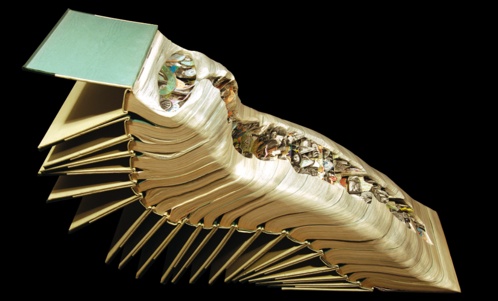
Brian Dettmer's new show of altered books prompts if:book's Sabastian Mary to wonder about "deeply-held taboos around the sanctity of books as objects":

Recycling, reimagining, repurposing the cultural glut amidst which we currently exist feels in many ways an appropriate artistic mode for today. Is authorship really so sacred that remixed works cannot themselves be things of beauty and value? Or, like European villages dismantling local medieval chateaux to build outhouses, are we taking our cultural history so completely for granted that we're in danger of forgetting or destroying millennia of culture in a thoughtless reappropriation of its materials for our current preoccupations?

Thursday, March 19, 2009

Tibetan books in Chinese media

The Chinese public relations campaign to influence Western views about Tibet includes--among headlines such as "Tibetans enjoy full religious freedom" and "Tibetan culture well preserved"--a couple of stories about Tibetan books and texts.

One video report from Xinhua Net shows the creation of a "Family Museum" to house a multi-volume Tibetan Buddhist classic after years of storage.


In another, Xinhua "China News" describes efforts to build "the largest stone sutra pagoda in Tibet" on Mount Chakpori opposite the Potala Palace in Lhasa, Tibet.

With a small mallet in one hand and a chisel in another, nine youngsters, sitting or squatting under a large piece of broken gray cloth shelter, are engraving lines of Tibetan sutra "Kangyur" into the stone slates. Less than 20 meters ahead is the pagoda, which is not yet completed after 14 years of construction, but embodies all their piety and faith to Buddha.

Tokdan Dawa Rinpoche, the sponsor of the pagoda, is sitting, with his legs crossed, on a carpet nearby the simple workshop, chanting sutras as throngs of devotees, with prayer wheels in hand, bowed to him and passed by, heading for the pagoda to pray along a dusty path.

As a tradition for centuries, Tibetan Buddhism believers engrave the sutras and Buddha images on stones as a way to keep the classics. It is also believed that the engravers, called "duoduo" in Tibetan, are able to achieve more happiness in their next lives through the toil of inscribing.

... usually a full set of Kangyur sutra includes 108 parts, each of which is written on a book of 200 to 400 pages. The engravers have finished inscribing the sutra and more than one million of stone slates piled into a 13-floor pagoda of more than 30 meters high.

... More than 100 engravers -- some from sophisticated stone-engraving families and some novices -- have volunteered to help build the pagoda. Most of them have worked here for five to six years though their pay for a whole-page Kangyur sutra is only 10 yuan (1.46 U.S. dollars).

... However, the beginning is always difficult.

As Zhoigar could not read, she just copied what she saw on the sutra book onto the stone.

"The characters were no more than some magic patterns to me at that time," recalled Zhoigar. "It also happened a lot that I had my fingers injured by the engraving tools, but the worst was that I wasted a lot of stone plates because of my mistakes, which made me cry a lot."

The tears are paid back after eight years of practicing. Zhoigar now can finish the engraving of an average of 20 stone slates every day at a speed of one Tibetan character in less than one second. She has also become a teacher for the newcomers.

"The more sutras I have engraved into the stones, the more Buddhism teachings I have engraved in my mind, which is far more important than how much money I have earned," said Zhoigar.

Arson burns Sikh scriptures

An arsonist set fire to London's Gurdwara Sikh Sangat on Tuesday, but it was the fate of the scriptures in the building that drew the emphatic attention of the Sikh and Indian press.

World Sikh News led it's story with: "As flames leapt and smoke billowed out, Sikh hearts cried at the thought of holy scriptures of Sri Guru Granth Sahib getting burnt inside this most famous of the London gurdwaras." It noted in the fourth paragraph that "The blaze, which caused the gurdwara’s roof to collapse, also engulfed all but one of the eight holy books it had housed" and quoted an onlooker: “It is like one of my gods is burning down—we worship our holy books as steps to God.”

Sify News also highlighted the scriptures in its lead: "One of London's most important gurdwara, housing priceless religious books, has been gutted in a suspected racist attack in Britain, a news report said on Tuesday."

Sindh Today included more information: "Singh said the women managed to save just one of the temple’s eight holy books before the flames took hold. 'I cannot describe how important those holy books were to the Sikh community,' he added."

Giant Qur'an sold


The Gulf News reports:

The third largest Quran in the world was sold in Abu Dhabi on Tuesday on the first day of the Abu Dhabi International Book Fair.

The manuscript which is 80cm by 120cm was displayed in the Antiquarian Book Fair which is being hosted for the first time at the event. The Quran, which was produced in 1890 in Indonesia, came about as a result of a request from wealthy people in Arabia. Indonesian calligraphers were known at that time for their high quality artwork, Ebergard B. Talke, a German antiquarian who was selling the Quran told Gulf News.

Thursday, March 12, 2009

Who owns Torah scrolls?

A dispute over ownership of four Torah scrolls has spilled out of the confidential confines of Jewish courts into Los Angeles District court, reports the Jewish Journal. The case pits a rabbi's widow, who claims the scrolls belong to her, against the rabbi who succeeded her husband who claims the scrolls belong to his congregation.

The case raises interesting questions regarding the Torah's iconic status as something more and different than just another book. The congregation's current rabbi,

Ohana disputes the very notion that the scrolls belong to Pauker, questioning whether they ever were family scrolls. Besides, he said, Torahs are owned by a community, not by a rabbi, a donor or anyone else. 'Sifrei Torah are not like money to change hands'.
(picture of Ohana from the LA Times)

He is refusing to accept the decision of a rabbinical court which disagreed with him and decided the case in favor of Mrs. Pauker. This pitting of community interests versus private ownership is reminiscent of the struggle to gather the fragments of the Aleppo Codex that remain in private hands.

April 9, 2009: The LA Superior Court judge reversed the rabbinical court's ruling and has awarded the scrolls to Rabbi Ohana and his congregation, according to the LA Times.

Friday, March 6, 2009

Cologne's Archives Collapse


Spiegel reported Tuesday on the sudden collapse of the building housing the city of Cologne's archives:

Disaster struck in Cologne on Tuesday, as the building housing the city's Historical Archive suddenly collapsed. According to city officials, two people are officially missing and believed dead. And hundreds of firefighters were on the scene Wednesday looking for survivors as Cologne historians and archivists mourned the apparent destruction of Germany's largest municipal archive.

... Cologne's archives are one of the only collections in Germany to have survived World War II completely intact. Because of Cologne's long history, much of its heritage was stored locally rather than in a state archive.

Cologne's history goes back more than 2000 years, when it was the Roman city of Colonia. In the Middle Ages, the city's prime spot along the Rhine River made it one of northern Europe's trading powerhouses, part of the Hanseatic League and a gateway between France and Germany. The Historical Archives contained extensive documentation from the city's Hanseatic period, as well as the archives of other Hanseatic League members, invaluable for historians looking at Europe's economic development.

The sheer numbers -- in total, the building had more than 18 kilometers of shelves -- reflect the rich history of what was once Germany's largest metropolis. The archive's collection of original documents included thousands from Cologne's golden age. The founding charter of the University of Cologne, signed in 1388, was inside, along with the documents that established Cologne as a free imperial city under Emperor Friedrich III in 1475. Two of the four manuscripts in the hand of Albertus Magnus, considered the greatest German theologian of the Middle Ages, were kept in the archive's rare books collection.

For historians trying to reconstruct the past, the greatest loss may be the more quotidian papers: Tens of thousands of receipts issued by the city government between 1350 and 1450, for example, or the 358 volumes of decisions and minutes of the Cologne City Council dating back 700 years.

The archives also contained the personal papers of almost 800 prominent German authors, politicians and composers, including Konrad Adenauer, the first post-war chancellor of Germany. The manuscripts and letters of Nobel Prize winner Heinrich Böll and Jacques Offenbach, a 19th century cellist and opera composer, were stored at the archive. Weimar Republic politician Wilhelm Marx and German-Jewish composer Ferdinand Hiller were among the other notables whose collections have been buried under tons of concrete. "These are fragile papers, that are now ground to dust," Illner told the daily.


... There may be no way to recover the lost collections. Large parts of the pre-1945 documents were put on microfilm and stored in a bunker in the Black Forest, but according to Illner the microfilm is of poor quality. And the post-war collections -- including records from the Cologne Art Association used to track the provenance of artworks -- have no back-up at all.

From the outside, the Historical Archive certainly looked indestructible. The bunker-like concrete structure was built in 1971, with a raw concrete façade and slit-like windows. Designers hoped the mass of concrete would keep the temperature inside constant without expensive air conditioning systems, an archive design that became known as the "Cologne model."

... The collapse may be connected with the construction of a new subway line under the street out in front of the archive.

Thursday, February 26, 2009

Qur'an desecrated in India

The Muslim community in a town in north India is on edge after discovering a desecrated Qur'an, according to Thaindian News:

Members of the Muslim community took to the streets and blocked traffic in Uttar Pradesh’s Rae Bareli district after a half-burnt and torn copy of the Quran was found, the police said Thursday.

The holy book was found torn and its pages burnt near the Chhoti Masjid in the Khwajkhan locality in Jaayas town Wednesday night, police added. ...

Protesters blocked roads, disrupting traffic in various parts of Jaayas, about 90 km from here [Lucknow]. The police are yet to make any arrest in the case.

Monday, February 23, 2009

Painting Books on 3x5 Cards

Michael Lieberman on Book Patrol profiles Cliff Eyland and his 3x5 inch paintings of books:


At times Cliff Eyland thinks of himself as a "librarian painter." A longtime bibliophile, Eyland has been painting on 3" x 5" index cards for 30 years. ...

To read more, click here.

Wednesday, February 18, 2009

Top Shelf Scriptures

Librarians in Leicester, England, have been caught between different religions' contrary views of how their scriptures should be treated, reports the Telegraph:

The situation was brought to light in guidance published by the Museums, Libraries and Archives Council, a quango answering to Culture Secretary Andy Burnham, on how to handle controversial materials.

It said some Muslims in Leicester had moved copies of the Koran to the top shelves of libraries, because they believe it is an insult to display it in a low position.

The city's librarians consulted the Federation of Muslim Organisations and were advised that all religious texts should be kept on the top shelf to ensure equality.

... Some critics have expressed concern that the books will now just be treated as objects to revere rather than books to read.

... Simon Calvert of the Christian Institute said: "It is disappointing if the policy of libraries is dictated by the practices of one group.

"It is particularly disappointing if this is done to put the scriptures beyond reach."

The incident shows the tendency, in religiously pluralistic societies, for the customs regarding treatment of one scripture to be applied to others. Though this story highlights Christian opposition to such tendencies, other stories we've mentioned in the past show Christians themselves making the equation (e.g. in the German TV burning Bible furor of 2007). Though the arguments by contending parties usually cite tradition as if it were invariable, customary practices with iconic books seem to be evolving rapidly. I suspect they always have ...

Bach's Bible

Iconic books become relics when individual copies are treasured because of their history. But this video illustrates that relic status can be slow in coming:

Thursday, February 5, 2009

Stolen Syriac Gospel seized

The Assyrian International News Agency is reporting that Cypriot authorities have seized a rare Syriac Gospel book from smugglers:

... The bible, estimated to be worth around €2 million, was seized during a raid at the Famagusta bus terminal last Friday where smugglers were seeking to sell it to buyers in the north. It is thought Turkish Cypriot police had been tipped off about the impending sale.

Although the north's 'antiquities department' refused yesterday to comment on the bible, because it was "the subject of an ongoing inquiry", a statement from police said it was bound in deerskin, written in gold letters in the Syriac language, and believed to be around 2000 years old. The bible may have come from the heartland of the Syrian Orthodox community in southeastern Turkey, where a small community remains, despite often being caught in the crossfire between Kurdish rebels and the Turkish military.

"It is very likely to come from the Tur-Abdin area of Turkey, where there is still a Syriac speaking community," Dr Chalotte Roueche, professor of Late Antique and Byzantine Studies at King College, London told Reuters yesterday. ...

Of course, Roueche went on to challenge the dating to a more reasonable range of the 4th century to the middle ages. The book, however, is not (yet?) available for scholars to inspect.

This story illustrates how two aspects of an old Bible's iconic dimension come into conflict: the high monetary value on the (black) market of an old copy of scripture on the one hand versus its iconic value as an identity marker for the Syrian / Assyrian Christian communities of Turkey on the other. In both contexts, the book functions as a relic and relics have always been the subject of controversy and conflict.

Thursday, January 29, 2009

Books for making icons

Fubiz provides a different interpretation of the meaning of "iconic books":


Saturday, January 24, 2009

Worries about reading books

There is no surer sign of the iconic status of books in our culture than the continuous complaints about the decline in the number of people reading literature. The endless anecdotal evidence for poor cultural literacy is increasingly buttressed by polling data, though the latter does not instill much confidence. So in the same week that a colleague pointed out to me FirstThings's approving review of Mark Bauerlein’s jeremiad, The Dumbest Generation: How the Digital Age Stupefies Young Americans and Jeopardizes Our Future; or, Don’t Trust Anyone Under 30, the Chronicle of Higher Education reported on a new NEA survey that showed a sharp up-tick in literary reading, especially among young adults.

Maybe it's just because I deal with ancient history, but I think these discussions, and especially the statistics they depend on, treat far too short a time-span (usually less than fifty years) to draw meaningful conclusions about the effect of reading rates on society in general ...

Bookstore pictures


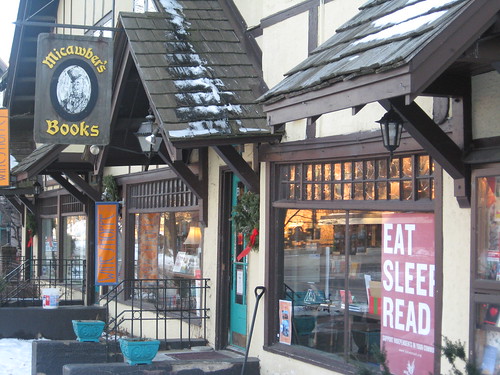
Nigel Beale has put a large set of pictures of independent and college bookstores on Flikr, like this one of Micawber's Books in Minneapolis, MN. Is this an homage to an endangered species?

Thursday, January 15, 2009

How Books (should be) Produced

The digital marketing team at Macmillan has produced a tongue-in-cheek (and self-promoting) account of book production on UTube:


I wonder how many people will take it at face value ...

(h/t to Michael Lieberman on Book Patrol).

Wednesday, December 24, 2008

Obama will use Lincoln Bible for inaugural oath


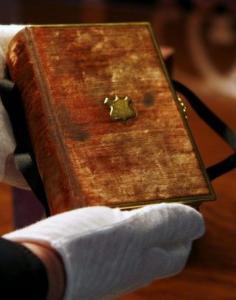
Following many other presidents who have used relic Bible's to take their oath of office, Barack Obama has chosen to use Lincoln's, according to Cox News Service:

President-elect Barack Obama will take the oath of office on the same Bible that Abraham Lincoln used for his swearing-in.

The burgundy velvet-bound volume known as the Lincoln Bible was purchased in 1861 by then-Supreme Court Clerk William Thomas Carroll for use in Abraham Lincoln's inauguration because the president-elect's family Bible was packed away and en route from Illinois to Washington.

The Lincoln Bible, now in the Library of Congress collection (as is Lincoln's family Bible), has not been used in a presidential inauguration since Lincoln took the oath in 1861.

The reader's comments on this article in the Boston Globe are unusually interesting. Ray Sollier takes issue with some common claims about the history of using Bibles in presidential oaths. I wish Ray would cite his sources ...

Thursday, December 11, 2008

Preservation, preservation, preservation ...

Kevin Kelly on the Long Now Blog points out that storage of digital information should really be called movage, because it's only by moving it from one medium and platform to another that you can keep it accessible. And then there's the problem that:
The storage medium itself can decay. Turns out that paper is much more stable over the long term than most digital media. Magnetic surfaces flake, peel, shatter. And the supposed durable CDs and DVDs aren’t very stable either. ...

Proper movage means transferring the material to current platforms on a regular basis — that is, before the old platform completely dies, and it becomes hard to do. This movic rythym of refreshing content should be as smooth as a respiratory cycle — in, out, in, out. Copy, move, copy, move.

In other words, anything you want moved to the future has to be given attention to keep it moving forward.

We don’t know what the natural movage respiration cycle is for digital media yet since it is still very new, but I suspect the cycle is much shorter than we think. I would guess it is 5 years. No matter what digital format you have your precious stored on, you should expect to move it onto new media in five years — and five years after that forever!

Move it, move it, move it.

Paper is looking better all the time. Clay tablets, even better! Alexander Rose writes also on the Long Now Blog that the invention of a tough and resilient ceramic at UC Berkeley has the Long Now Foundation interested:
... we are quite interested in it as a long lasting material for the 10,000 Year Clock. We already plan on using engineered ceramics for bearings and other wear components, but the elimination of ceramics only real drawback, that it can shatter, really opens up the engineering possibilities.

It seems to me that they should broaden their thinking beyond clocks. Ceramics formed the original cheap and durable writing medium, as I've commented before. Wouldn't it be funny if the end result of all our experimenting with electronic technology would turn out to be a high-tech version of the cuneiform tablet!

Bookbindings of the Morgan

Sylvia on Classical Bookworm points out:
Legendumst posted about a new exhibit at the Morgan Library and Museum, Protecting the Word: Bookbindings of the Morgan. Pierpont Morgan was, well, filthy rich, and he purchased a lot of beautiful things including books with exquisite bindings. These are now on display and you can see a handful of them online. I thought I would post one of them—it actually made me gasp when it came up on screen. They aren't sure exactly where and when it was made but they guess Salzburg around 760–790. A hundred years later or so it was "recycled" as the back cover of the Lindau Gospels. The front cover is astonishing also, but I prefer the older one.

Book Patrol: The Chinese Book Burner and the Great Wall of Books

Michael Lieberman on Book Patrol:


Qin Shi Huang, is one of the most notorious and prolific book burners in history. During his reign from 221 BC - 210 BC, Qin Shi Huang outlawed Confucianism and ordered the burning of pretty much all the books that came before him including the classic works of the Hundred Schools of Thought. It is also believed that he buried alive many of the scholars of the day. All in his quest to unite China.

This the same guy who built the Great Wall.

Jorge Luis Borges wrote an essay on Qin Shi Huang, 'The Wall and the Books' (La muralla y los libros) which appeared in the collection Other Inquisitions (Otras Inquisiciones), where he muses on these two grand feats.

The contemporary art company WELL has taken the Borges essay a bit further with their Great Wall of Books project - "a unique contemporary art project, simultaneously: public sculpture, interactive installation, outdoor performance, exhibition space and a point of creative departure for invited artists and communities. Literally a gigantic book, 5 metres tall and opening out to over 11 metres wide, it is a vessel that both generates and stores written, aural and visual stories." The project launched in 2007 with a 4 month stint in Macao, China and spent January of this year in Melbourne, Australia.


This has been the third installment in Book Patrol's new series Life of Google, featuring images from the vast archives of Life magazine that now appear on Google.

Modern Library Architecture

Sylvia on Classical Bookworm points out:

The WebUrbanist has just put together a collection of fifteen "dazzling" modern libraries from all over the world. It's a diverse assortment, from the Anchorage "washtub" to Prague's purple and pea green amoeba. Seattle is there, of course, as is Jay Walker's library. Two interesting libraries missing from the list are Salt Lake City's main library and the Vancouver Public Library. I haven't featured the latter before, so here it is:


Wednesday, December 3, 2008

Breathing Books!

Michael Lieberman on Book Patrol calls attention to "Bre Pettis takes us on a short video tour of Edith Kollath's latest exhibit Property and Evidence: The Whole Story which is currently on view at Dam, Stuhltrager Gallery."

Things - Edith Kollath Creates Books that Breathe from Bre Pettis on Vimeo.
- Kollath's account of the experience.
- Press release for the exhibit

Sunday, November 30, 2008

Book Publishing After Google Books

The author, James Gleick, who negotiated on behalf of authors in the recent legal settlement between Google and publishers, writes in the New York Times about the book business after Google Books.

He argues against those who think the book is obsolete:
I think, on the contrary, we’ve reached a shining moment for this ancient technology. Publishers may or may not figure out how to make money again (it was never a good way to get rich), but their product has a chance for new life: as a physical object, and as an idea, and as a set of literary forms.

As a technology, the book is like a hammer. That is to say, it is perfect: a tool ideally suited to its task. ... I’m just saying that the book is technology that works.

He observes that the range of genres taking book form has been narrowed by the electronics revolution:
There’s reading and then there’s reading. There is the gleaning or browsing or cherry-picking of information, and then there is the deep immersion in constructed textual worlds: novels and biographies and the various forms of narrative nonfiction — genres that could not be born until someone invented the codex, the book as we know it, pages inscribed on both sides and bound together. These are the books that possess one and the books one wants to possess.

For some kinds of books, the writing is on the wall. Encyclopedias are finished. ... Basic dictionaries no longer belong on paper .... And those hefty objects called “telephone books”? As antiquated as typewriters. The book has had a long life as the world’s pre-eminent device for the storage and retrieval of knowledge, but that may be ending, where the physical object is concerned
.

Glieck sees a great value for authors in Google's project:
The vast majority [of books scanned by Google], four million to five million, are books that had fallen into a kind of limbo: protected by copyright but out of print. Their publishers had given up on them. They existed at libraries and used booksellers but otherwise had left the playing field. ... This means a new beginning — a vast trove of books restored to the marketplace. ...

He has clear advice for how book publishers can survive in these new circumstances:
Go back to an old-fashioned idea: that a book, printed in ink on durable paper, acid-free for longevity, is a thing of beauty. Make it as well as you can. People want to cherish it.

That matches our observation that while the book as information source is facing stiff competition, the book remains unchallenged as the preeminent icon of education, wisdom, tradition, culture and religion.

Friday, November 28, 2008

Cremation ceremonies for Guru Granth

Thaindian News provides a feature story on the regular cremation rites for the Sikh scripture, the Guru Granth Sahib, in northern India:

At Angitha Sahib, the old copies of Guru Granth Sahib from all over the world are put to flames as part of funeral rites. The whole procedure is a way of bidding farewell to the scripture with utmost reverence. This is the only Gurudwara, which performs this ritual.

“Scriptures from all across the world like England, America, Canada and Pakistan have come to Angitha Sahib in Sahaspur for getting cremated. With full respect, these holy epics are first given bath, and then they are wrapped in new clothes. Then these scriptures are treated like living beings. This service is done in privacy,” said Harsharan Singh, Mukhya Sewadaar (chief helper), Angitha Sahib Gurudwara.

When old and worn out scripture reach Angitha Sahib in Sahaspur, first of all they are given bath after which every page is cleansed and later these scriptures are wrapped in white cloth and then the funeral takes place. The cremation lasts over six days and on the seventh day, the ashes are collected. ...

"And apart from Guru Granth Sahib we also cremate Holy Bible, Bhagwad Gita, Ramayana and Quran,” ...

This year about 2,000 scriptures have come from all over the world to Gurudwara Angitha Sahib for cremation, of which around 470 worn out scriptures were flown in from the Great Britain by a chartered flight. (ANI)

It is particularly interesting that the Gurudwara extends its funerary services for scriptures to Christian, Hindu and Muslim texts as well as Sikh. This illustrates the widespread tendency to extend one's own standards for manipulating scriptures to those of other traditions in a spirit of mutual respect and tolerance.

Life's pictures on Google


Michael Lieberman on Book Patrol posts this delightful picture of children parading the books selected for the William Allen White children's book awards in Americus, Kansas in 1959. It is from the vast picture archive of Life Magazine that is now being made available on Google Image Search.

Wednesday, November 26, 2008

Floppy Bibles Invade Academics

The book exhibits at the Society of Biblical Literature meeting focus on academic titles, but that icon of Protestant religiosty, the floppy Bible, is encroaching even here.

Zondervan's A Reader's Hebrew Bible comes in a limp, light-brown faux-leather binding with silver-tinged pages. The text is BHS with the Westminster morphology at the bottom of the page, for quick reference. As an icon, it is facinating to see how the Reader's Hebrw Bible associates itself simulataneously with the scholar's Biblica Hebraica Stuttgartensia by the color of its cover and with the preacher's bible by its limp cover material and metallic edges. Rumor has it that sales were brisk. This is Zondervan's second scholarly floppy-Bible: last year, it released A Reader's Greek New Testament.

Harper Collins' entry in the floppy Bible competition is the very different Green Bible (see Cordell's previous comment about it). Its limp cover is made of recycled linen, its paper is (partly) recycled, of course, and its NRSV text is periodically rendered in green ink to highlight environmentally friendly verses. In this case, at least, the Bible takes an iconic form that indexes its publishers' intended message directly, and in its own substance models the behavior it aims to elicit from readers!

Friday, November 14, 2008

Iconic Books at SBL

Those of you heading to Boston for the Society of Biblical Literature Annual Meeting next week-end might want to check out several papers on iconic books. As usual, the Scripture As Artifact consultation on Monday will highlight the subject:

Dori Parmenter will address "Burials and Book-Burnings: Contemporary Concerns for Bible Disposal";

Jay Larson will talk about "Codifying Memory" in the Gospel Codices of late antiquity; and

Zeev Elitzur will start off the session with “Holding an Object”: The Coming of Age of Scripture as Holy Artifact."

Jay is also talk about "The Gospels as Sites of Memory" analogous to monuments in the session on Mapping Memory: Tradition, Texts, and Identity on Sunday morning.

This year, I'm leaving the iconic dimension in their capable hands while I talk about "Performing the Torah: The Rhetorical Function of the Pentateuch" with the Performance Criticism consultation on Sunday afternoon.

Hope to see you in Boston!

Tuesday, November 11, 2008

Monumental Text Debate in Pleasant Grove City, UT

The latest contest in a long history of debates over the presentation of monumental scriptures in public places is unfolding in Pleasant Grove City, Utah. As reported by the New York Times in the article "From Tiny Sect, Weighty Issue for Justices," a city park already has a Ten Commandments monument (donated in 1971 by the Fraternal Order of Eagles) that the town's mayor, Michael W. Daniels, explains as representing "law and history" (but not religion).

Now a religious group called Summum would like to donate a similar monument displaying the Seven Aphorisms that guide the group's theology. Pleasant Grove City did not accept the donation, and the resulting lawsuits have reached the U.S. Supreme Court level. At stake are issues of free speech and freedom of religion in public spaces, and whether a public park that displays the texts of some religions ought to display the texts of other religions as well (if their members choose to donate such monuments). As with other disputes over Ten Commandments monuments, this goes far beyond the text itself, and the physical presence of the monument takes on the weight of Constitutional law; the acceptance (or lack thereof) of a particular religion; and the identity politics of the city, state, and nation.

Saturday, November 8, 2008

Pricey pictures of books


Michael Lieberman on Book Patrol points out that the two top-grossing pictures in Christie’s Nov. 6 auction of Impressionist and Modern art contained images of books. They were “Book, Pipe and Glasses” by Juan Gris (above) for $20 million and Picasso's "Two People" for $16 million.

Monday, November 3, 2008

Betting on the Future of the Book

The folks at if:book have issued an invitation to participate in an NEH-funded effort to create "two ambitious digital publishing projects." Their goal is to merge rich multimedia, which so-far largely exists on CDs and hard drives, with internet collaboration, which so far "generally occurs around predominantly textual media."

I find it fascinating that their goal is explicitly to emulate a book:

The printed book is still the gold standard of the academy. The goal of these projects is to produce born-digital works that are as elegant as printed books and also draw on the power of audio and video illustrations and new models of community-based inquiry — and do all of these so well that they inspire a generation of young scholars with the promise of digital scholarship.

It seems like the logical end-point of this line of development would likely look very much like the books on my shelf, or maybe even Dori's beautiful artbook pictured at the left top of this blog, except that the pages inside would contain electronic media. But if that is the end produce, in what sense would that be anything but ... a book?

Meanwhile, the folks at the Long Now Foundation who spend time worrying about a "digital dark age" in our future, are placing their bets on laser-etched titanium for preserving the world knowledge, or at least its languages. They've announced that their Rosetta Disk Project is now complete. You, too, can help preserve this knowledge by taking home one of the last two first-edition disks--for $25,000, or so.

Friday, October 31, 2008

More on Guru Granth Sahib's Tercentenary

The Sikh celebration of the 300th Anniversary of the Granth Sahib's elevation to the status of Guru is being covered by many news reports. The Hindu describes the various politicians involved in the celebration, including of course India's Prime Minister Manmohan Singh. It also describes the procession (nagar keertan) of the Guru Granth:

The Guru Granth Sahib was carried in a ‘palki’ (palanquin) placed in a specially designed vehicle. ... The straight road between the two Gurdwaras was choked with an estimated 3 lakh [300,000] pilgrims. ... The sacred Guru Granth Sahib was received at the main gate amid the ‘shastra salami’ of swords. The process of enthroning it included its ‘prakash’ and application of sandalwood tilak and aarti. The Guru Granth Sahib was opened at random for the ‘hukamnama’ or the edict for the day.

NDTV provides a slideshow of the celebrations. NewsBlaze provides a more discoursive account of the meaning of the event:

The Adi Granth was conferred the title of "Guru of the Sikhs" by the tenth Guru, Guru Gobind Singh, in October, 1708. The event, when Guru Gobind Singh installed Adi Granth as the Guru of Sikhism, was recorded in a Bhatt Vahi (a bard's scroll) by an eyewitness, Narbud Singh, who was a bard at the Guru's court. There are a variety of other documents attesting this proclamation by the tenth Guru.

As per the Guru's commandment: A close associate of Guru Gobind Singh and author of Rehit-nama, Prahlad Singh, recorded the Guru's commandment saying "With the order of the Eternal Lord has been established [Sikh] Panth: all the Sikhs hereby are commanded to obey the Granth as their Guru".(Rehat-nama, Bhai Prahlad Singh)

... Guru Gobind Singh Guru (1666-1708), the tenth Guru in Sikh tradition, affirmed the sacred text Adi Granth as his successor, terminating the line of human Gurus, and elevating the text to Guru Granth Sahib. From that point on, the text remained not only the holy scripture of the Sikhs, but is also regarded by them as the living embodiment of the Ten Gurus. The role of Guru Granth Sahib, as a source or guide of prayer, is pivotal in worship in Sikhism.

... The 'Guru Granth Sahib' is a voluminous text of 1430 pages, compiled and composed during the period of Sikh Gurus from 1469 to 1708. It is compiled in the form of hymns written in praise of God, which describe what God is like and the right way to live.

Sri Guru Granth Sahib has been given status of juristic person -The Supreme Court of India has held that Sri Guru Granth Sahib is a juristic person and it is also very clearly clarified and left no lacuna to raise any misconceptions and controversies and the judgment does not equate Guru Granth Sahib with Hindu idol or deity. Rather the Supreme Court said when faith and belief of two religions are different; there is no question of equating one with another. The Court held categorically that Guru Granth Sahib couldn't be equated with an idol, as idol worship is contrary to the Sikh principles. Thus it clearly maintains and upholds the separate, unique and independent identity of Sikhism. It was held that no doubt the Sikh scripture is a sacred book but it can't be equated with the sacred books of other religions as the reverence of Guru Granth Sahib is based on different conceptual faith, belief and application. It is the living and eternal Guru of Sikhs.

... Huge properties worth crores of rupees exist in the name of Guru Granth Sahib in various parts of the country. These were encroached upon by usurpers as Guru Granth Sahib, not being a juristic person, could not be deemed to hold property in the eyes of law. It also could not sue to recover the property for the same reason. This judgment has plugged the loophole. Now Guru Granth Sahib is a juristic person that can hold and dispose of property and can sue for recovery of property belonging to Guru Granth Sahib in the wrongful possession of unscrupulous people who were taking the undue benefit the legal lacunae.....

Sunday, October 26, 2008

Video Game Recall Due to Qur'anic Content

Sony has recalled the roll-out of its latest video game LittleBigPlanet because some late vetting discovered Qur'anic quotations in some of the game's licensed music. Sony's Director of Corporate Communications posted the following statement on the Playstation 'blog on October 17th:
During the review process prior to the release of LittleBigPlanet, it has been brought to our attention that one of the background music tracks licensed from a record label for use in the game contains two expressions that can be found in the Qur’an. We have taken immediate action to rectify this and we sincerely apologize for any offense that this may have caused.

We will begin shipping LittleBigPlanet to retail in North America the week of October 27th. Sorry for the delay, and rest assured, we are doing everything we can to get LittleBigPlanet to you as soon as possible.
An ABC.com article clarifies the content in question:
The song is titled "Tapha Niang," composed by world musician and Malian kora player Toumani Diabate.
[. . .]
The two lines that appear in Diabate's song are from 3:185 ("Every soul shall taste of death") and probably 55:26 ("All that is on earth will perish").
This action is another example of the debates over the limits on performing scriptural texts. For critics of Sony and Diabate, the use of Qu'ranic verses in a video game is inappropriate. For others (like Diabate, who is Muslim, and the American Islamic Forum for Democracy), the use is acceptable.

Bible Read Day and Night

For the Synod of Bishops in Rome this month, the Vatican not only sponsored a special polyglot edition of the Bible, it also organized a week-long reading of the whole Bible in the Basilica di Santa Croce in Gerusalemme a Roma, with simultaneous broadcast on Vatican radio. See the links and accounts collected by Silvia on Classical Bookworm.

In the U.S., the International Bible Reading Association sponsors a read-through of the Bible every year in Washington, D.C., over ninety hours leading up to the National Day of Prayer.

The Green Bible


Harper-Collins is publishing a new edition of the NRSV Bible with an ecological twist. Hearkening back to the traditional "red-letter" Bibles, this "green-letter" Bible uses green to highlight ecology-minded passages, is printed on recycled paper using soy-based ink, and is bound in a cotton/linen cover.

The Green Bible may be understood as the textual component in a shift in certain Christian theology that is taking place. As an MSNBC article summarizes it,
While some Christians have been active on these issues for decades, others – particularly Evangelicals – have long questioned the justification and aims of environmentalism. Many conservative Christians have viewed it as a "leftist" issue, sometimes bordering on pantheism. In recent years, however, some prominent evangelical leaders have been converted by the evidence of climate change, and in 2006, they signed the Evangelical Climate Initiative. Others continue to dispute the evidence.
Iconic books have long been used to stake dogmatic and theological claims—here we recall the late medieval controversies over Bibles in English—and this one makes the same move by manifesting its values in its physical form.