Iconic books are texts revered as objects of power rather than just as words of instruction, information, or insight. In religious and secular rituals around the globe, people carry, show, wave, touch and kiss books and other texts, as well as read them. This blog chronicles such events and activities. (For more about iconic books, see the links to the Iconic Books Project at left.)

Showing posts with label art history. Show all posts

Monday, June 22, 2015

Bibliography on Books in Art


A query about studies of depictions of books in art produced many suggestions this month on SHARP-L, the discussion list of the Society for the History of Authorship, Reading and Publishing. It is interesting how many of them focus on artistic depictions of women reading or writing. When we first compiled a pictorial database for the Iconic Books Project, we noticed the prominent association women with books across a wide variety of cultures and throughout history. Since books in art have been a key interest of the Iconic Books Project from its inception, I have taken the liberty of compiling the suggestions here. 

Books and articles:
Adler, Laure, Stefan Bollman and Jean Torrent, Les femmes qui lisent sont dangereuses ("Reading Women Are Dangerous"), Flammarion, 2006, new ed. 2015.
Adler, Laure, Stefan Bollman and Jean Torrent, Les femmes qui lisent sont de plus en plus dangereuses ("Reading Women are More & More Dangerous") Flammarion, 2012.
Allen, James Smith. In the Public Eye: a History of Reading in Modern France, 1800-1940. Princeton University Press, 1991.  Chapter Five: “Artistic Images.”
Brown, Kathryn. Women Readers in French Painting 1870-1890. Ashgate, 2012. Introduction online here.  
Docherty, Linda J. "Women as Readers: Visual Interpretations," Proceedings of the American Antiquarian Society 107 (October 1997): 335-88, online here.
Inmann, Christiane. Forbidden Fruit : a History of Women and Books in Art. Prestel, 2009.
Lerner, Loren. “William Notman’s Portrait Photographs of Girls Reading from the 1860s to 1880s: A Pictorial Analysis Based on Contemporary Writings.” Papers of The Bibliographical Society of Canada 47/1 (2009), online here.  
Long, Elizabeth. Book Clubs: Women and the Uses of Reading in Everyday Life, Chicago: University of Chicago Press, 2003. Chapter 1.
Stewart, Garrett. The Look of Reading: Book, Painting, Text. Chicago: University of Chicago Press, 2006.
Thornton, Dora. The Scholar in His Study: Ownership and Experience in Renaissance Italy. Yale University Press, 1998.
Warner, William. “Staging Readers Reading.” Online here.
Zanker, Paul. The Mask of Socrates: the Image of the Intellectual in Antiquity. Tr. A. Shapiro. Berkeley: University of California, 1995.

Exhibition and Sale catalogs:
il libro come tema, National Gallery of Modern Art in Rome, September – November, 2006.
Das Buch in der Kunst - die Kunst im Buch. Graphik-Salon Gerhart Söhn, 1984.

Library and Museuam Collections:
Antwerp City Library: Former Antwerp city librarian Ger Schmook (1898-1985) collected a huge set of images of books in art; it’s a collection of photocopies with a card file.
Metropolitan Museum of Art: catalog by Mindell Dubansky of photographs and descriptions of bindings and images of books depicted in the art works of the Met: “Catalog of Bookbindings in The Metropolitan Museum of Art” [v. 9.] European Paintings, Representations of the book in art. -- [v. 10.] The Lehman Collection, Representations of the book in art.

Saturday, July 21, 2012

Sacred Texts Online


The British Library has made available in digitized form online over 70 sacred texts from ancient and contemporary world religions.

The link to the online collection can be accessed for free here.

Notably, the curators of this online resource have included both aesthetic and kinesthetic elements in the display, such as the ability to "turn" virtual pages of the texts, as if flipping through a "real" codex.

These attempts to make virtual texts more "book like" are worth exploring.  They involve resources of time, programming, and storage space--not to mention considerable extra monetary investments in website development.  How well, I wonder, do the curators research the desire, or "need," for this sort of feature before implementation?  Or do they simply assume that these sorts of functionalities are needed to make the site more appealing?

I'd be interested to hear others' thoughts on these questions.


Thursday, December 15, 2011

Norms for reading postures

I recently responded to a query on the SHARP discussion list that may be of interest:
My SHARP query: in conjunction with my research on graphic novels, I'm looking at the normative act of reading--how readers are supposed to use their hands, not move their heads, NOT move their lips, not move their fingers over the words, not underline passages, not write in the margins, etc., and how they are supposed to sit rather than stand or lie down or kneel, etc. (except with regard to public readings of liturgical texts, obviously). I'd be interested to know if anyone has done work or is presently working on the relationship of hierarchical codes inscribed in the book object to the physical acts involved in reading. My sense is that reading was physically engrossing in the seventeenth and eighteenth centuries, and progressively less so in the 19th and 20th. Morris, Gill, Morison, Warde all have notes that point to the disembodiment of reading, and I assume that somewhere there must be a mid-20th century book or film or filmstrip that actually depicts for children how they are supposed to comport themselves nicely as they read, but I haven't located one, and if anyone has, I'd be grateful for a citation.

Michael Joseph
Rutgers University Libraries
My response:

In compiling and analyzing a pictorial database for the Iconic Books Project, we noticed the significant role of art in promulgating norms of reading behavior, especially posture. This appears as early as ancient Egyptian portraiture and ritual texts, shows up famously (though not uniquely either in time or culture) in late medieval and renaissance depictions of Mary's Annunciation, and remains a prominent feature of contemporary illustrative photography and art.


Posture varies, of course, depending on the material form of the text and also the situation of its use. In many religious communities from antiquity to the present, for example, liturgical reading takes place standing while devotional reading is usually depicted in a seated posture--often simultaneously in congregations where the liturgist reads the scripture from the pulpit while congregants follow along in their own Bibles. Maybe the increasing publication of genres for private use has led to emphasizing sitting modes of reading to the point of disembodiment (an idea that echoes devotional, even mystical reading practices), but I should point out that standing to read publicly remains the norm, even (especially?) in academic conference presentations.

Beyond these general observations, though, I can't point out much specific bibliography. Study of the embodied and material uses of texts is in its infancy, especially comparative study that begins to generalize about norms of reading and their social significance. That makes it, for me at least, a very exciting subject to work on!

Jim Watts
Syracuse University
jwwatts@syr.edu


Saturday, September 24, 2011

Arcimboldo's Librarian

Michael Lieberman on Book Patrol lays some markers for tracking the influence of Giuseppe Arcimboldo's painting, The Librarian, in the sixteenth and twentieth centuries.

Wednesday, July 28, 2010

Stewart on Book Art

Garrett Stewart, writing in Critical Inquiry (Spring 2010), theorizes the nature and function of book art. In "Bookwork as Demediation", he notes that "Book sculpture is something done to a book, done with it and others like it, or done in place of it--alteration, assemblage, or simulation." He calls this action "demediation" which "peels away the message service, leaving only the material support."

Stewart notes that book art, or as he prefers to call it, "bookwork" calls attention to books' materiality:

It is one way of studying their material preconditions, and this in the absence of their function as conduits--a function absent and gone but not forgotten. For nonbooks serve to itemize the features of book-based textuality that may otherwise be subsumed and elided by the channels of tansmission.

And that is just the beginning of his analysis...

Saturday, April 24, 2010

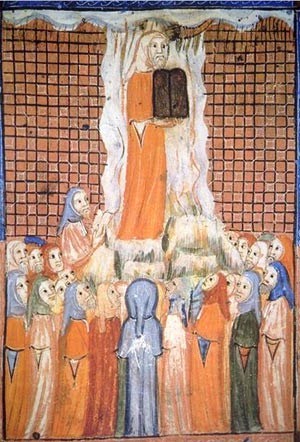
The Shape of the Decalogue Tablets


Menachem Wecker in the Jewish Press surveys the shape of the Decalogue in Jewish art, especially late medieval illuminated manuscripts. Though the stereotypical round-topped double tablets appear in the Sarajevo Haggadah (right, ca. 1350), he also finds rectangles, single tablets, and framed texts. No standard shape or depiction carries the day, though Wecker observes that

the claim Jews envision the tablets in the rectangular while Christians hold them to have been rounded does not stand. For the most part, Jewish artists do seem to have followed the grammar of the biblical phrase luchot avanim (tablets of stone) or luchot ha'brit (tablets of the law), which is always presented in the plural, while many Christian artists attached the two tablets to each other.


Perhaps the most interesting depiction is in the Alba Bible (left). Wecker comments:

The tablets seem positioned to squash Moses' head, and if one examines them carefully, one notices that the text - which is not carved into the rock, but painted on top of it - sometimes overflows the allotted space and hangs midair, particularly in the third commandment. It is almost tempting to read the white space surrounding the letters as empty space, in which case the artist has interpreted the forms of the letters as all being miraculously suspended.

Saturday, November 8, 2008

Pricey pictures of books


Michael Lieberman on Book Patrol points out that the two top-grossing pictures in Christie’s Nov. 6 auction of Impressionist and Modern art contained images of books. They were “Book, Pipe and Glasses” by Juan Gris (above) for $20 million and Picasso's "Two People" for $16 million.

Saturday, February 23, 2008

A House for the Mind


Fiona MacCarthy, in The Guardian, profiles Colin St. John Wilson (1922-2007), the architect of the (new) British Library.

The driving force for the library was his own bookishness. Colin (always known as Sandy) St John Wilson was born in 1922, the year of Ulysses and The Waste Land, Wittgenstein's Tractatus, Mandelstam's Tristia and the last volume of Proust. For him, an ideal library had a certain aura close to that of the solemn sacred spaces of the Anglican churches and cathedrals he grew up in. His father was a notably radical bishop of Chelmsford and an expert on the 17th-century Divines. He was brought up understanding that books were a protected species and libraries were bastions of intellectual freedom. As he wrote: "One has only to recall the destruction of the library in Alexandria or, akin to that fire, the blasphemy that underlay the burning of the books by Nazi decree, for one to be aware that the library and what it houses embody and protect the freedom and diversity of the human spirit in a way that borders on the sacred."

His first ambition would have been to build a great cathedral, but a library came second. He retained a childlike vision of a "magic mountain of all the knowledge in the world".

Pallant House Gallery in Chichester is exhibiting Wilson's art collection in a gallery that he designed, and reflects on his career in the exhibit, "Colin St John Wilson: Collector and Architect."

Saturday, January 26, 2008

Review of People of the Book

Jeremy Dibbell, of PhiloBiblos, writes a beautiful review of Geraldine Brooks new novel, People of the Book (Viking, 2008). The novel features the 14th-century Sarajevo Haggadah, interweaving its history into the contemporary plot. Dibbell comments:

There's a message here for those of us who study books as artifacts - there are stories there, real people's stories, and although they may be impossible to get at really, we should think of them.

As Hanna is preparing her essay about the Haggadah to accompany the exhibition catalogue, Brooks has her say "I wanted to give a sense of the people of the book, the different hands that had made it, used it, protected it. I wanted it to be a gripping narrative, even suspenseful" (pp. 264-265).

Saturday, January 19, 2008

PhD program in "Texts, Contexts, Cultures"

Mark Bertrand, on Bible Design & Binding, points out a new set of PhD scholarships in Ireland:

"Dr Crawford Gribben, who is the Long Room Hub Senior Lecturer in Early Modern Print Culture at Trinity College in Dublin -- as well as a reader of this blog -- e-mailed me with some news that will be of interest to academics in the audience. He's directing a new PhD program at Trinity College and has twelve fully-funded scholarships to award. Here are the details:

12 fully-funded 4-year PhD scholarships are available for Arts and Humanities research in Trinity College Dublin

A new interdisciplinary and inter-institutional PhD pathway for research in Arts and Humanities has been launched by Trinity College Dublin in conjunction with NUI Galway and University College Cork. 12 four-year scholarships of fees plus €16,000 per annum are available for those who wish to pursue this pathway as students of Trinity College Dublin. Other scholarships are being offered by NUI Galway and University College Cork. The scholarship competition at Trinity College Dublin is open to both EU and non-EU applicants. The closing date for entry is 1 March 2008.

Texts, Contexts, Cultures has been designed to prepare students for life in academia – and beyond. First-year students will develop their research through multi-institutional training elements in the pathway's core themes – History of the Book, Imaging Ireland and Renaissance intellectual history – much of which training will be delivered through audiovisual and online networks. Research will be supervised by multi-institutional scholarly panels. Students will also be provided with the opportunity for work placement in the knowledge economy sector.

Dr John Hegarty, Provost of Trinity College Dublin, commented that the Texts, Contexts, Cultures pathway "represents an exciting new beginning for higher education in Ireland and for higher education itself."

Full details can be found on www.textscontextscultures.ie . All enquiries should be directed to Dr Crawford Gribben, the Director of Texts, Contexts, Cultures at Trinity College Dublin (crawford.gribben@tcd.ie).

Dr. Gribben teaches a course focusing on Renaissance Bibles, including their design and binding! There's a PDF course description online that gives a flavor -- "Group exercises will include the preparation of an online annotated edition of part of an individual Biblical book, which edition will compare the forms and contents of
various early modern texts, translations and multimedia receptions"."

Monday, November 19, 2007

Scriptures As Artifacts at SBL meeting

The Iconic Books Project is not the only research effort on this subject. The Scripture as Artifact Consultation, chaired by Brian Malley, showcased the work of eleven scholars at the annual meeting of the Society of Biblical Literature in San Diego.

The session on Saturday, November 17th, focused on “the late medieval period to the present.”
     Marianne Schleicher (Aarhus University) described her research on the relationship between ritual uses and displays of Torah scrolls and the interpretation of Torah in a Dutch Jewish congregation (paper title: “Transitions between Artifactual and Hermeneutical Use of Scripture”).
     Miriam Levering (U. Tennessee, Knoxville) surveyed artifactual/iconic uses of texts in Buddhist traditions before focusing in particular on Zen schools. She noted the irony that medieval Zen traditions generally downplayed the role of scriptures in comparison with other Buddhist schools, but then proceeded to produce a flood of texts that seem to function as scriptures nevertheless (paper title: “Scripture as Artifact: A Comparative Perspective”).
     Unfortunately, I had to miss the remaining papers in Saturday’s session. They were “Curbing Phantasm: The Bible Moralisée” by Eva Maria Raepple (College of DuPage), “The Danish Hymnbook: Artifact and Text” by Kirsten Nielsen (Aarhus University), and “Some Biblical Artifacts in Search of a Sociological Theory” by David Chalcraft (University of Derby). [But see Dori's comment below for a summary of these last two papers.]

Though the session on Sunday, November 18th, focused on “the ancient and early medieval world,” Brian Malley began with a theoretical paper on the relationship between the artifactual use and semantic meaning of scriptures. Starting with a standard model in communications theory, he argued that artifactual uses, rather than being a small and insignificant aspect of scriptural usage, actually impact virtually all uses of the text (paper title: “Text, Artifact and Meanings”).
     The next four papers all described various kinds of ancient evidence for the artifactual uses of scriptural texts. Larry Hurtado (University of Edinburgh) presented the manuscript evidence for the distinctive forms and uses of early Christian scriptures (2nd-3rd centuries C.E.). Christians’ preference for binding their scriptures (OT and NT) in codex (book) form, rather than as scrolls, their use of distinctive abbreviations (nomina sacra) for the names and titles of God and Jesus, and their employment of reader’s aids in manuscripts intended for public reading all distinguish their material culture from its Greco-Roman context (paper title: “Early Christian Manuscripts of Biblical Texts as Artifacts”).
     Stephen Reed (Jamestown College) surveyed the contents and textual form of the Dead Sea Scroll texts used for ancient Jewish phylacteries (tefillin) and mezuzot. He noted that they differ from other biblical scrolls from Qumran not only in their contents ( fairly standardized excerpts from Exodus and Deuteronomy) but also in the condition of their materials (the texts in tefillin were often written on tattered scraps of leather) and their very small, run-together letters that show they were clearly not meant to be read but manipulated ritually (paper title: “Physical and Visual Features of Dead Sea Scriptural Texts”).
     Eduard Iricinschi (Princeton University) described the heavy use and dependence of the ancient Manicheans on the texts written by their founder Mani/Manus. Their texts served to spread the faith rapidly in the Sassanian and Roman empires of the third century and following, but also became a principal target of imperial efforts (in the long run, successful) to suppress the religion (paper title: “ ‘A Thousand Books will be Saved’: Manichean Manuscripts and Religious Propaganda in the Roman Empire”).
     Thomas J. Kraus (Willibald Gluck Gymnasium) investigated the nature and function of Byzantine armbands with medallions that cite the opening verse of Psalm 91 (Ps 90 in the Greek translation) along with others depicting the Madonna and child. He charted the popularity of the talismanic use of Greek Ps 90 in Byzantine Christian culture to explain its prominence in cryptic form on these artifacts (paper title: “ ‘He that Dwelleth in the Help of the Highest’: Septuagint Psalm 90 and the Iconographic Program on Byzantine Armbands”).
     Dori Parmenter (Syracuse University, co-director of the Iconic Books Project) concluded the session with a broader survey of myths of heavenly books and their impact on early and medieval Christian beliefs. She demonstrated that Christians were influenced by ancient Near Eastern and, especially, Jewish ideas of pre-existent heavenly scriptures and “books of life,” but they conceived the heavenly equivalent of Gospel books to be Christ himself as the Word of God. This equivalence between book and Christ appears prominently in ancient and medieval Christian art and provides the ideological underpinning for the liturgical reverence shown Gospel books (paper title: “The Bible as Icon: Myths of the Divine Origins of Scripture”).

Monday, October 15, 2007

Chinese text & book art

Book Art has come a long way: The July/August edition of the Atlantic dubbed Xu Bing’s “The Book From the Sky” (1987-1991) “one of the most important works of 20th-century Chinese Art." For a better image of his installation, see the online slide show, “Visionaries from the New China,” which ends with another of Bing’s word/book pieces, “The Living Word” (2001). (Thanks to my colleague, Sam Gorovitz, for pointing out this article.)

(October 23) Michael Lieberman on Book Patrol calls attention to an exhibit of many pieces by Chinese artists featuring books at the Seattle Asian Art Museum. The catalog of the exhibit, Shu: Reinventing Books in Contemporary Chinese Art, claims that "in Chinese Contemporary Art there are few objects as important as the book."

(2014: See Zak Braiterman's reaction to the Met's display of Bing's installation.)

Friday, October 12, 2007

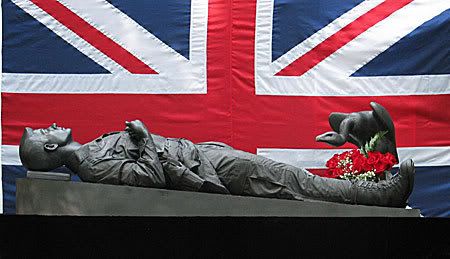
Prince Harry Sculpture

American sculptor Daniel Edwards, known for his controversial works depicting Britney Spears giving birth and Paris Hilton undergoing an autopsy, includes a Bible in his latest sculpture. Iraq War Memorial: Death of Prince Harry depicts the prince with his head resting on a Bible. The iconic value of the book is strong here, as this is a Bible that cannot be opened, read, studied, or performed, but it is poignantly associated with death and political commentary.


I am curious about the ritual this artist is portraying, and I would appreciate comments on it. Plutarch mentions that Alexander the Great kept a copy of the Iliad beneath his bed when he was on campaign, so there is a long precedent for keeping one's favorite text nearby, but I'd like to know if this is done in funeral or burial rituals. Does any funeral practice (past or present, any culture) really include using scripture in this manner or is this an artistic trope?

Tuesday, August 21, 2007

Instant relics: $1000+ coffee table books

Thanks to Rare Book News for pointing out this Wall Street Journal article which reports that an art book publisher has five new art books on its fall list priced in excess of $1,000. Leading the pack is Super Yacht, $3,950, with "an Italian-silk cover, protected by a clamshell Lucite case, and 648 color pages, which include rare photographs."

Sunday, July 22, 2007

Islamic Art in London (2)


In addition to the article cited in my previous post, the BBC has now published a review of the London exhibit, Spirit and Life, which includes a slide show of seven images from the exhibit, including this page of a blue Qur'an. It adds that "Other texts on display include a single page from a vast Koran whose pages stretch 2m (6.5ft) in height and a scroll the width of a palm with a microscopic text probably painted with a single-haired brush."

Tuesday, July 17, 2007

Chinese to preserve Tibetan books


The Chinese Academy of Social Sciences and the China Tibetology Research Centre is launching a two-year effort to preserve 426 volumes of Buddhist scriptures on palm-leaf manuscripts, dating from the 7th to the 13th centuries C.E. For a short history of the development and impact of palm leaf manuscripts, see Palm Leaf. An impression of the literary and artistic effort that went into creating the vast Tibetan libraries can be gathered from the pictures and introduction to the exhibit, Guardians of the Sacred Word, that was on display in New York in 1996. The difficulties involved in such preservation work are described vividely in the report on similar efforts in Thailand.

The vast majority of the Tibetan libraries and their contents were destroyed during and after the Chinese invasion of Tibet in 1951. This new effort at preserving Tibet's manuscript heritage under Chinese sponsorship seems to be a remarkable policy reversal. I wonder how the Tibetan government in exile feels about this ...

Monday, July 16, 2007

Islamic Art in London

Rare Book News points out the opening of "Spirit and Life," an exhibit of Islamic Art from the Agha Khan Museum collection at the Ismaili Center in London, July 14 through August 31. The displays include "one of the finest illustrated manuscripts ever produced, the Persian epic masterpiece of Shahnameh (The Book of Kings), and an extremely rare copy of the Canon of Medicine of Ibn Sina also known as Avicenna."

Wednesday, June 20, 2007

Books in French presidential portraiture

Thanks to Dan Visal on if:book for reproducing the Times Literary Supplement's one-paragraph historical survey of the use of books in the official portraits of French Presidents. The topic was stimulated by Nicolas Sarkozy's decision to have himself portrayed in a library full of leather-bound volumes (a pose favored also by many American lawyers).

Saturday, May 26, 2007

The Early Christian Book

At last, the papers from the Early Christian Book Conference held at the Catholic University of America in 2002 have been published. Papers that are particularly relevant to early Christian iconic books are Claudia Rapp, "Holy Texts, Holy Men and Holy Scribes: Aspects of Scriptural Holiness in Late Antiquity;" John Lowden, "The Word Made Visible: The Exterior of the Early Christian Book as Visual Argument;" and Caroline Humfress, "Judging by the Book: Christian Codices and Late Antique Legal Culture."