Iconic books are texts revered as objects of power rather than just as words of instruction, information, or insight. In religious and secular rituals around the globe, people carry, show, wave, touch and kiss books and other texts, as well as read them. This blog chronicles such events and activities. (For more about iconic books, see the links to the Iconic Books Project at left.)

Showing posts with label amulets. Show all posts

Monday, November 22, 2021

15th c. gold book pendant


The Smithsonian reports that a metal detector turned up a tiny gold pendant in the shape of an open book in a field near York, England. On its leaves are engraved images of Saints Leonard and Margaret, patron saints of childbirth. the pendant dates from the fifteenth century.

Monday, October 14, 2019

Miniature Books


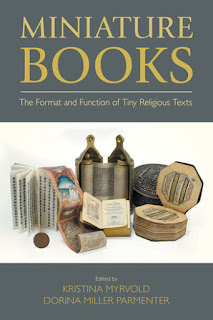
Miniature Books: The Format and Function of Tiny Religious Texts, edited by Kristina Myrvold and Dorina Miller Parmenter, has now been published by Equinox. 
Miniature Books

Miniature books, handwritten or printed books in the smallest format, have fascinated religious people, printers, publishers, collectors, and others through the centuries because of their unique physical features, and continue to captivate people today. The small lettering and the delicate pages, binding, and covers highlight the material form of texts and invite sensory engagement and appreciation. This volume addresses miniature books with a special focus on religious books in Jewish, Christian, Muslim, Hindu and Buddhist traditions. The book presents various empirical contexts for how the smallest books have been produced, distributed, and used in different times and cultures and also provides theoretical re ections and comments that discuss the divergent formats and functions of books.

Contents
Religious Miniature Books: Introduction and Overview
– Kristina Myrvold, Dorina Miller Parmenter
1. Ritualizing the Size of Books – James W. Watts
2. On the Functions of Miniaturizing Books in Jewish Religion
– Marianne Schleicher
3. Words in a Nutshell: Miniaturizing Texts in Early Modern England
– Lucy Razzall
4. Small Things of Greatest Consequence: Miniature Bibles in America
– Dorina Miller Parmenter
5. Diminutive Divination and the Implications of Scale: A Miniature Quranic Falnama
of the Safavid Period – Heather Coffey
6. Mite Qurans for Indian Markets: David Bryce in the Late Nineteenth and Early
Twentieth Century – Kristina Myrvold
7. Miniature Qurans in the First World War: Religious Comforts for Indian Muslim
Soldiers – Kristina Myrvold, Andreas Johansson
8. Size Matters! Miniature Mushafs and the Landscape of Affordances
– Jonas Svensson
9. Gitamahatmya! Paratexts in Miniature Bhagavad Gitas with Special Reference to
Pictures and Gender – Jon Skarpeid
10. Sutras Working in Buddha’s Belly and Buddhists’ Pockets: Miniature Sutras in
Korean Buddhism – Yohan Yoo, Woncheol Yun
Index


Tuesday, November 6, 2018

Sensing Sacred Texts


The 2017 special edition in Postscripts has now been published as an independent volume, Sensing Sacred Texts, ed. J. W. Watts; Sheffield: Equinox, 2018:

All the human senses become engaged in ritualizing sacred texts. These essays focus especially on ritualizing the iconic dimension of texts through the senses of sight, touch, kiss, and taste, both directly and in the imagination.

Ritualized display of books engages the sense of sight very differently than does reading. Touching gets associated with reading scriptures, but touching also enables using the scripture as an amulet. Eating and consuming texts is a ubiquitous analogy for internalizing the contents of texts by reading and memorization.

The idea of textual consumption reflects a widespread tendency to equate humans and written texts by their interiority and exteriority: books and people both have material bodies, yet both seem to contain immaterial ideas. Books thus physically incarnate cultural and religious values, doctrines, beliefs, and ideas.

These essays bring theories of comparative scriptures and affect theory to bear on the topic as well as rich ethnographic descriptions of scriptural practices with Jewish, Sikh, Muslim, Christian, Buddhist and modern art and historical accounts of changing practices with sacred texts in ancient and medieval China and Korea, and in ancient Middle Eastern and Mediterranean cultures.

Friday, September 23, 2011

Arguing over digital texts

In July, James Glieck writing in the New York Times Sunday Review, meditated on the digitization and web publication of rare manuscripts and books by libraries around the world. He celebrated the advantages of open access for historical research and derides critics of digitization such as Tristam Handy, who wrote in the Guardian that "it is only with MS in hand that the real meaning of the text becomes apparent: its rhythms and cadences, the relationship of image to word, the passion of the argument or cold logic of the case." Glieck responded:

I think it’s sentimentalism, and even fetishization. It’s related to the fancy that what one loves about books is the grain of paper and the scent of glue. ... We’re in the habit of associating value with scarcity, but the digital world unlinks them. ... Nor is obscurity a virtue. A hidden parchment page enters the light when it molts into a digital simulacrum. It was never the parchment that mattered.
Glieck did notice that desire for the material book, at least rare books and texts, continues unabated which he finds "odd":
Oddly, for collectors of antiquities, the pricing of informational relics seems undiminished by cheap reproduction — maybe just the opposite. ... Why is this tattered parchment valuable? Magical thinking. It is a talisman. The precious item is a trick of the eye. The real Magna Carta, the great charter of human rights and liberty, is available free online, where it is safely preserved. It cannot be lost or destroyed. An object like this — a talisman — is like the coffin at a funeral. It deserves to be honored, but the soul has moved on.
The label "magic" is the oldest (really: thousands of years old) put-down of scribal culture. This blog concurs with recent scholarship on magic that such polemics obscure transactions of real social power, whether in the form of magical objects or material (or, for that matter, digital) texts. We should therefore remember that a digital text, after all, is composed of matter too. It can certainly be destroyed (rather easily, in fact), and even all the copies of a text can disappear (less easily, but very likely as years turn into decades and centuries). When that happens, I doubt its soul will be any easier to find that those in human bodies.

Wednesday, September 16, 2009

Miniatures too small to read


Julia O'Brien blogs about seeing the exhibit of miniature books at Baltimore's Walters Art Museum.

There were small mosaics, small sculptures, small shipping guides, but mostly small religious texts. Small Psalters. Small Qurans. And small Bibles.

Some of these miniatures were functional, actually used by readers even before the days of bifocals. They allowed people to have words that were portable and private-- pocket editions.

But many were clearly too small to be read. It's hard to imagine how they were even produced. These texts weren't reading material; they functioned atropaically--as amulets , talismans, good luck pieces. These Bibles were owned, touched, tucked away, treasured. But not read. The idea of the Bible mattered more than its content
.

Indeed! But the fact that more texts than just the Bible get subjected to such miniaturization shows that the iconic potential of books is not limited to scriptures, though they provide the most extreme examples.

Tuesday, May 5, 2009

Matching Bible & Purse


Tyndale House Publishers is marketing this "Veritas Journey Bible and Purse." The marketing copy states:

Introducing Veritas, the fashionable and smart new solution for women who crave something different. The Bible goes where they go with these stylish, full-size purses complete with a coordinating compact New Living Translation tucked away in its very own easy-to-access compartment. Veritas gives fashion-savvy women the freedom to conveniently and comfortably carry the Truth with them everywhere, every day.

Julia O'Brien, who drew my attention to this, comments:

For many, religious symbols and words are chosen for how they look and feel, rather than what the words themselves say. As in the illuminated Bibles of the past, words become art. Biblical texts have the additional benefit of feeling ancient and serious and important. It does something for people even when they don't read it.

Which is what keeps the Iconic Books Project in business!

Wednesday, March 19, 2008

Shema on Golden Amulet

Ha'aretz reports that Austrian archeologists found a 3rd century C.E. silver pendant containing a golden scroll. Engraved on the scroll is the Shema (Deuteronomy 6:4) in Hebrew but transliterated in Greek letters: "suma Istrahl adwne elwh adawt n a" with alpha, the first letter in the Greek alphabet used as the numeral one substituting at the end for the Hebrew word echad "one." The pendent had been buried with a two-year old boy in a Roman graveyard at Halbturn. Its discovery provides evidence for Jewish migration to the area in this period or earlier.

Sunday, March 16, 2008

Watts, "Three Dimensions of Scriptures"

Failure to consider scriptures’ function as icons has left modern scholars of religion nonplussed by the continuing power and influence of scriptures in twenty-first century culture. In “The Three Dimensions of Scriptures,” Postscripts 2 (2006) 135-159, I build on Dori’s work by asking how the iconic nature of scriptures interacts with their other aspects. I argue that all texts function in three dimensions: iconic, performative and semantic. What distinguishes scriptures from other texts is that religious communities ritualize all three dimensions to a lesser or greater extent. Through ritual, scriptures’ dimensions convey different kinds of social power—the iconic dimension of scriptures conveys legitimacy, the performative dimension conveys inspiration, and the semantic dimension conveys authority. “The explanatory value of recognizing the three dimensions of scriptures does not depend on them being ritualized to the same degree in all times and places: they are not. It rather helps explain the religious tendency towards ritualizing scriptures in all three dimensions. It also provides a means for explaining the social effects of doing so” (p. 148).

The full article in .pdf is available here from Equinox publishing. It was reprinted in Iconic Books and Texts (ed. J. W. Watts; London: Equinox, 2013), 9-32. A pre-print repository version is available here from Syracuse University.

Malley, "Bible in British Folklore"

Brian Malley, in “The Bible in British Folklore,” Postscripts 2 (2006) 241-272, marshals a great deal of archival evidence for the magical use of Bibles in early-modern Britain. He concludes that “the British laity seem to have exploited the Bible as text and artifact in rather different ways than ecclesiastical Christianity.”

The evidence shows that (1) in contrast to the church’s emphasis on the Bible’s meaning, the laity exploited the Bible’s textual and artifactual properties as supernatural means to practical ends; (2) charmers made use of particular biblical (or taken-for-biblical) texts, whereas the Bible generally was used in exorcisms, which seem to have remained the purview of clergy; (3) lay traditions about the Bible seem to have been focused on specific issues, though a general uncertainty about what powers Bibles might have is also indicated. (p. 241)

The full article is available in .pdf from Equinox publishing.

Friday, January 18, 2008

Bullet in My Breast Pocket

From the early standup of Woody Allen:

Years ago, my mother gave me a bullet...a bullet, and I put it in my breast pocket. Two years after that, I was walking down the street, when a berserk evangelist heaved a Gideon bible out a hotel room window, hitting me in the chest. Bible would have gone through my heart if it wasn't for the bullet.

For contemporary manifestations of the Bible/bullet scenario, see Cordell's previous post.

Monday, November 19, 2007

Scriptures As Artifacts at SBL meeting

The Iconic Books Project is not the only research effort on this subject. The Scripture as Artifact Consultation, chaired by Brian Malley, showcased the work of eleven scholars at the annual meeting of the Society of Biblical Literature in San Diego.

The session on Saturday, November 17th, focused on “the late medieval period to the present.”
     Marianne Schleicher (Aarhus University) described her research on the relationship between ritual uses and displays of Torah scrolls and the interpretation of Torah in a Dutch Jewish congregation (paper title: “Transitions between Artifactual and Hermeneutical Use of Scripture”).
     Miriam Levering (U. Tennessee, Knoxville) surveyed artifactual/iconic uses of texts in Buddhist traditions before focusing in particular on Zen schools. She noted the irony that medieval Zen traditions generally downplayed the role of scriptures in comparison with other Buddhist schools, but then proceeded to produce a flood of texts that seem to function as scriptures nevertheless (paper title: “Scripture as Artifact: A Comparative Perspective”).
     Unfortunately, I had to miss the remaining papers in Saturday’s session. They were “Curbing Phantasm: The Bible Moralisée” by Eva Maria Raepple (College of DuPage), “The Danish Hymnbook: Artifact and Text” by Kirsten Nielsen (Aarhus University), and “Some Biblical Artifacts in Search of a Sociological Theory” by David Chalcraft (University of Derby). [But see Dori's comment below for a summary of these last two papers.]

Though the session on Sunday, November 18th, focused on “the ancient and early medieval world,” Brian Malley began with a theoretical paper on the relationship between the artifactual use and semantic meaning of scriptures. Starting with a standard model in communications theory, he argued that artifactual uses, rather than being a small and insignificant aspect of scriptural usage, actually impact virtually all uses of the text (paper title: “Text, Artifact and Meanings”).
     The next four papers all described various kinds of ancient evidence for the artifactual uses of scriptural texts. Larry Hurtado (University of Edinburgh) presented the manuscript evidence for the distinctive forms and uses of early Christian scriptures (2nd-3rd centuries C.E.). Christians’ preference for binding their scriptures (OT and NT) in codex (book) form, rather than as scrolls, their use of distinctive abbreviations (nomina sacra) for the names and titles of God and Jesus, and their employment of reader’s aids in manuscripts intended for public reading all distinguish their material culture from its Greco-Roman context (paper title: “Early Christian Manuscripts of Biblical Texts as Artifacts”).
     Stephen Reed (Jamestown College) surveyed the contents and textual form of the Dead Sea Scroll texts used for ancient Jewish phylacteries (tefillin) and mezuzot. He noted that they differ from other biblical scrolls from Qumran not only in their contents ( fairly standardized excerpts from Exodus and Deuteronomy) but also in the condition of their materials (the texts in tefillin were often written on tattered scraps of leather) and their very small, run-together letters that show they were clearly not meant to be read but manipulated ritually (paper title: “Physical and Visual Features of Dead Sea Scriptural Texts”).
     Eduard Iricinschi (Princeton University) described the heavy use and dependence of the ancient Manicheans on the texts written by their founder Mani/Manus. Their texts served to spread the faith rapidly in the Sassanian and Roman empires of the third century and following, but also became a principal target of imperial efforts (in the long run, successful) to suppress the religion (paper title: “ ‘A Thousand Books will be Saved’: Manichean Manuscripts and Religious Propaganda in the Roman Empire”).
     Thomas J. Kraus (Willibald Gluck Gymnasium) investigated the nature and function of Byzantine armbands with medallions that cite the opening verse of Psalm 91 (Ps 90 in the Greek translation) along with others depicting the Madonna and child. He charted the popularity of the talismanic use of Greek Ps 90 in Byzantine Christian culture to explain its prominence in cryptic form on these artifacts (paper title: “ ‘He that Dwelleth in the Help of the Highest’: Septuagint Psalm 90 and the Iconographic Program on Byzantine Armbands”).
     Dori Parmenter (Syracuse University, co-director of the Iconic Books Project) concluded the session with a broader survey of myths of heavenly books and their impact on early and medieval Christian beliefs. She demonstrated that Christians were influenced by ancient Near Eastern and, especially, Jewish ideas of pre-existent heavenly scriptures and “books of life,” but they conceived the heavenly equivalent of Gospel books to be Christ himself as the Word of God. This equivalence between book and Christ appears prominently in ancient and medieval Christian art and provides the ideological underpinning for the liturgical reverence shown Gospel books (paper title: “The Bible as Icon: Myths of the Divine Origins of Scripture”).

Tuesday, November 6, 2007

Aleppo Codex as Talisman

A report in today's Haaretz illustrates why experts in scriptures' textual dimension (that is, scholars) frequently find veneration of its iconic dimension more than a little problematic:

An eight-centimeter-square piece of the 1087-year-old Aleppo Codex will be given to a representative of the Ben Zvi Institute in Jerusalem on Thursday, following 18 years during which Israeli scholars tried to retrieve it from businessman Sam Sabbagh.

Sabbagh salvaged the fragment from a burning synagogue in Aleppo, Syria in 1947.

Inscribed on both sides, it is one of the lost fragments of the codex, a copy of the Bible written in 920 C.E. in Tiberias by the scribe Shlomo Ben Buya'a. The fragment Sabbagh had bears verses of Exodus chapter 8, including the words of Moses to Pharaoh: "Let my people go, that they may serve me..."

Sabbagh believed the small piece of parchment was his good luck charm for six decades. He was convinced that thanks to the parchment, which he kept with him always in a transparent plastic container, he had been saved from riots in his hometown of Aleppo during Israel's War of Independence, and he had managed to immigrate from Syria to the United States in 1968 and start a new life in Brooklyn and make a living. The charm was with him when he underwent complicated surgery.

Just two years ago, it completed its task, when Sabbagh passed away.

Of course, the scholars' interest is not just textual, since this fragment is very unlikely to influence anyone's interpretation of Exodus 8. The value to scholars in the codex's reunification derives from, among other things, the public reinforcement of the view that texts are best kept intact. This position serves the purposes of contextual interpretation of semantic meaning, of course, but it also concentrates the legitimacy conveyed by their iconic status in the one person or institution that owns them and can display them. Fragmentation of texts for talismanic purposes serves conversely to distribute more broadly their iconic prestige.

December 3, 2007: Now Haaretz reports that:

Scholars at Yad Ben-Zvi research institute in Jerusalem have called on Jews around the world who originally come from Aleppo, Syria and may possess fragments of the ancient Aleppo Codex to turn them over to Israel.

... "This is the No. 1 asset of the Jewish people," Dr. Zvi Zameret, head of Yad Ben-Zvi said, "and I believe the Jewish people would do a great deal to have it back."

This last quotation illustrates perfectly a typical conflict over iconic texts which pits the interests of a reified collective (in this case, "the Jewish people") represented by scholars against the interests of individuals (the Jews from Aleppo). For the collective, the iconic text serves purposes of legitimation ("the No. 1 asset of the Jewish people"). For individuals, a scrap of text provide a sense of prestige or empowerment (the "good luck charm" of the previous story).


September 27, 2008: The Associated Press picks up the story. Again, note the clear distinction and very different value judgments made on individual interests vis-a-vis the collective's interests:
Some people might be superstitious about the fragments they hold, or believe they are rightfully the property of Aleppo Jews, not of scholars. Others might simply have no idea of the value of what they own. ...

The manuscript doesn't contain passages missing from other versions. Instead, its accuracy is a matter of details like vowel signs and single letters that would only slightly alter pronunciation. But Judaism sanctifies each tiny calligraphic flourish in the Bible as a way of ensuring that communities around the world use precisely the same version of the divine book. That's why the Codex is considered by some to be the most important Jewish text in existence, and why the missing pieces are so coveted.

Friday, October 12, 2007

Prince Harry Sculpture

American sculptor Daniel Edwards, known for his controversial works depicting Britney Spears giving birth and Paris Hilton undergoing an autopsy, includes a Bible in his latest sculpture. Iraq War Memorial: Death of Prince Harry depicts the prince with his head resting on a Bible. The iconic value of the book is strong here, as this is a Bible that cannot be opened, read, studied, or performed, but it is poignantly associated with death and political commentary.


I am curious about the ritual this artist is portraying, and I would appreciate comments on it. Plutarch mentions that Alexander the Great kept a copy of the Iliad beneath his bed when he was on campaign, so there is a long precedent for keeping one's favorite text nearby, but I'd like to know if this is done in funeral or burial rituals. Does any funeral practice (past or present, any culture) really include using scripture in this manner or is this an artistic trope?

Sunday, August 19, 2007

Bulletproof Bible

One of the traits often attributed to the Bible is the ability to stop a bullet and save a soldier's life. An About.com Internet site documenting urban legends offers quotations reporting this legend at least as far back as 1841 (with one quotation claiming Oliver Cromwell knew about it!), and the latest war continues the tradition. According to a Buffalo, New York, television news broadcast, US Army PFC (Private First Class) Brendan Schweigart's Bible protected him from a ricocheting bullet:
It's the personal story of a Southern Tier soldier who can tell you the Word of God literally saved his life in Iraq! Army PFC Brendan Schweigart tells News 4's Ellen Maxwell how his personal bible stopped a bullet that would have killed him.

[. . .]

"They were cleaning the wound, you know, working on me, and then I for some reason just asked for my bible."

When the 22 year old was handed his bible, he realized the sniper's bullet had stopped there.

[. . .]
More skeptical readers might also be interested in Episode 16 of Season 2 of the cable television show Mythbusters, in which the hosts test the myth by seeing whether or not a book can stop a bullet. (For the most part, it can't.)

Friday, June 1, 2007

Tiny books

Books seem to lend themselves to experiments in miniaturization--and in marketing. LabNewsOnline reports that Canadian physicists have created a 0.07 x 0.10 mm book with thirty silicon chip pages and letters 40 nanometers high (cost per copy: £10,000). Unlike this case, miniature books frequently take the form of scriptures. WNG-GraphiLux markets several scriptures, each inscribed in its entirety on the surface of a single crystal. Available and marketed separately are the entire Greek Bible, the Qur'an in Arabic, and Bhagavad Gita in Sanskrit, which are sold in pendants and other jewelry. The popularity of scriptures as amulets has long fueled the production of tiny scriptures. Miniature Bibles and Qur'ans are now widely marketed on the internet.

Monday, May 28, 2007

KJV USB Flash Bible


It seems inevitable that the latest technologies are put into service for proliferating the text of a sacred book, but those of us interested in the iconic aspect of the Bible should find this USB flash drive version of the KJV Bible interesting. That it looks like a Bible ought to look is an important selling point: according to one sales pitch, it has a "High quality leather look and feel with gold detail and chain."

Sunday, May 27, 2007

Scripture as Talisman, Specimen, and Dragoman

"Scripture as Talisman, Specimen, and Dragoman" is the title of Dr. Edwin Yamauchi's Presidential Address to the Evangelical Theological Society on November 16, 2006. Dr. Yamauchi's address now appears in the latest issue of the conservative Journal of the Evangelical Theological Society 50/3 (March 2007): 3-30. Dr. Yamauchi, an internationally known scholar of the ancient Mediterranean, maintains a long-standing research interest in the uses (and abuses) of Scriptures for magical purposes in the ancient world. Yamauchi highlights several case examples of how the Bible was used as a magical talisman for "prophylactic purposes," and discusses some cultural consequences of this functional purpose. The author also considers how the Bible functions as a "specimen" for scholars, where the text is of interest only for academic criticism and analysis, and notes additional consequences of this function. Finally, Yamauchi argues that the Bible functions as a "dragoman," a word the author adopts to suggest that the Bible acts as an "interpreter" in the way that a diplomat from the Ottoman Empire would interpret the ruler's decrees. Scholars of iconic books will likely find the "Talisman" portion of Dr. Yamauchi's article to be of the most use, as it is the only section where the author explicitly considers material aspects of the Bible, although even here Yamauchi's focus is more on material configurations of the content of the Bible and less on magical uses of the Book itself.