Iconic books are texts revered as objects of power rather than just as words of instruction, information, or insight. In religious and secular rituals around the globe, people carry, show, wave, touch and kiss books and other texts, as well as read them. This blog chronicles such events and activities. (For more about iconic books, see the links to the Iconic Books Project at left.)

Showing posts with label preservation. Show all posts

Tuesday, June 9, 2026

Family libraries and bookbinders in Harar, Ethiopia

This blog has discussed many times the role of private family book collections in preserving the cultural heritage of Timbuktu (see here, here, here, here, and here) and also in Haiti (see here). 

Now we can add another example: Al Jazeera has profiled the work of a bookbinder and collector in Harar, which is now in Christian Ethiopia but was capital of a separate Muslim sultanate until the late nineteenth century. 

After years of painstaking searches going from household to household, [Abdallah Ali Sherif] collected enough items to open Ethiopia’s first private museum, Abdallah Sherif Museum, 14 years ago in the hope of reconnecting Harar’s people with their history. The collection of hundreds of old manuscripts has become a particular passion.

“Each book I find, it feels like I am peeking through a window into a beautiful and rich culture that was almost forgotten,” he says.

To preserve these manuscripts, Sherif has also revitalised the ancient tradition of bookbinding. By tracing the last Hararis with knowledge of this art form, he has brought a once-extinct practice back to life. 

The production of manuscripts – as a way of sharing and safeguarding religious knowledge – was an important aspect of Harar’s culture, says Nuraddin Aman, an assistant professor of philology at Addis Ababa University.

Manuscript making is believed to have emerged in the city in the 13th century ... Some Qurans found in Harar use a unique cursive calligraphic script said to have been developed in India’s northern Bihar region at about the 14th century and rarely seen outside India.

Manuscript makers developed their own style that merged local creativity and outside influences.

Within families, manuscripts were considered sacred heirlooms passed down through generations. Each Harari house had at least two or three manuscripts – often, the Quran, Hadiths, or other religious texts. ... Harar also grew into a centre for bookbinding with artisans making leather covers to protect manuscripts, and people travelling to the city to learn the craft.

Saturday, June 21, 2014

Torah to the Moon

The Washington Post reports plans to send a Torah scroll to the moon. "The Torah on the Moon project, based in Tel Aviv, has been courting private firms to deliver a handwritten Jewish scroll called a sefer Torah to the lunar surface. Later flights would carry Hindu scriptures called the Veda and the I Ching, an ancient Chinese philosophical work. Each document would be housed in a capsule designed to protect it from the moon’s harsh radiation and temperature changes for at least 10,000 years." The Post article concludes by noting, "The texts would join a Bible left on the moon in 1971 by Apollo 15 commander David Scott. The red leather Bible sits on the control console of an Apollo moon buggy."

Wednesday, April 25, 2012

Off-site storage debate at NYPL

The Chronicle of Higher Education today reports on a debate at the New York Public Library over Off-site Storage. The Library is considering sending many more of its volumes to Recap, a storage facility run by Columbia, Princeton and the NYPL in New Jersey.
The library promises that materials sent to Recap will be safely stored and quickly accessible—usually within 24 hours—to patrons who request them. Critics say that remote storage doesn't work so well in practice, and that the wrong message is sent by taking books out of the heart of the librar.
This is a familiar debate which played out on my campus at Syracuse University two years ago. The rest of the Chronicle article, however, reads like an advertizement for off-site storage. It presents the objections and counters them, point by point, continuing a unfortunate trend at this newspaper to displace news with advocacy.

Monday, April 9, 2012

Franzen's fear of e-books

Jonathan Franzen made headlines in January by announcing the he fears the effects of e-books. The acclaimed author of the novels, Freedom and The Corrections, both available as e-books, lamented digital texts' lack of permanence:

I think, for serious readers, a sense of permanence has always been part of the experience. Everything else in your life is fluid, but here is this text that doesn’t change.
“Will there still be readers 50 years from now who feel that way? Who have that hunger for something permanent and unalterable? I don’t have a crystal ball.
“But I do fear that it’s going to be very hard to make the world work if there’s no permanence like that. That kind of radical contingency is not compatible with a system of justice or responsible self-government.”

This blog has frequently documented the desire for the preservation  of cultures and values in the form of material books.

Tuesday, December 27, 2011

Heritage Librarians as "Ambassadors of the Book"

The University of Antwerp will host an international library conference on February 1-2, 2012, on the theme "Ambassadors of the book: Competences for heritage librarians." The conference website explains the goal:
It seems trivial, these days, to state that libraries have been challenged by recent technological, social and economic developments. On the other hand, these developments have not minimized the library’s mission as a memory institution, quite the contrary. Among the many roles that libraries will continue to play in the 21st century and beyond, their responsibility for the preservation of the written heritage is perhaps the one that is questioned least.
I am less optimistic that preservation remains widely acknowledged as a core service of libraries. Rhetoric about accessibility and digitization dominates discussions I've heard and read much more than memory preservation does. I think the organizers are right, though, that preservation remains the chief cultural role of libraries, especially research libraries. It is the one that corporate interests are least likely to replace.

Tuesday, December 20, 2011

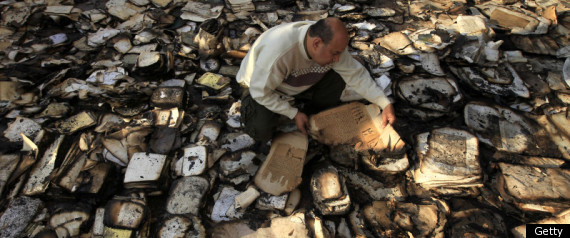
Thousands of rare books go up in flames in Cairo


Huffington Post has reported today that the "Institute d'Egypte, a research center set up by Napoleon Bonaparte during France's invasion in the late 18th century, caught fire during clashes between protesters and Egypt's military over the weekend. It was home to a treasure trove of writings, most notably the handwritten 24-volume Description de l'Egypte, which began during the 1798-1801 French occupation."

Thousands of volumes have been damaged, and many are burned beyond recovery. "This is equal to the burning of Galileo's books," Zein Abdel-Hady, who runs the country's main library, said.

The full Huffington Post article can be accessed here.

Saturday, September 24, 2011

Creating Relics of Endangered Alphabets

Tim Brookes has been documenting the world's alphabetic heritage by carving specimens on local curly maple in his Endangered Alphabets Project. The website explains his motivation:
Every one of the Endangered Alphabets (Inuktitut, Baybayin, Manchu, Bugis, Bassa Vah, Cherokee, Samaritan, Mandaic, Syriac, Khmer, Pahauh Hmong, Balinese, Tifinagh and Nom), carved and painted into a slab of Vermont curly maple, challenges our assumptions about language, about beauty, about the fascinating interplay between function and grace that takes place when we invent symbols for the sounds we speak, and when we put a word on a page—or a piece of bamboo, or a palm leaf.

The text in each case is Article One of the Universal Declaration of Human Rights. Brookes chose these alphabets because:
Writing has become so dominated by a small number of global cultures that those 6,000-7,000 languages are written in fewer than 100 alphabets. Moreover, at least a third of the world’s remaining alphabets are endangered–-no longer taught in schools, no longer used for commerce or government, understood only by a few elders, restricted to a few monasteries or used only in ceremonial documents, magic spells, or secret love letters.

The Atlantic, in describing his work, commented: "Letters in carved wood filled with black enamel paint ... make everything sharper and convey something of the awe of ancient inscriptions." Brookes art should certainly serve the purpose of relics, which is to contain and preserve things of great value, in this case, alphabets.

(h/t Fine Books and Collections)


The burden of saving a book collection

In June, numerous media outlets (e.g. 1, 2) reported on the problems of Shaunna Raycraft of Saskatoon. She saved a collection of 350,000 books when a neighbor threatened to burn them. She and her husband brought a small house onto their property to store the books, but the weight of 30 tons of books threatened to collapse the building.
Raycraft tried selling the books on eBay, and to collectors and used book stores, but no one wants the task of sorting through them. ... "We are kind of at a standstill," said Raycraft. "I work at two jobs. My husband is a full-time student. We have three kids and no time. And no money. And so we're at the point now where were looking at having to burn some of the books ourselves."

The news coverage prompted almost twenty people to volunteer to help sort and dispose of the books. I have not found any later reports of how that effort is going.

Internet (Physical) Archive

The Internet Archive was founded in 1996 to build an Internet library to offer permanent access for researchers, historians, and scholars to historical collections that exist in digital format. But this year it announced that it is also creating a physical archive to back-up its digital collection.
A reason to preserve the physical book that has been digitized is that it is the authentic and original version that can be used as a reference in the future. If there is ever a controversy about the digital version, the original can be examined. A seed bank such as the Svalbard Global Seed Vault is seen as an authoritative and safe version of crops we are growing. Saving physical copies of digitized books might at least be seen in a similar light as an authoritative and safe copy that may be called upon in the future.


As the Internet Archive has digitized collections and placed them on our computer disks, we have found that the digital versions have more and more in common with physical versions. The computer hard disks, while holding digital data, are still physical objects. As such we archive them as they retire after their 3-5 year lifetime. Similarly, we also archive microfilm, which was a previous generation’s access format. So hard drives are just another physical format that stores information. This connection showed us that physical archiving is still an important function in a digital era.
They are therefore creating a facility that can accomodate up to ten million items in long term storage.

They are accepting donations of large collections and libraries. Their comments about the donors feelings are pertinent to this blog:
Working with donors of books has been rewarding because an alternative for many of these books was the used book market or being destroyed. We have found everyone involved has a visceral repulsion to destroying books.

Friday, March 18, 2011

Burying Iconic Books

The University of Chicago's Martin Marty Center is showcasing Max Moerman's essay, "The Death of the Dharma: Buddhist Sutra Burials in Early Medieval Japan" on its Religion and Culture Web Forum this month. The essay originally appeared in The Death of Sacred Texts, edited by Kristina Myrvold.

I was asked to write a short response to Moerman's essay. It concludes:

... Book and text rituals, which include their public performance and interpretation as well as their physical display and manipulation, serve to focus the attention of communities on enduring values. They cherish texts that contain those values as material representations of them, as relics of their faith. Anxiety about the future fuels efforts to reproduce and preserve those texts, so that they become material guarantors of cultural and religious persistence and, in Moerman's words, “a rhetorical center around which other personal, familial, and political anxieties converge” (p. 86).

Find the rest of it, as well as two other responses, here.

Monday, March 29, 2010

The Digital Publishing Future?

Jason Epstein imagines the digital future of publishing in the New York Review of Books. His stream-of-consciousness-like invocation of the digital future is "a predictable inference from digitization in its current stage of development." His occasional mention of the surprising and unpredictable nature of technological developments do not slow his imagination, though they do introduce some commendable notes of caution.

Despite the all-digital-all-the-time form of Epstein's vision, he argues that physical books will remain necessary.
Digital content is fragile. The secure retention, therefore, of physical books safe from electronic meddlers, predators, and the hazards of electronic storage is essential. ... actual books printed and bound will continue to be the irreplaceable repository of our collective wisdom.
His business model of decentralized digital publishing does not, however, explain how that will be financed.

At the end, he points to his stacks of books to show his allegiance to the material tome. But his entire piece emphasizes "the inevitability of digitization as an unimaginably powerful, but infinitely fragile, enhancement of the worldwide literacy on which we all—readers and nonreaders—depend."

But considering how unpredictable the short history of textual digitization has already been, who can say whether and in what regard he is right?

Tuesday, February 23, 2010

Money for Preserving Books

Evidence in support of my contention that our culture still values libraries for preserving the culture comes now in the form of two major gifts for precisely this purposes. Fine Books & Collections reports that the University of Pennsylvania's Rare Book & Manuscript Library has received $4.25 million towards renovations of the library that will include "a fully equipped and staffed conservation suite [that] will ensure continued effective stewardship of Penn's rare book and manuscript collection." Meanwhile, Mount Vernon has received $38 million to construct a George Washington Library at Mount Vernon.

Saturday, February 20, 2010

Why Books Matter

(The news that a New England prep school has dismantled its entire library to replace it with computers and e-readers keeps the idea of "bookless libraries" in the news. Since the headmaster's rationale cites SU's Dean of Libraries, Suzanne Thorin, I'm posting here a piece I wrote last November when the controversy first hit Syracuse University.)

Worries about the future of books hit home recently on the campus where I work. The university library announced plans to dispose of some materials and move many more books to a commercial storage facility across the state in order to free space in the stacks for new acquisitions. These plans came soon after renovations transformed two of the library’s seven floors from book stacks into a coffee shop, a computer commons, “collaborative learning spaces” (i.e. tables with chairs), and classrooms. So the announcement of deacquisition and off-site storage plans prompted an uproar among humanities faculty members and students, producing 113 faculty signatures (including mine) on two letters of protest. Faculty in the sciences and social sciences soon circulated their own protest letters in solidarity with the humanists’ initiatives. A student petition against the plan garnered more than 1000 signatures. All demanded greater consultation and collaboration in developing library collections and policies. The library responded with its own letters and policy papers, claiming that it has always sought input, especially from faculty.

Beyond the argument over input on library practices, however, the dueling documents reveal a conceptual gap between the library’s administration and the protestors. Comparing the professors’ letters and the librarians’ policy papers shows that their subjects are completely different. The library’s policies focus on “information”—how and by whom it is accessed, distributed, analyzed and used. The faculty’s letters almost never mention that word; only the social scientists use it at all. The letters focus instead on the importance of reading physical books and documents, browsing stacks and viewing fold-out charts and maps. The library letters emphasize collaborative learning while the professors focus on the needs of solitary researchers. The library invokes utility while the faculty worry about recruitment and institutional prestige. The different subjects of the dueling documents show that this dispute involves very different ideas about books.

The whole affair could be dismissed as one more academic tempest in a teapot were it not for the much wider debates over the role of libraries on college campuses, over the state of book publishing and marketing, and, of course, over the future of books themselves. Like most long-standing social institutions, libraries are more than just mechanisms for providing particular services. They symbolize a cultural ideal. But libraries exemplify that ideal only by virtue of the books they house. Questions about the roles of libraries are, at bottom, questions about the significance of books.

Missing in this debate has been any exploration of the values that modern societies invest in books. As it happens, my university also hosts an interdisciplinary research program aimed at documenting and analyzing precisely this question across history and diverse cultures. I am co-founder of the Iconic Books Project, and so have followed the library debate with particular interest. It has prompted me to imagine how an iconic books perspective can help us understand the values attached to browsing stacks, material books, and library architecture.

The Importance of Browsing

Complaints against both digitized texts and off-site storage of library books frequently evoke the experience of browsing library shelves. Faculty members report the benefit of getting an overview of an entire subject contained in a collection. They repeat stories of finding just what they were looking for in the book next to the one they came into the stacks to collect. They celebrate how browsing stacks can produce random juxtapositions that neither cataloguing systems nor their own research plans anticipate, yet which provide the key to resolving their problem or to setting their research onto a new and more productive path. For them, this kind of browsing is not possible with either a catalog or an internet “browser” because its success depends on the physical juxtaposition of books on a shelf.

The open-stack library that makes browsing possible manifests an old idea. The notion that the contents of texts should be randomly accessible has slowly grown in strength over three thousand years. It decisively shapes the physical forms of books as well as libraries.

Ancient Egyptian and Mesopotamian libraries were owned by temples and royal courts who strictly limited access to their priests and officials. When new religions made knowledge of their sacred texts public instead of keeping them secret, public reading and interpretation became a standard element in Jewish, Christian and Muslim worship. At first, the books were scrolls whose pages were sewn together edge to edge. Scrolls must be read sequentially, either the whole text at once or sections over a series of sessions. In synagogue services, Torah scrolls are still read sequentially over a year. The scroll form makes it hard to compare different parts of the same book, and it cannot be opened randomly.

Ancient Christians adopted a different technology for their sacred books, one that binds together sheets of parchment or paper on a single edge. This is called a codex and is the form that almost all books take today. The codex allows you to skip from one part of the book to another easily, to compare different sections, to read in any order that you want, and even to read randomly by letting the book fall open. People of various religious traditions still use random access to divine in scriptures a message appropriate to their circumstances.

The public library movement of the nineteenth and twentieth centuries made volumes of literature and information much more widely available, often in the form of open stacks libraries that allow the public to browse the shelves. Open stacks multiply the advantages of codex technology. You can access as many volumes as you can lay your hands on in any way you wish, including randomly. Open stacks represent the reader’s complete control over the physical process and sequence of reading. Refusing such access by storing volumes off-site or on-line feels like imposing the textual strait-jacket of a scroll on readers who have become used to the freedom of a codex.

Attention to the physical form of texts reminds us that reading is an embodied practice. You must hold a book physically, brace it with your hands or put in on a table, position your body in certain ways and, of course, focus your eyes in order to read. Working on computers or e-readers requires different physical activities that have provided much fodder to debates about e-books.

But here I want to point out that visiting a library is also an embodied practice. Walking into the building, navigating the stacks, sitting in carrels to study your finds, and checking out and carrying away the most promising books comprise physical routines that have long characterized the scholar’s lifestyle. The convenience of electronic texts and computerized catalog searches that deliver texts to you is offset by constricting the physical scope of your research activities to your own desk and computer. This loss may be felt especially keenly by faculty and students in the humanities whose research already tends to be the most individualistic of all the disciplines in the university and, therefore, the most isolating. For them, trips to the library have traditionally provided a physical research activity that many are sorry to see go.

Material Books and the Desire for Textual Permanence

Books represent more, however, than just the reader’s control over the reading process. They are powerful cultural symbols. Books matter because they are material manifestations of our culture’s ideals: educational ideals, political ideals, philosophical ideals, and religious ideals. They represent our best hopes for ourselves. But ideals can be hard to remember, much less live by. Books seem to preserve our values in physical objects. They are material manifestations of whatever we hold most dear. And when we struggle to know what that is, we can read books to remember what we’ve forgotten.

To a great degree, therefore, the cultural significance of books involves old knowledge. They represent our desire for old knowledge even while publishing new information. The publishing business, of course, wants new products to sell. Professors, especially those in the humanities, want to write and sell books. Research universities require them to do so. As a result, more books are published every year than the year before, and research libraries find themselves losing ground and floor-space in the effort to keep up. But unlike chain bookstores, libraries owe their cultural prestige to their role in preserving old books as much as in acquiring new ones.

Many fields of the humanities as well as qualitative fields in the social sciences promulgate old knowledge preserved in books. Of course, humanists also conduct creative research, use electronic resources and expect the most recent intellectual trends to appear on their library’s shelves. But their teaching tends to be book-centered and many of those books are old. In courses in literature, philosophy, history, and religion, students’ work consists mostly of reading books, often primary texts. Distinguishing primary from secondary sources is a hallmark of humanistic research that emphasizes the importance of reading authors from diverse times and cultures. Many professors in such classes teach book in hand, modeling by their own performance a text-centered way of thinking. Explicit in such performances is the assertion that these old texts still have important things to say to contemporary students. Implicit is the hope that, in this or another book, we may find forgotten wisdom that could benefit us and our society.

Such pedagogies reflect wider cultural commitments. Human cultures tend to vest some material objects with important, even transcendent, meanings. Objects like national flags, religious art, and grave markers evoke powerful emotions and motivate the behavior of very many people, no less today than in the past.

Books also evoke powerful emotions and symbolic connotations. That is most obviously the case for religious scriptures. The Torah, Bible and Qur’an, to name only three, function as icons not only for Jews, Christians and Muslims, but also serve as powerful symbols of those religions within the wider culture. But many other books also exhibit iconic qualities, if not to the same degree. The image of the book (codex) appears in art and other visual media to represent knowledge and learning. It is a conventional prop in the portraits of scholars and writers. Many universities put images of books on their institutional seals.

Material books evoke a semi-sacred sense in many people. They will therefore go to great lengths to avoid destroying them. Librarians, who must dispose of redundant or out-of-date volumes, have told me stories of loading the dumpster at night so as not to be seen. The cultural roots of this antipathy run deep. Memories of cultural loss because of mass book destructions lie at the roots of both Chinese and Western cultures: the first Quin emperor ordered the destruction of most forms of literature in 213 B.C.E, while Roman troops accidentally burned the library of Alexandria in 48 B.C.E. Historians debate the accuracy of both stories, but that has not lessened their cultural significance. Conflict between and within religious traditions has frequently included destroying books and attacking their owners. These were also prominent practices of totalitarian governments and political movements in the twentieth century. As a result, book burning remains one of the most outrageous activities in contemporary culture, closely followed by attempts to ban books from libraries or bookstores.

From a practical point of view, all of this is inexplicable. Books are very common and widely distributed commodities. The destruction of one copy or even many copies will not seriously threaten the availability of mass marketed books. But such practical observations do nothing to lessen the iconicity of books. Most religious scriptures are even more widely distributed, often in very inexpensive form, and so common that the destruction of tens of thousands of copies would not seriously affect access to their texts. Yet news of scripture desecrations arouses very strong fury and catches the attention of the world’s news media. The iconic status of books in contemporary culture is unaffected by their ubiquity or commercial value.

So research libraries in the early twenty-first century find themselves in a difficult predicament. On the one hand, the ever-rising number of academic publications and ever-expanding scope of scholarly interests puts enormous pressure on their acquisitions budgets and their shelf space. It is understandable that the advent of electronic texts might look like a timely technological fix to these woes. On the other hand, the broader society privileges research libraries—and the universities that support them—as conservators of intellectual culture. The prestige of a university is often crudely calculated by the sheer number of volumes in its collections. (Even more extreme examples of the social priority on book conservation can be found in national depository libraries like the U.S. Library of Congress and the British Library, which try to collect most if not all books published in their countries.)

E-books do not serve this desire to preserve culture in books very well. Electronic texts are an ephemeral textual medium, like chalk boards. And like chalk boards, preserving electronic texts depends on frequent copying, though they are much easier to reproduce. They show absolutely no promise for permanence, however, either physically (on various kinds of computer hardware all of which suffers rather rapid physical decline and even more rapid technological obsolescence) or culturally (due to ever-changing software that overwhelms the human expertise needed to operate old systems). The widespread hope that constant copying and upgrades will preserve e-texts long term shows remarkable ignorance of human history. When physical, economic, and political systems can all be disrupted on a catastrophic scale—as they were several times in the twentieth century alone—systems that depend on power and communication networks cannot be trusted as reliable long-term repositories of cultural memories.

The research university library has served the function of cultural repository for centuries. Though its collections can also be destroyed by war and other catastrophes, books at least do not require dedicated electrical technologies in order to work. They need only a human eye and a mind that understands the language and script they contain, and even that knowledge can often be reconstructed after being lost.

Books preserved in libraries of various kinds have proven to be the most reliable, flexible, and portable technology for long-term cultural preservation for the last two thousand years. That is why books symbolize the preservation of cultural ideals, and that gives them a lot of cultural prestige. Libraries that appear to abandon the role of book preservation lose the prestige that goes with it.

Architectural Values

On university and college campuses, library buildings share the culture’s symbolic investments in the books they contain. It is a very old religious idea that books of scripture convey some of their importance to the buildings that house them. A synagogue is holy because of the sacred Torah scrolls it contains, a Sikh gurdwara is a shrine for the Guru Granth Sahib, and a mosque is holy to many Muslims because of its Qur’ans. Buddhists as well as Christians have frequently treated books of scripture just like the relics of saints, and the boxes and buildings that contain them as reliquaries.

Library architecture often reflects this tradition by imitating Greek temples or Gothic churches. University professors and administrators frequently claim that the library is the heart and soul of the university, but university crests show that the real referents are the books inside those libraries.

This architecture and rhetoric do not make casual claims. They tie the university’s identity to material artifacts—books—that exemplify learning and wisdom, in contrast to other campus architecture—such as the football stadium—that emphasizes very different cultural values. Library policies therefore evoke heated debates because the cultural identity of universities in general, and the humanities in particular, are at stake. Books matter because they are the icons for such values. A university without a book-stuffed library is a university without a soul.

I hope that will not be the case at my university. Greater collaboration between faculty and librarians should result in more books on open stacks, and that will represent a tangible recommitment to the university’s role as a cultural conservator.

Besides, that investment will benefit the university’s research programs in another way: those books contain lots of interesting information too!

© 2009 James W. Watts

Monday, January 25, 2010

Haiti's libraries and books

Among all the other tragedies, artifacts of Haiti's cultural heritage seem to have been severely damaged by the earthquake. As reported on the SHARP-L listserv, most libraries collapsed, though the National Archives survived. As we've noted with Timbuktu's historical documents, however, the New York Times reports that many of Haiti's most important texts were being preserved in private homes.

Among the truths bared by the quake was the reality that, after so many years of government dysfunction, private groups and individuals had become some of the most important protectors of the country’s treasures.

Many of the country’s most valuable historical texts, for instance, were owned by individuals, and preserved at their homes — rather than under glass or in wood-walled libraries as they might have been in Washington or other moneyed capitals.

So last week, as they have done so many times since their country’s latest tragedy struck, Haitians again stepped up to perform rescues themselves because other help was slow in coming.

Patrick Vilaire, a sculptor, met on Thursday night with others concerned about saving some of the country’s legacy from looters or further building collapses. They put at the top of their agenda preserving the book collections at two private homes, a cache of irreplaceable history, political and economic texts from the 19th and 20th centuries.

Asked how he could focus on old books after such a catastrophic event, Mr. Vilaire said, “The dead are dead, we know that. But if you don’t have the memory of the past, the rest of us can’t continue living
.”

(h/t Germaine Warkentin)

Tuesday, January 12, 2010

Timbuktu's Old Books (5): The Moral for Libraries

Bryan Campen, writing on the Long Now blog, draws an interesting moral from news of the survival of old manuscripts in the private possession of Timbuktu families:

It is interesting that that so many families were able to preserve these manuscripts for so long. What caused this culture of long term preservation?

Consider the Library of Alexandria, which Stewart Brand covers in Clock of the Long Now. It experienced at least four fires, two from “collateral damage” by Ptolemy VIII (88 B.C.E) and Julius Caesar (47 B.C.E.), and two from religions on the rise (Christianity and Islam).

The ability to preserve these books over many centuries so far rests with families intent on honoring and adhering to requests from ancestors, a rather small and fragile model compared to the infrastructure needed to build a great library. Yet it is possible that a family with instructions from ancestors is, in some sense, a better library than a library itself.

Six hundred years ago, Timbuktu was packed with university students (at about 25,000, the size of a modestly large mid-western university these days) and a constant flow of merchants. It was a nexus of trade and intellectual life on the continent which then slowed. Perhaps because it did not intersect with the dramatic tension between three continents, like Alexandria, it was less prone both to collateral damage *and* the request by military or religious leaders to dispose of books not relevant to the prevailing winds. In any case, this slowing may well have ensured greater preservation over time.

It’s also confirmation that a library in the middle of a continent–away from the intersection of countries, military conquests and ascendant religious movements–is a really good idea. With “ancient-book fever” now in Timbuktu, some combination of library and family models will have to preserve them
.

Wednesday, January 6, 2010

Timbuktu's Old Books (4)


The Washington Post has an update (see our previous posts here, here, and here) about the efforts to collect and preserve Timbuktu's ancient manuscripts, which have been preserved in private family collections (see article for excellent pictures; see also the different discussion by Nancy Mattoon on Book Patrol).

Although the books began to resurface in the 1970s, when Mali created the Ahmed Baba Institute, efforts to preserve them have gained momentum in recent years. South Africa has been a key player. The nation's scholarly former president, Thabo Mbeki, viewed the manuscripts as a tool for addressing "an urgent need to rethink Africa . . . an urgent need for Africa to define herself," as he said in a 2008 speech.

Early this year, archivists and curators trained by South Africa will take up residence at the Ahmed Baba Institute's new building. The 30,000-volume collection -- complete with a 17th-century Koran written on the skin of a gazelle -- will move into its climate-controlled rooms.

There is space for 100,000 books. Haidara said he is trying to persuade families to ensure their books' protection by selling them to the library, but it is a difficult task.

"This is the family heritage. You don't give it away," he said. "We are trying to raise their awareness."

... The effort has been slow going. Travel warnings about Islamist insurgents in the area have deterred tourists. And most of the books remain in private hands and will probably stay that way: Many owners refuse to part with their books on the instructions of ancestors, but they struggle to raise funds to restore or display them
.

The story here is not only about efforts to preserve Timbuktu's literary heritage, but also about the rival claims of private and public ownership. We have observed that conflict over ownership of iconic texts in many parts of the world (for other posts about this, click the label "ownership" at left).

Tuesday, December 8, 2009

Belanger on Old Books

The Chronicle of Higher Education presents a profile of Terry Belanger, founder and director of UVA’s Rare Book School (text for non-subscriber’s here). The reporter immediately describes Belanger’s pragmatic attention to the materiality of books:

Some years ago, Terry Belanger found a striking way to reveal the reverence that many citizens of the digital age continue to feel for old books. It is a sentiment he finds fascinating but only rarely appropriate or useful. Belanger, who retired in September as director of an educational institute called Rare Book School but who continues to teach there, brings an old volume to class, speaks about its binding and typography, and then, still discussing the book, rips it in half and tears it into pieces. As his horrified students watch in disbelief, Belanger tosses the shards into a nearby trash can and murmurs, "Bibliography isn't for sissies."

It is a brilliant piece of classroom theater. In one transgressive act, Belanger lays bare the pieties of his students and stakes out his own more pragmatic relationship with old books
.

The story is notable for paralleling the actions of some Bible professors who do similar things to Bibles to emphasize the importance of the contents, not the form. Like them, Belanger also tries to disrupt emotional attachments to the form of books, but in order to draw more attention to their material functions:

Belanger despises the tendency of some of his colleagues in the world of rare books to allow their fondness for books to become an undiscriminating fetish of form over function. He calls that "pretty-book syndrome" and works hard to guard against it by emphasizing the prosaic aspects of working with rare books and playing down the spiritual satisfactions. As he likes to quip, "Librarianship is not all glamour."

… Belanger told me that he has struggled throughout his career to "desanctify the notion that a book is a holy object" because he believes that "we have a better chance of saving books if people see that they have a use than if they are simply religious objects." Convinced that sentiment and veneration are not stable grounds upon which to build an academic field, Belanger wants rare-book libraries to be seen as laboratories, not shrines
.

The whole article is well worth reading, but these quotations do a particularly good job of highlighting issues of particular interest to the Iconic Books Project. Rather than dismissing “pieties” about books as Belanger does to call attention to their material functions or as almost all scholarship does to call attention to their textual contents, we are calling attention precisely to such book veneration. Our goal is not to increase or reinforce it: our project is descriptive, not normative. But the knee-jerk dismissal of books’ iconic values has produced a blind spot in scholarship that hides from analysis the social transactions conducted through books and other kinds of iconic texts. It is that blind spot that we are trying to expose to correct for its distorting affects. One such distortion shows up in this article's approving quotation of Belanger above: it is a very odd historical judgment indeed to think that laboratories are more likely to be preserved than shrines ...

Saturday, November 14, 2009

Durable Digital Media?

I have long complained that digital media shows no promise for long term preservation of texts and other data. Milleniata is now marketing a DVD that actually etches data the disk and is readable in a standard drive.

But even if this proves to be a permanent storage medium for digital data, it doesn't address the problem of cultural obsolescence, as Alexander Rose points out on the Long Now Blog:

They really need some sort of marking on the tops of all the blank media that explains what the DVD data standard is and how to read it. Otherwise in a 100 years, I can't imagine that many people will remember…

Saturday, September 19, 2009

Carl Jung's Red Book


Sara Corbett wrote a long article for the New York Times Magazine about the publication of Carl Jung's Liber Novus, "New Book," better known as his "Red Book." The Times also provides a photographic sample of its handwritten pages including many full-page paintings by Jung of what Corbett calls

a kind of phantasmagoric morality play, driven by Jung’s own wish not just to chart a course out of the mangrove swamp of his inner world but also to take some of its riches with him.

Jung wrote and illustrated the book by hand over a sixteen-year period to record his dreams, active imaginations and self-induced hallucinations. These experiences became the basis for much of his later theorizing about myths, dreams, and the unconscious.

Jung never published the book and his family refused to publish it or even let very many people see it. Corbett's description of the book's history presents a detailed case study of the three dimensions of an important text and their social consequences.

The book itself is beautiful and imposing, as an iconic book should be:

There sunbathing under the [photographer's] lights, sat Carl Jung’s Red Book, splayed open to Page 37. One side of the open page showed an intricate mosaic painting of a giant holding an ax, surrounded by winged serpents and crocodiles. The other side was filled with a cramped German calligraphy that seemed at once controlled and also, just given the number of words on the page, created the impression of something written feverishly, cathartically.

... The Red Book had an undeniable beauty. Its colors seemed almost to pulse, its writing almost to crawl.

Here we find a paradigmatic description of an iconic book, even a relic book. Its iconic status derives from its impressive physical appearance and one-of-a-kind nature, but also from legendary stories about its origins (what Dori Parmenter calls "the myth of the book"). That iconic/relic status precedes and lays the basis for its inspirational reading (performance) and semantic significance.

[Jungian analyst Stephen Martin] added “It gives me goose bumps just thinking about it.” He had at that point yet to lay eyes on the book, but for him that made it all the more tantalizing. His hope was that the Red Book would “reinvigorate” Jungian psychology, or at the very least bring himself personally closer to Jung. “Will I understand it?” he said. “Probably not. Will it disappoint? Probably. Will it inspire? How could it not?” He paused a moment, seeming to think it through. “I want to be transformed by it,” he said finally. “That’s all there is.”

Jung himself seems to have recognized the iconic power of textuality. One of his clients recorded his advice on how to process her inner life:

“I should advise you to put it all down as beautifully as you can — in some beautifully bound book,” Jung instructed. “It will seem as if you were making the visions banal — but then you need to do that — then you are freed from the power of them. . . . Then when these things are in some precious book you can go to the book & turn over the pages & for you it will be your church — your cathedral — the silent places of your spirit where you will find renewal. If anyone tells you that it is morbid or neurotic and you listen to them — then you will lose your soul — for in that book is your soul.”


The first and chief semantic interpreter of the Red Book is its translator, Prof. Sonu Shamdasani who teaches at University College, London. In the classic tradition of textual experts of any tradition and era, he emphasizes semantic expertise:

He tends to be suspicious of interpretive thinking that’s not anchored by hard fact — and has, in fact, made a habit of attacking anybody he deems guilty of sloppy scholarship — and also maintains a generally unsentimental attitude toward Jung. Both of these qualities make him, at times, awkward company among both Jungians and Jungs.

... Having lived more or less alone with the book for almost a decade, Shamdasani — who is a lover of fine wine and the intricacies of jazz — these days has the slightly stunned aspect of someone who has only very recently found his way out of an enormous maze. When I visited him this summer in the book-stuffed duplex overlooking the heath, he was just adding his 1,051st footnote to the Red Book.

As with other relic books the world over, the iconic claims of private owners and public scholarship come into conflict:

The relationship between historians and the families of history’s luminaries is, almost by nature, one of mutual disenchantment. One side works to extract; the other to protect. One pushes; one pulls.

... To talk to Jung’s heirs is to understand that nearly four decades after his death, they continue to reel inside the psychic tornado Jung created during his lifetime, caught between the opposing forces of his admirers and critics and between their own filial loyalties and history’s pressing tendency to judge and rejudge its own playmakers.

As a result of all of these factors, the Red Book's publication next month seems to arouse apprehension as much as excitement from everyone involved. Corbett observes that its publication

is a victory for someone, but it is too early yet to say for whom.

... The relationship between the Jungs and the people who are inspired by Jung is, almost by necessity, a complex symbiosis. The Red Book — which on one hand described Jung’s self-analysis and became the genesis for the Jungian method and on the other was just strange enough to possibly embarrass the family — held a certain electrical charge. Martin recognized the descendants’ quandary. “They own it, but they haven’t lived it,” he said, describing Jung’s legacy. “It’s very consternating for them because we all feel like we own it. ... This is the greatest psychic explorer of the 20th century, and this book tells the story of his inner life.”

... The Red Book is not an easy journey — it wasn’t for Jung, it wasn’t for his family, nor for Shamdasani, and neither will it be for readers. The book is bombastic, baroque and like so much else about Carl Jung, a willful oddity, synched with an antediluvian and mystical reality. The text is dense, often poetic, always strange. The art is arresting and also strange. Even today, its publication feels risky, like an exposure.

The book will be reproduced for mass consumption (as every icon should) early next month by W. W. Norton. The original Red Book will soon be on public exhibit (as every relic should) at the Rubin Museum of Art in New York.

Monday, June 29, 2009

Digitizing Relics

An international effort to preserve centuries-old Indonesian manuscripts has run into trouble getting access to privately owned texts. The Jakarta Globe reports that:

the surviving manuscripts were written in various languages and scripts, including Arabic, Malay, Javanese, Sundanese, Sasak, Balinese and the Wolio language of Buton Island. ... Jeje Abdul Rojak, the program coordinator for digitalization at Islamic pesantrens, said that many manuscripts from pesantren , or traditional Islamic boarding schools, have already been secured using digitalization. “The problem is that there are many more important ancient manuscripts in private hands,” he said. “The owners usually refuse us access to them because they consider them sacred relics that have been handed down for generations.”

This situation differs from the resistence to scholars of private owners of pieces of the Aleppo Codex in that here scholars only want access in order to make photographs and publish them digitally. The owners, however, seem to think this would desecrate the relic text and/or reduce its potency.