Iconic books are texts revered as objects of power rather than just as words of instruction, information, or insight. In religious and secular rituals around the globe, people carry, show, wave, touch and kiss books and other texts, as well as read them. This blog chronicles such events and activities. (For more about iconic books, see the links to the Iconic Books Project at left.)

Thursday, June 11, 2026

Iconic bindings and typefaces in contemporary bible publishing


This bog has chronicled the creative formats and contents used by large publishing companies to sell bibles in a saturated market: as glossy magazines, as manga graphic "novels" and, of course, as study bibles aimed at every religious, demographic, and political niche market (e.g. the God Bless the USA Bible). The Bible today takes almost an infinite number of forms (and here).

But many smaller publishers cater to the market by producing bibles that imitate historical forms and typefaces.

For example, the website selling the Bibliotheca Bible emphasizes that the iconicity of this five-volume cloth-bound set in a walnut wood box elevates the semantic reading experience: 

Biblioteca volumes in wooden slip cover

an elegant, meticulously crafted edition of the Bible ... in classic typographic style, free of all added conventions such as chapter and verse numbers, section headers, cross-references, and marginalia. ... grounded in the time-tested principles of fine bookmaking and typography ... introducing Katharos  —  a custom-designed typeface created specifically for Bibliotheca, blending timeless elegance with optimal readability. Its clean, open forms and carefully balanced proportions are tailored to support immersive, effortless reading. ...  [of ]the American Literary Version  —  a respectfully revised edition of the 1901 American Standard Version ... [which] isn’t meant to smooth over or explain away the complexities inherent to the text  —  rather, it invites readers into the profound depth and literary artistry of the biblical library.

The NASB HIStory Bible uses even more traditional typography and bindings, even though the flexible goatskin binding comes in pink, blue, orange, yellow, or amethyst. The gilt pages edges depict Christ amid images drawn from both testaments. And "we've created exquisite dropped capitals to be placed at the beginning of each story, so that the reader can readily follow the story line, unperturbed by chapter divisions." 


I do not know how well these bibles sell. Presumably, the mass-produced versions sell in much larger numbers. But these efforts attest to the continuing nostalgia for scriptures that look and feel like popular stereotypes of older bibles.  

Wednesday, June 10, 2026

Avni Chag, The Relic in the Glass Cabinet


Avni Chag, The Relic in the Glass Cabinet: A History of the Śikṣāpatrī with New Translation and Notes, AAR's Religion in Translation series, Oxford University Press, 2026.

The publisher's blurb notes that this new book "Offers an original perspective on the ritualization and institutionalization of texts as relics, and how such materialities shape perceptions of authority

"The Shikshapatri (1826) is a scripture presented as a letter to devotees from Swaminarayan (1781-1830), the founder and principal deity of the eponymous Swaminarayan tradition. Designated by millions as a revelatory scripture down to the belief of its divine authorship, the text is treated as a succinct and authoritative index of Swaminarayan beliefs and practices. Early manuscripts of the text are so cherished that some, like the one enclosed in a glass cabinet in the Oxford Bodleian libraries, are treated as relics. ...

"The Relic in the Glass Cabinet submits the text's authorship, intent, and historical development to critical scrutiny. Based on a comparative study of two Shikshapatri recensions, Chag demonstrates that the text did not originally align with the specific Vaisnava theological identity it now claims. Instead, doctrinal commitments were added after Swaminarayan's passing, fundamentally reshaping how the text, its author, and his tradition have been understood.

"The Relic in the Glass Cabinet ... tells an untold story of the complex histories of textual production, exploring the interplay between historically contingent circumstances and inherited, albeit negotiated, religious ideas and practices, all at the formative moment of a tradition's inception in early nineteenth-century western India, present day Gujarat." 

Tuesday, June 9, 2026

Family libraries and bookbinders in Harar, Ethiopia

This blog has discussed many times the role of private family book collections in preserving the cultural heritage of Timbuktu (see here, here, here, here, and here) and also in Haiti (see here). 

Now we can add another example: Al Jazeera has profiled the work of a bookbinder and collector in Harar, which is now in Christian Ethiopia but was capital of a separate Muslim sultanate until the late nineteenth century. 

After years of painstaking searches going from household to household, [Abdallah Ali Sherif] collected enough items to open Ethiopia’s first private museum, Abdallah Sherif Museum, 14 years ago in the hope of reconnecting Harar’s people with their history. The collection of hundreds of old manuscripts has become a particular passion.

“Each book I find, it feels like I am peeking through a window into a beautiful and rich culture that was almost forgotten,” he says.

To preserve these manuscripts, Sherif has also revitalised the ancient tradition of bookbinding. By tracing the last Hararis with knowledge of this art form, he has brought a once-extinct practice back to life. 

The production of manuscripts – as a way of sharing and safeguarding religious knowledge – was an important aspect of Harar’s culture, says Nuraddin Aman, an assistant professor of philology at Addis Ababa University.

Manuscript making is believed to have emerged in the city in the 13th century ... Some Qurans found in Harar use a unique cursive calligraphic script said to have been developed in India’s northern Bihar region at about the 14th century and rarely seen outside India.

Manuscript makers developed their own style that merged local creativity and outside influences.

Within families, manuscripts were considered sacred heirlooms passed down through generations. Each Harari house had at least two or three manuscripts – often, the Quran, Hadiths, or other religious texts. ... Harar also grew into a centre for bookbinding with artisans making leather covers to protect manuscripts, and people travelling to the city to learn the craft.

Monday, June 8, 2026

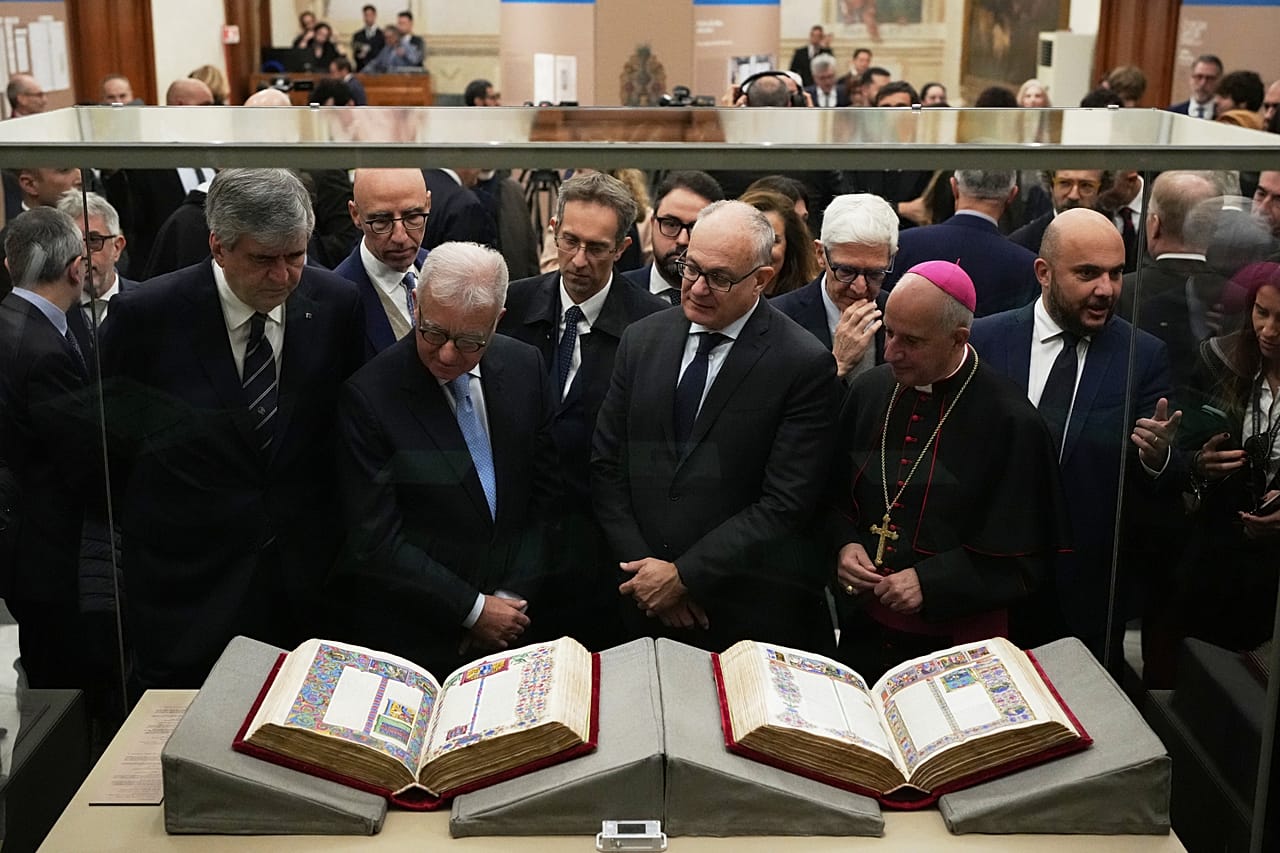
Displaying the Modena Bible in the Italian Senate

 
The Vatican displayed the Borso D'Este Bible, also know as the Modena Bible, in the Italian Senate to celebrate 2025 as a Jubilee Year. This elaborated illuminated 15th-century manuscript in two volumes is, according to Euro News (click for pics), "considered one of the most spectacular examples of Renaissance illuminated manuscripts and said to be one of the most expensive books of its time." As is typical of such news stories, it emphasizes this bible's origins and also the extensive security measures taken to protect it during its display--stories that emphasize the expense and prestige of this iconic book. Its display by the Roman Catholic Church in the Italian Senate serves to bolster the legitimacy of both institutions, which is a core function of icon books and, especially, of relic texts like this.

From right, Monsignor Rino Fisichella, Rome's Mayor Roberto Gualtieri and Italian government undersecretary Alfredo Mantovano look at the 15th century Borso D'Este Bible 


Sunday, June 7, 2026

Rising Bible sales figures


Reports that church attendance is rising have been retracted because of research mistakes. But rising sales figures for bibles are based in publishing industry statistics and probably have more basis. The Guardian reported in January 2026 that 

Sales of the good book reached a record high in the UK in 2025, increasing by 134% since 2019 – the highest since records began – according to industry research. Last year, total sales of Bibles in the UK reached £6.3m, £3.61m up on 2019 sales. 

Publishers Weekly noted the same trend in the United States:

Last year, Bible sales—which have been on the rise since 2021—hit record highs in the U.S. and the UK, according to statistics drawn from Circana BookScan. ...  Brenna Connor, Circana director and industry analyst for U.S., said that "2025 marked a 21-year high for Bible sales in the U.S.," with 19 million units sold. That figure, she noted, is up 12% compared to 2024 and double the number of units sold in 2019. 

The news stories credit increased bible sales to growing interest in spiritual subjects in the aftermath of COVID and current political and economic anxieties. Christian book sellers point to new readers buying a bible for the first time. These news stories therefore bolster the idea of a Christian revival. But most bibles are bought by people who already own multiple copies. 

See my 19-year-old post: Bible sales & media messages. 

Thursday, January 1, 2026

Iconic copies of Qur'an used in NY governor's inauguration


The New York Times devoted an advance article to the iconic scriptures used in today's NY mayor's inauguration: "Mamdani Is First New York Mayor to Use the Quran at His Swearing-In." Zoran Mamdani used three different copies in two ceremonies: "One of the Qurans was from Mr. Mamdani’s grandfather. The other once belonged to Arturo Schomburg, the Black writer and historian. It was lent to the mayor by the New York Public Library." The third was one owned by Mamdani's grandmother. Schomburg's Qur'an was carefully chosen: "Showcasing the Quran that belonged to Mr. Schomburg, an Afro-Latino writer whose work shaped the Harlem Renaissance, underlines the city’s blend of faiths and racial and ethnic backgrounds."


Though using a Qur'an is a first for New York city, Mamdani was following the lead of many Muslim office holders in the U.S., including in Congress, as well as abroad as this blog has noted before. The thought put in to the selection of scriptures shows that politicians have proven much more adept at consciously manipulating the iconic dimension of scriptures than scholars, who have been slow to recognize, much less understand how the ritualizing scriptures in this way bestows legitimacy on those who hold them and on the religious communities that venerate them. For more examples, click the label OATHS at left. For the effects of ritualizing the iconic dimension, see my How and Why Books Matter, chapters 1-2.