

 Posts


James Bielo and Amanda White have created a website that catalogs Bible-based attractions around the world. Materializing the Bible locates and describes 145 attractions that "create material environments directly inspired by biblical texts." The welcome introduces the project in words very similar to those that headline this blog: "People do more than read Bibles. They use the written words to
make material environments. What happens when the Bible is transformed
across different media?"
Bielo and White catalog the attractions under seven headings: Creation Museums, Re-Creations, Transmission Museums, Holy Land Replicas, Archeology Museums, Gardens, and Art Collections. A customized Google Map allows viewers to see their distribution by region and by category.
This website is a valuable demonstration that such Bible attractions are widespread and deserve to be understood as a typical phenomenon, especially when we remember that the stations of the cross and art collections in Catholic (and many other) churches are smaller and much more numerous iterations of the same phenomenon. This catalog of Bible-based attractions should stimulate research on their religious and social functions.
Showing posts with label monuments. Show all posts
Showing posts with label monuments. Show all posts
Monday, July 20, 2015


Monday, May 25, 2015
Dr Seuss Books in Bronze
This winter, I found myself with an hour to spare in Springfield, Massachusetts, so I visited the Dr. Seuss National Memorial Sculpture Garden.

What a delightful place! The bronze sculptures by Lark Grey Dimond-Cates were unveiled in 2002. They reproduce some of Seuss's most famous characters around or popping out of two giant books.

Nearby is a likeness of Theodore Geissel (Dr. Seuss) himself at his desk with the Cat in the Hat looking over his shoulder.

Now here are iconic books in every sense of the term!
Monday, June 30, 2014
Slovenian book art 2
A sculpture in the harbor of Piran, Slovenia, reproduces the town in the form of heaps of books (courtesy of Lyn Watts).

Thursday, January 2, 2014
Book Shelves in Snow
My second New Year's gift comes from Emma Brodeur, who took this picture in the Cazenovia, NY, art park:


Bookish Iowa Rest Stop
My New Year's gifts included new photos of iconic books in art and architecture. First, from Cordell Waldron, come these pictures of a rest stop on an Iowa high way (I-80 Westbound near Tiffin). Cordell notes that, "The rest stop theme is Iowa's education history, so the columns of the building are books."


Monday, April 9, 2012
Giant Afghan Qur'an
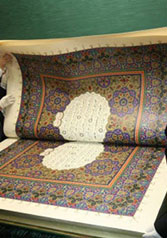 The Hindustan Times announced in January the completion of a hand-written and decorated Qur'an measuring 2.28 meters (90 inches) by 1.55 meters (61 inches).
An Afghan calligrapher has worked for five years to create the world’s biggest Koran, a bid to show the world that Afghanistan’s rich cultural heritage and traditions have been damaged but not destroyed by 30 years of war.
Mohammad Sabir Khedri, the master calligrapher behind the project, worked with nine students on a design that combines gold script with millions of tiny colorful dots, forming highly symbolic decorations around the giant pages.
“I wanted to use as many tasteful colors as possible to make this holy book look beautiful,” he said, standing beside his enormous creation in a room built specially to house it.
Friday, June 24, 2011
The Ezekiel Plates

... each marble or black basalt tile is about 12 inches square and contains raised lettering on one side in an ancient Hebraic script, with no spaces between the words. Examples of such raised lettering are known from the distant past, though most ancient stone tablets had the words etched or chiseled into the stone.An explanation for this tomb inscription may be provided by the Talmud:
... the tiles were supposedly found over 100 years ago when visitors to the traditional tomb of Ezekiel in the small Iraqi town of Kfar al-Kafil, located about 50 miles south of Baghdad, noticed a stone tile had fallen off the inside of the burial chamber. Oddly, its back side contained an ancient lettering which had been deliberately hidden, facing the wall. Other tiles were removed and similar inscriptions were found on their back sides as well.
... there is an old Talmudic tradition that Israel's prophets and other great sages were often buried with copies of their writings. One such Talmudic legend held that the original book of Ezekiel was buried with the prophet in his tomb and was left there to be revealed in the last days.That may not help in dating the text. But it does suggest that the Ezekiel Plates may be examples of eschatalogical texts that were created to be buried until a future or last age (see my previous blog entry, Burying Iconic Books).
Thursday, June 23, 2011
Tripitaka Koreana (3)
I have twice already blogged about the Tripitaka Koreana (here and here), the 13th-century collection of 88,000 wooden printing blocks of Buddhist sutras stored and displayed in the Haeinsa monestary in Korea. On Sunday, I was lucky to see a procession in Seoul that began the cellebrations of the millenial anniversary of the carving of the original set of printing blocks. Participants carried reproductions of the print blocks on their heads or backs through the streets of the city, preceded by palanquins containing more blocks and followed by dancers and soldiers in period costumes. It was a vivid example of how ritualizing the iconic dimension of texts allows broad participation by lay people who are unlikely to have the linguistic skills necessary to read and interpret these Chinese texts.


Wednesday, November 10, 2010
"Most Beautiful" Campus Libraries
Campus Grotto has produced a list and pictures of the "Most Beautiful Campus Libraries" (reproduced as a top-ten list by Huffington Post). It is limited to U.S. colleges and universities. Nevertheless, it is obvious that the list is dominated by architectural styles inspired by European religious traditions: most are either Gothic or Neo-Classical.
Yale's Stirling Library exhibits the extreme end of this tradition, with its circulation desk dominated by an icon of personified wisdom surrounded by the seven liberal arts.

But Yale also hosts the most stunning modernist library architecture, the Beinecke Rare Book Library, whose glass-enclosed climate-controlled cube within an alabaster exterior cube displays the books themselves as the objects of veneration.

Tuesday, November 3, 2009
Book Wall

Dutch artist, Sanja Medic, created this building facade in 2006 out of tiles that represent specific books. She notes that the building thus reflects its neighborhood, whose streets are named for well-known 18th and 19th century writers.

Sunday, May 3, 2009
The Preservation of Monumental Texts

The Georgia Guidestones were vandalized in early December. The mysterious Guidestones were built in 1980 and are inscribed in eight languages with tenets usually described as "new age." Randall Sullivan writes in Wired Magazine:
the stones had been splattered with polyurethane and spray-painted with graffiti, including slogans like "Death to the new world order." This defacement was the first serious act of vandalism in the Guidestones' history, but it was hardly the first objection to their existence.
(For pictures of the vandalism and a list of the tenets, along with paranoid commentary, see Prison Planet). Sullivan thinks the unknown people behind the Guidestones
knew what they were doing: The monument is a highly engineered structure that flawlessly tracks the sun. It also manages to engender endless fascination, thanks to a carefully orchestrated aura of mystery. And the stones have attracted plenty of devotees to defend against folks who would like them destroyed. Clearly, whoever had the monument placed here understood one thing very well: People prize what they don't understand at least as much as what they do.
Maybe, but I suspect they were mistaken in thinking that monuments survive due to their mystery and durable materials. Monuments rather survive due to social structures (political, religious or cultural) that guard and maintain them. As the Long Now Blog notes:
As for the Guidestones’ likelihood to survive, it is interesting to note that the surrounding mystery has been both a help and a hindrance. By instilling wonder and encouraging curiosity, the secretive creators have generated a good deal of interest in the monument. They’ve also, however, allowed some blanks to be filled by people offended by the little that is discernible about their agenda.
They note that interest in preserving and maintaining the monument seems to be come primarily from business interests represented by the local county tourism office.
UPDATE: The NY Times reported that an explosion destroyed the Guidestones on July 6, 2022. As of June 2026, the vandals have not been caught and the Guidestones have not been rebuilt. For full discussion, see Wikipedia, "Georgia Guidestones."
Monday, April 13, 2009
The Alhambra's Inscriptions

The AP, along with many other media sources, reports on an effort to translate and catalog all the inscriptions on the walls of the Alhambra, in Grenada, Spain. Caligraphic carvings, estimated to number around 10,000, cover walls, columns, and fountains.
Through the centuries, the popular belief was that most of the writings were verses from the Quran or poetry. But on the basis of the Alhambra building that has been studied so far, the Comares Palace, those amount to less than 10 percent of the total, Castilla said.
In fact, the phrase repeated most often — hundreds upon hundreds of times — is a sentence considered the slogan of the Nazrid dynasty, one of the successions of rulers that passed through the Alhambra. It says: "There is no victor but God."
... "As you walk along, it seems as if you are opening a book of poetry and turning the pages," he said.
The presumption that all the incriptions are Qur'anic shows the power that the convention of monumentalizing iconic scriptures exerts on popular expectations of any monumentally inscribed Arabic text.
Thursday, March 19, 2009
Tibetan books in Chinese media
The Chinese public relations campaign to influence Western views about Tibet includes--among headlines such as "Tibetans enjoy full religious freedom" and "Tibetan culture well preserved"--a couple of stories about Tibetan books and texts.
One video report from Xinhua Net shows the creation of a "Family Museum" to house a multi-volume Tibetan Buddhist classic after years of storage.

In another, Xinhua "China News" describes efforts to build "the largest stone sutra pagoda in Tibet" on Mount Chakpori opposite the Potala Palace in Lhasa, Tibet.
With a small mallet in one hand and a chisel in another, nine youngsters, sitting or squatting under a large piece of broken gray cloth shelter, are engraving lines of Tibetan sutra "Kangyur" into the stone slates. Less than 20 meters ahead is the pagoda, which is not yet completed after 14 years of construction, but embodies all their piety and faith to Buddha.
Tokdan Dawa Rinpoche, the sponsor of the pagoda, is sitting, with his legs crossed, on a carpet nearby the simple workshop, chanting sutras as throngs of devotees, with prayer wheels in hand, bowed to him and passed by, heading for the pagoda to pray along a dusty path.
As a tradition for centuries, Tibetan Buddhism believers engrave the sutras and Buddha images on stones as a way to keep the classics. It is also believed that the engravers, called "duoduo" in Tibetan, are able to achieve more happiness in their next lives through the toil of inscribing.
... usually a full set of Kangyur sutra includes 108 parts, each of which is written on a book of 200 to 400 pages. The engravers have finished inscribing the sutra and more than one million of stone slates piled into a 13-floor pagoda of more than 30 meters high.
... More than 100 engravers -- some from sophisticated stone-engraving families and some novices -- have volunteered to help build the pagoda. Most of them have worked here for five to six years though their pay for a whole-page Kangyur sutra is only 10 yuan (1.46 U.S. dollars).
... However, the beginning is always difficult.
As Zhoigar could not read, she just copied what she saw on the sutra book onto the stone.
"The characters were no more than some magic patterns to me at that time," recalled Zhoigar. "It also happened a lot that I had my fingers injured by the engraving tools, but the worst was that I wasted a lot of stone plates because of my mistakes, which made me cry a lot."
The tears are paid back after eight years of practicing. Zhoigar now can finish the engraving of an average of 20 stone slates every day at a speed of one Tibetan character in less than one second. She has also become a teacher for the newcomers.
"The more sutras I have engraved into the stones, the more Buddhism teachings I have engraved in my mind, which is far more important than how much money I have earned," said Zhoigar.
Thursday, December 11, 2008
Book Patrol: The Chinese Book Burner and the Great Wall of Books
Michael Lieberman on Book Patrol:

Qin Shi Huang, is one of the most notorious and prolific book burners in history. During his reign from 221 BC - 210 BC, Qin Shi Huang outlawed Confucianism and ordered the burning of pretty much all the books that came before him including the classic works of the Hundred Schools of Thought. It is also believed that he buried alive many of the scholars of the day. All in his quest to unite China.
This the same guy who built the Great Wall.
Jorge Luis Borges wrote an essay on Qin Shi Huang, 'The Wall and the Books' (La muralla y los libros) which appeared in the collection Other Inquisitions (Otras Inquisiciones), where he muses on these two grand feats.
The contemporary art company WELL has taken the Borges essay a bit further with their Great Wall of Books project - "a unique contemporary art project, simultaneously: public sculpture, interactive installation, outdoor performance, exhibition space and a point of creative departure for invited artists and communities. Literally a gigantic book, 5 metres tall and opening out to over 11 metres wide, it is a vessel that both generates and stores written, aural and visual stories." The project launched in 2007 with a 4 month stint in Macao, China and spent January of this year in Melbourne, Australia.
This has been the third installment in Book Patrol's new series Life of Google, featuring images from the vast archives of Life magazine that now appear on Google.

Friday, November 14, 2008
Iconic Books at SBL
Those of you heading to Boston for the Society of Biblical Literature Annual Meeting next week-end might want to check out several papers on iconic books. As usual, the Scripture As Artifact consultation on Monday will highlight the subject:
Dori Parmenter will address "Burials and Book-Burnings: Contemporary Concerns for Bible Disposal";
Jay Larson will talk about "Codifying Memory" in the Gospel Codices of late antiquity; and
Zeev Elitzur will start off the session with “Holding an Object”: The Coming of Age of Scripture as Holy Artifact."
Jay is also talk about "The Gospels as Sites of Memory" analogous to monuments in the session on Mapping Memory: Tradition, Texts, and Identity on Sunday morning.
This year, I'm leaving the iconic dimension in their capable hands while I talk about "Performing the Torah: The Rhetorical Function of the Pentateuch" with the Performance Criticism consultation on Sunday afternoon.
Hope to see you in Boston!
Tuesday, November 11, 2008
Monumental Text Debate in Pleasant Grove City, UT
The latest contest in a long history of debates over the presentation of monumental scriptures in public places is unfolding in Pleasant Grove City, Utah. As reported by the New York Times in the article "From Tiny Sect, Weighty Issue for Justices," a city park already has a Ten Commandments monument (donated in 1971 by the Fraternal Order of Eagles) that the town's mayor, Michael W. Daniels, explains as representing "law and history" (but not religion).
Now a religious group called Summum would like to donate a similar monument displaying the Seven Aphorisms that guide the group's theology. Pleasant Grove City did not accept the donation, and the resulting lawsuits have reached the U.S. Supreme Court level. At stake are issues of free speech and freedom of religion in public spaces, and whether a public park that displays the texts of some religions ought to display the texts of other religions as well (if their members choose to donate such monuments). As with other disputes over Ten Commandments monuments, this goes far beyond the text itself, and the physical presence of the monument takes on the weight of Constitutional law; the acceptance (or lack thereof) of a particular religion; and the identity politics of the city, state, and nation.
Now a religious group called Summum would like to donate a similar monument displaying the Seven Aphorisms that guide the group's theology. Pleasant Grove City did not accept the donation, and the resulting lawsuits have reached the U.S. Supreme Court level. At stake are issues of free speech and freedom of religion in public spaces, and whether a public park that displays the texts of some religions ought to display the texts of other religions as well (if their members choose to donate such monuments). As with other disputes over Ten Commandments monuments, this goes far beyond the text itself, and the physical presence of the monument takes on the weight of Constitutional law; the acceptance (or lack thereof) of a particular religion; and the identity politics of the city, state, and nation.
Friday, July 25, 2008
More Ten Commandments monuments
 As controversy and court cases continue to swirl around when and under what circumstances decalogues can appear on public property in the U.S. (see Associate Press, Associated Press), many advocates of monuments to the Ten Commandments have moved or erected them on private property, often as a direct result of the controversies (see Project Moses, World Net Daily). But this new monument on Highway 2 in Bimidji, Minnesota, seems to have arisen from more personal reflections, as reported in the Bemidji Pioneer.
Thursday, May 15, 2008
Isaiah Scroll back in the Shrine of the Book

As part of the commemorations of the State of Israel's 60th anniversary, the Israel Museum will display major sections of the Qumran Isaiah scroll from May 16 through August 30th, reports ArtDaily. The permanent display for the Dead Sea Scrolls in "the Shrine of the Book" was designed in 1965 to present the Isaiah scroll in the elevated spindle at its center. Concerns for the preservation of the scroll, however, resulted in its being replaced by a facsimile for most of the past 40 years. Now it will reappear temporarily in the place designed for it.

Sunday, December 2, 2007
Book Architecture
 The images of giant book spines have turned the facade of a Kansas City library car park into a giant book shelf. (Thanks to Jeremy for the tip about deputydog's coverage, who also shows pictures of a temporary construction wall in bookshelf form in Cardiff, Wales.)
Saturday, November 24, 2007
"Divinely Inspired Constitution"
Americans have a long history of revering their Constitution. Such veneration is particularly strong among politically active Evangelicals of the so-called "religious right," some of whose leaders have termed the U.S. founding documents "the most wonderful instrument ever drawn by the hand of man" (echoing Justice William Johnson in 1823). But Ron Paul, U.S. Representative and Republican presidential candidate, takes this one step further in his "Statement of Faith", which in the second-to-the-last paragraph reads:
" I am running for president to restore the rule of law and to stand up for our divinely inspired Constitution."
Christian bloggers have already castigated Ron Paul as heretical for this statement (see Parableman and evangelical outpost, with Paul's clarification in comment 78). I think it rather represents a logical outcome of efforts to elevate the iconicity of the U.S. Constitution which has, in turn, fueled reactions to portray the Christian Bible as supreme (e.g. with Ten Commandments monuments). Though theologians would like to believe otherwise, practices generate beliefs as often as the reverse. Monuments and shrines to national texts will generate beliefs in their supernatural origins.
Subscribe to:
Posts (Atom)

