Iconic books are texts revered as objects of power rather than just as words of instruction, information, or insight. In religious and secular rituals around the globe, people carry, show, wave, touch and kiss books and other texts, as well as read them. This blog chronicles such events and activities. (For more about iconic books, see the links to the Iconic Books Project at left.)

Showing posts with label scribes. Show all posts

Monday, November 30, 2020

Handwritten epidemic bibles

Writing in Christian Century, Heidi Haverkamp reports on her personal experience participating in hand-writing part of the Bible. The idea began in at the Abbey of St. Gall (which, btw, has a famously iconic library):

In the early days of quarantine, the Roman Catholic Abbey of St. Gall in northeastern Switzerland invited more than 1,000 parishioners to create a completely handwritten and
illustrated Corona-Bibel while they sheltered in place. The project inspired clergy in Chicago and Lincoln, Nebraska, to launch similar projects. While the American iterations are smaller in scope than the Swiss Corona-Bibel, focusing on select books of the Bible rather than all 66, the projects all share a common purpose: to gather people into community during a crisis and encourage them to experience the healing, comforting power of God’s word.

Haverkamp signed up to take part. She reports that

copying the text of Matthew made God’s Word sacramental in a new way. I had to pay attention to the text of the chapter as a whole, and it felt like I was reading with a part of my brain I have never used for Bible study before. The result was a deep and tangible immersion in scripture; I was inside each passage, not just looking on from a distance.

... Alone at my desk, I joined that vast spiritual family, the communion of saints, with Hebrew scribes, medieval monks, and kids and adults in Chicago and around the world, picking up our pens together.

This is a creative response to the isolation of the epidemic. But some European churches have sponsored and displayed bibles hand-written by the parishioners for some time. 

Here is an example I saw in a church in Muenster, Germany, in 2015. The page is open to the Beatitudes:


Saturday, September 24, 2011

Creating Relics of Endangered Alphabets

Tim Brookes has been documenting the world's alphabetic heritage by carving specimens on local curly maple in his Endangered Alphabets Project. The website explains his motivation:
Every one of the Endangered Alphabets (Inuktitut, Baybayin, Manchu, Bugis, Bassa Vah, Cherokee, Samaritan, Mandaic, Syriac, Khmer, Pahauh Hmong, Balinese, Tifinagh and Nom), carved and painted into a slab of Vermont curly maple, challenges our assumptions about language, about beauty, about the fascinating interplay between function and grace that takes place when we invent symbols for the sounds we speak, and when we put a word on a page—or a piece of bamboo, or a palm leaf.

The text in each case is Article One of the Universal Declaration of Human Rights. Brookes chose these alphabets because:
Writing has become so dominated by a small number of global cultures that those 6,000-7,000 languages are written in fewer than 100 alphabets. Moreover, at least a third of the world’s remaining alphabets are endangered–-no longer taught in schools, no longer used for commerce or government, understood only by a few elders, restricted to a few monasteries or used only in ceremonial documents, magic spells, or secret love letters.

The Atlantic, in describing his work, commented: "Letters in carved wood filled with black enamel paint ... make everything sharper and convey something of the awe of ancient inscriptions." Brookes art should certainly serve the purpose of relics, which is to contain and preserve things of great value, in this case, alphabets.

(h/t Fine Books and Collections)


Monday, January 18, 2010

Writing Torah and the Power of Prayer


The Philadelphia Inquirer reports on the ceremonial restoration of a Torah scroll.

While inking ceremonies are a tradition when a synagogue gets a new scroll, the honor of lettering in the last words typically goes to the rabbi or congregation president.

But like most of the immigrant rowhouse synagogues of a century ago, Shivtei Yeshuron, founded in 1876, does not have its own rabbi. And so it allowed any adult Jew who came through the doors yesterday to step up to the bimah, or Torah platform, and take up Youlus' quill pen
.

Participating in such a miqveh "good work" is generally believe to bring blessings, but Torah scribe Menachem Youlus was very specific as he explained the importance of the act:

"This is the highest form of charity. When you fill in your letter you will have God's undivided attention.

"Even with all the six and a half billion people in the world, God will be listening at that moment only to your prayers. And so you can change the world.

"You can ask God for peace in the Middle East," he said. "You can ask for an end to world hunger. And if there is someone you know who is deceased, you can ask God to move that person's soul closer to him."

"This is your one opportunity to change things," Youlus said, grinning broadly. "You get to play God. And there's nothing wrong with playing God
."

Many participants were overcome with emotion:

After each inking of a letter with Youlus' help, a member of the congregation recorded in a notebook the precise chapter, verse, line, and letter - an aleph, or lamed, or shin, or resh - that each person filled in.

One of the many women who lettered the Torah also said she felt overwhelmed by the occasion.

"Just being allowed, as a woman, to do something like this was an honor, a thrill," said a woman who gave her name only as Phyllis.

After identifying the exact letter - a tau - she had inked, she pulled open an English translation of her Torah portion and studied it closely.

It was Genesis 1:2. "Now the Earth was unformed and void," she read.

"From now on," she said, "that's going to be my verse.
"

Friday, May 8, 2009

Female Torah Scribes


Jen Taylor Friedman, a Jewish woman in the Bronx, has mastered the skills of a Torah scribe and already completed two scrolls, according to the Riverdale Press:

Many consider Ms. Friedman, 29, an important feminist figure, holding her up as a pioneering example to young Jewish women. Other Jews, primarily in the Orthodox community, believe she is out of bounds, doing work meant only for men or — in the case of Tefillin Barbie — simply inappropriate.

Ms. Friedman sold her first two Torahs to synagogues in St. Louis and Michigan.

Now, as she undertakes a third Torah, she is still adjusting to her role as lightning rod in the Jewish community. She’s been named to the Forward’s list of 50 influential Jews and, just last week, to Jewish Week’s list of 30 influential Jews under 30
.

What that story does not say is that opposition to women scribes stems, at least in part, from the traditional purification rituals required of Torah scribes. Many believe that women cannot maintain the purity necessary to complete a scroll, a task that usually takes nearly a year. The issue, then, is not about skill and ability, but rather about the sanctity of a Torah scroll itself. However, the positive attention being shown Ms. Friedman also employs the legitimizing function of an iconic scripture, in this case to legitimize efforts for gender equality by putting a scribe among a select group of "influential Jews."

Thursday, March 19, 2009

Tibetan books in Chinese media

The Chinese public relations campaign to influence Western views about Tibet includes--among headlines such as "Tibetans enjoy full religious freedom" and "Tibetan culture well preserved"--a couple of stories about Tibetan books and texts.

One video report from Xinhua Net shows the creation of a "Family Museum" to house a multi-volume Tibetan Buddhist classic after years of storage.


In another, Xinhua "China News" describes efforts to build "the largest stone sutra pagoda in Tibet" on Mount Chakpori opposite the Potala Palace in Lhasa, Tibet.

With a small mallet in one hand and a chisel in another, nine youngsters, sitting or squatting under a large piece of broken gray cloth shelter, are engraving lines of Tibetan sutra "Kangyur" into the stone slates. Less than 20 meters ahead is the pagoda, which is not yet completed after 14 years of construction, but embodies all their piety and faith to Buddha.

Tokdan Dawa Rinpoche, the sponsor of the pagoda, is sitting, with his legs crossed, on a carpet nearby the simple workshop, chanting sutras as throngs of devotees, with prayer wheels in hand, bowed to him and passed by, heading for the pagoda to pray along a dusty path.

As a tradition for centuries, Tibetan Buddhism believers engrave the sutras and Buddha images on stones as a way to keep the classics. It is also believed that the engravers, called "duoduo" in Tibetan, are able to achieve more happiness in their next lives through the toil of inscribing.

... usually a full set of Kangyur sutra includes 108 parts, each of which is written on a book of 200 to 400 pages. The engravers have finished inscribing the sutra and more than one million of stone slates piled into a 13-floor pagoda of more than 30 meters high.

... More than 100 engravers -- some from sophisticated stone-engraving families and some novices -- have volunteered to help build the pagoda. Most of them have worked here for five to six years though their pay for a whole-page Kangyur sutra is only 10 yuan (1.46 U.S. dollars).

... However, the beginning is always difficult.

As Zhoigar could not read, she just copied what she saw on the sutra book onto the stone.

"The characters were no more than some magic patterns to me at that time," recalled Zhoigar. "It also happened a lot that I had my fingers injured by the engraving tools, but the worst was that I wasted a lot of stone plates because of my mistakes, which made me cry a lot."

The tears are paid back after eight years of practicing. Zhoigar now can finish the engraving of an average of 20 stone slates every day at a speed of one Tibetan character in less than one second. She has also become a teacher for the newcomers.

"The more sutras I have engraved into the stones, the more Buddhism teachings I have engraved in my mind, which is far more important than how much money I have earned," said Zhoigar.

Giant Qur'an sold


The Gulf News reports:

The third largest Quran in the world was sold in Abu Dhabi on Tuesday on the first day of the Abu Dhabi International Book Fair.

The manuscript which is 80cm by 120cm was displayed in the Antiquarian Book Fair which is being hosted for the first time at the event. The Quran, which was produced in 1890 in Indonesia, came about as a result of a request from wealthy people in Arabia. Indonesian calligraphers were known at that time for their high quality artwork, Ebergard B. Talke, a German antiquarian who was selling the Quran told Gulf News.

Friday, October 10, 2008

Copying the Koran


Two very interesting looking exhibits at the Asia Society (725 Park Ave, New York, NY) highlight practically all of the themes of iconic books. From the opening lines of the NY Times review:

“Say it!” the angel Gabriel commanded Muhammad, who had been chosen to channel the message of Allah to mankind. “Write it,” the angel might have said, because the words the prophet recited became a book, the Koran. And in the hands of artists over the centuries that book became a devotional object of surpassing beauty.
The article includes a slide show of various elements, tools, and furniture used in Qur'anic calligraphy here.

Information about the exhibit is at the bottom of the article.

Tuesday, September 23, 2008

Illuminated Bibles in the 21st Century (2)


This summer, I had the opportunity to spend several days at St. John’s Abbey in Collegeville, MN. I went there to see the St. John’s Bible, an ongoing project to produce the first Bible in many centuries to be completely hand-written and illuminated by professional calligraphers. St John’s Abbey sponsors the project though the actual work is being carried out in Wales by a team of calligraphers led by Donald Jackson.

Four of the seven volumes have now been finished and are on sale in facsimile reproductions. The SJB’s illuminations are distinctive in content and contain a mix of styles by different artists, sometimes together in one illustration. They range from highly illustrative medleys (such as the distinctively African Garden of Eden scene) through atmospheric evocations of mood (such as the incipits for Proverbs and Ecclesiastes) to visual celebrations of textuality (such as the Ten Commandments illumination or the incipit of Matthew that casts Jesus’ genealogy in the form of a menorah). Like the text (which is modern English, the NRSV translation), the illumination art takes mostly modern form while consciously evoking many of the conventions of medieval illuminated manuscripts, such as text emphasized by color, marginal animals (often insects painted very realistically), as well as the style of the hand written letters themselves.

The original pages, however, have not yet been bound together as books. This allows their many illuminated pages to be displayed in traveling exhibitions, as well as at St. John’s. Almost a dozen pages from the newest volume, Wisdom Literature, were on display this summer. The manuscript pages are very striking—more so than the full-size reproduced facsimiles available for sale, as I was able to tell because I could compare them nearly side-by-side in this display. Displayed in museum cases, these manuscript pages work exactly like icons to draw attention to a transcendent reality—in this case, the biblical text itself. Viewing the illuminations made me refer to the text and want to re-read passages again.

St. John’s has produced a bible that combines the qualities of original art, icon and reproducible book—a form that draws attention to unique original in order to generate interest in its limitless reproductions. Its old-fashioned form—hand-written and illuminated parchment—works well to grab attention in the art museum culture of the twenty-first century.

Tuesday, May 27, 2008

Museum of Scribes in Safed

A new museum will open this summer in Safed, Israel. Kiryat Hasofrim "Palace of the scribes" is intended, according to Chabad.org News,
to educate visitors about the Jewish scribal arts. Some 30 scribes will produce Torah scrolls, mezuzahs and tefillin in a factory on the premises.

... The centerpiece of the visitors center – aptly named Letters of Experience – will be a three-roomed exhibit that will take tourists on a whirlwind tour of the scribal arts, beginning with G-d’s creation of the world through the power of speech.

A movie will explain the spiritual significance and history of each of the Hebrew alphabet’s 22 letters, while a three-dimensional show will illustrate how animal hides and plants become the various parchments, boxes and inks used in the preparation of mezuzahs, tefillin and Torah scrolls.

“The idea that physical things can attain holiness is a central concept in Judaism,” explained Kaplan. “The exhibit will show how we take the world around us and make it holy.”
... The factory operations will be decidedly technologically-based, as well, with supervisors scanning every parchment and entering it into a computerized database, providing a quality-control mechanism previously unknown to the scribal community.

Monday, November 12, 2007

Congregation Writes Torah


Fascinating story by Glen Collins in the NYT about the ritual of Torah-writing, only this time, a synagogue's ark will house a Torah written by members of its very own congregation, the Stephen Wise Free Synagogue in Manhattan.

"In a single stroke, those who join in the ambitious project are both honoring tradition and testing its bounds. Typically, the writing of a Torah has been left to a highly trained sofer, collaborating perhaps with a chosen few in the temple. For many centuries, the process has been a journey into an arcane and proscribed world of recondite rules and spiritual imperatives that are a mystery even to many devout Jews."

Monday, October 29, 2007

Robot Scribe

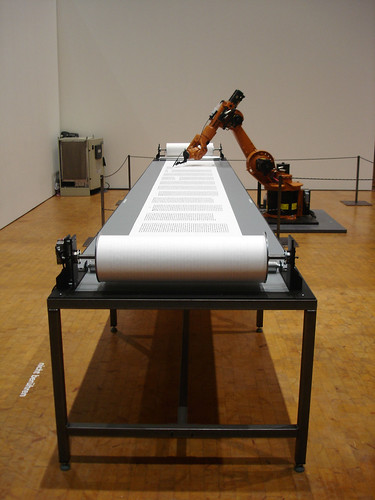
A German group, Robotlab, has constructed this robotic arm that does calligraphy. (Thanks to Michael Lieberman for this tip.) In this display, it is "hand" writing the Luther Bible. Note the use of THE iconic German Bible for purposes of this demonstration.

One commenter notes the irony in choosing this text to render mechanically in imitation calligraphy when it was originally printed. Another irony is the choice of the scroll form for the convenience of the machine, instead of the codex sheets more easily handled by printing presses.

Advocates of the possibilities inherent in new electronic media (such as the folks at if:book) often decry the wide-spread tendency to use new technology anachronistically, rather than taking advantages of its possibilities. They would probably not be comforted by the observation that this tendency is very old. This robot reproduces calligraphy because, despite five-and-a-half centuries of printing, careful hand calligraphy retains connotations of prestige and expense. Thus famous documents, like the U.S. Declaration of Independence and Constitution, are displayed and reproduced in calligraphic form, which is how they are popularly remembered, despite the fact that the originals were printed broadsheets. It was the secondary, anachronistic hand-written form that was given iconic status.

Tuesday, July 31, 2007

Calligraphy in decline?

Several new articles about religious calligraphy: An Iranian manuscript illuminator laments the decline of his art form because his contemporaries "prefer modern art to traditional work." I mentioned a similar complaint from a Indian calligrapher in a previous post. Two other articles show that some calligraphers still find patrons for hand-copied Qur'ans (Muslim scriptures) and Guru Granths (Sikh scriptures) in India and Canada. But both scribes' goal of writing the largest copy of their respective scriptures hints that calligraphic art alone is no longer enough either.

Tuesday, July 24, 2007

Giant Vietnamese Declarations of Independence


Thanh Nien News reports:
A calligraphy book in wood weighing over 300kg, thought to be the largest in Vietnam, titled Declaration of Independence, is on show in Hanoi.

The 2 m by 84 cm book was created in 21 days by Trinh Van Tuan from rare and durable kinds of wood and paper, and is a reproduction of three works considered national declarations of independence.

The first two documents included in this his new work of calligraphy date to 1077 and 1428 while the third was written by Ho Chi Minh "based on the American Declaration of Independence and the French Declaration of the Rights of Man and the Citizen to affirm the independence of the Democratic Republic of Vietnam from France."

Friday, July 6, 2007

Qur'ans as Islamic Art

The Australian provides a review by Sebastian Smee of "The Arts of Islam," an exhibit in Sydney of part of the private collection Nasser D. Khalili. Among many other things are a group of Qur'ans that illustrate several features of iconic and relic texts that we have been discussing on this blog:

"... the show opens with a display of Korans, big and small, from Iran, China, North Africa, Egypt and Sicily. Later on, there is a fragment from a Koran believed to have been inscribed by a one-handed, left-handed calligrapher from the central Asian city of Samarkand. Trying to impress the great ruler Tamerlane, he had written a Koran so small that it could fit under a signet ring. The ploy failed so he turned around and made a giant Koran: each page almost 1m long and 1.8m high, with only seven lines per page.

"A single line is on show here. Impressive as it is, it serves as a reminder that many of Islam's greatest cultural treasures -- a high proportion of them in book form -- have been split up or otherwise tampered with in the name of profit. The practice continues unabated today, with random pages from previously whole manuscripts and individual tiles ripped from the walls of buildings appearing at auction on a regular basis."

Tuesday, June 26, 2007

Caligraphy & Recitation: Islamic Arts

The Indian Muslim profiles a professional calligrapher trying to preserve what he perceives as a dying art. He is quoted as equating calligraphy with recitation: "There are two major arts in Islam. Reciting the Quran well and writing the script of the Quran gracefully."

"Reciting well" would probably not describe a group of six men in Bahrain who are attempting to break the world speed record for reading the Qur'an aloud, which currently stands at "140 hours and two minutes."

Monday, June 18, 2007

Leading Iraqi calligrapher killed


The chaos in Iraq is taking its toll on all aspects of Iraqi culture, including the art of classical Arabic calligraphy. The BBC reported that Khalil al-Zahawi was ambushed and killed on May 26th. For pictures of him at work and a few samples of his work, see Sad day for Arabic calligraphers.

Tuesday, June 12, 2007

Compilation of Guru Granth

The India Post conveniently summarizes traditions regarding the compilation of the Guru Granth Sahib (the Sikh scripture). The article details clearly how all three dimensions of this scripture were ritualized from the beginning: inclusion or exclusion from the text marked the relative authority of rival gurus, performance of the verses was based on various Indian musical traditions, and iconic veneration of the book was mandated from its first publication.

The same paper also reports that the Sikh conflict in Punjab seems to be subsiding.

Monday, June 4, 2007

On Restoring Sacred Objects


In On Restoring Sacred Objects (1998), Jack C. Thompson, engages thoughtfully the conflicts that can arise between a community with strict religious standards about who may handle a sacred text and professional conservators with strict professional standards about how to restore that text. This issue has generated discussion among museum curators and conservators: see, for example, Virginia Greene, "'Accessories of Holiness': Defining Jewish Sacred Objects" (1992), and Daniel D. Stuhlman, "The Preservation of Torah Scrolls" (2006).

Sunday, June 3, 2007

Female Torah scribe

An American has become "the world's only known, traditionally trained female scribe," according to The Jewish Daily Forward (June, 2005). But the article also describes the continuing halakhic arguments over whether women should be permitted to copy Torah scrolls.

Sunday, May 27, 2007

Copying Scriptures (2)

Members of a synagogue may participate in the completion of a new Torah scroll, most of which is hand-copied by a professional scribe. TwinCities.com reports on the feelings produced in a Minnesota congregation by this tradition. The Dallas Morning News describes how the congregation's participation helps underwrite the considerable expense of having a new scroll copied.