Iconic books are texts revered as objects of power rather than just as words of instruction, information, or insight. In religious and secular rituals around the globe, people carry, show, wave, touch and kiss books and other texts, as well as read them. This blog chronicles such events and activities. (For more about iconic books, see the links to the Iconic Books Project at left.)

Showing posts with label illuminated texts. Show all posts

Thursday, June 11, 2026

Iconic bindings and typefaces in contemporary bible publishing


This bog has chronicled the creative formats and contents used by large publishing companies to sell bibles in a saturated market: as glossy magazines, as manga graphic "novels" and, of course, as study bibles aimed at every religious, demographic, and political niche market (e.g. the God Bless the USA Bible). The Bible today takes almost an infinite number of forms (and here).

But many smaller publishers cater to the market by producing bibles that imitate historical forms and typefaces.

For example, the website selling the Bibliotheca Bible emphasizes that the iconicity of this five-volume cloth-bound set in a walnut wood box elevates the semantic reading experience: 

Biblioteca volumes in wooden slip cover

an elegant, meticulously crafted edition of the Bible ... in classic typographic style, free of all added conventions such as chapter and verse numbers, section headers, cross-references, and marginalia. ... grounded in the time-tested principles of fine bookmaking and typography ... introducing Katharos  —  a custom-designed typeface created specifically for Bibliotheca, blending timeless elegance with optimal readability. Its clean, open forms and carefully balanced proportions are tailored to support immersive, effortless reading. ...  [of ]the American Literary Version  —  a respectfully revised edition of the 1901 American Standard Version ... [which] isn’t meant to smooth over or explain away the complexities inherent to the text  —  rather, it invites readers into the profound depth and literary artistry of the biblical library.

The NASB HIStory Bible uses even more traditional typography and bindings, even though the flexible goatskin binding comes in pink, blue, orange, yellow, or amethyst. The gilt pages edges depict Christ amid images drawn from both testaments. And "we've created exquisite dropped capitals to be placed at the beginning of each story, so that the reader can readily follow the story line, unperturbed by chapter divisions." 


I do not know how well these bibles sell. Presumably, the mass-produced versions sell in much larger numbers. But these efforts attest to the continuing nostalgia for scriptures that look and feel like popular stereotypes of older bibles.  

Monday, June 8, 2026

Displaying the Modena Bible in the Italian Senate

 
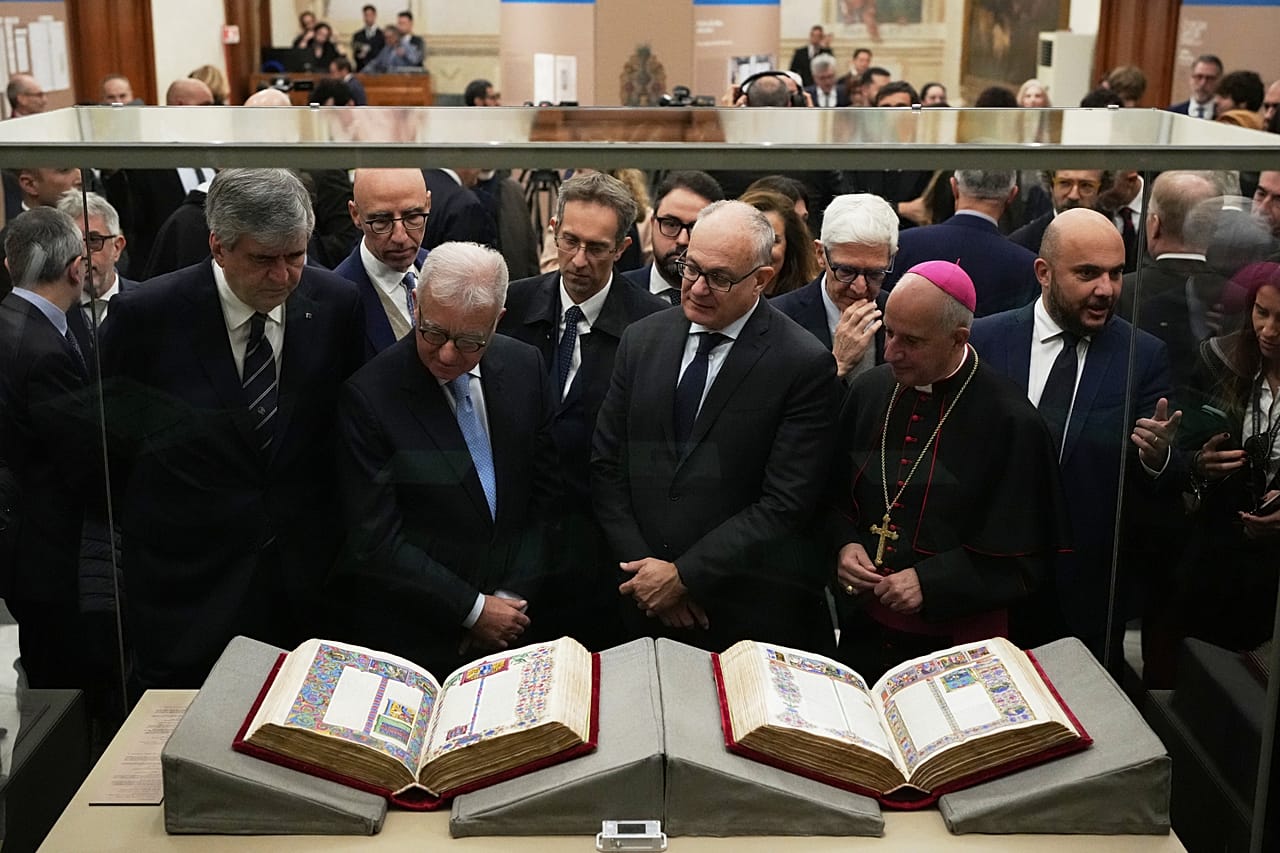
The Vatican displayed the Borso D'Este Bible, also know as the Modena Bible, in the Italian Senate to celebrate 2025 as a Jubilee Year. This elaborated illuminated 15th-century manuscript in two volumes is, according to Euro News (click for pics), "considered one of the most spectacular examples of Renaissance illuminated manuscripts and said to be one of the most expensive books of its time." As is typical of such news stories, it emphasizes this bible's origins and also the extensive security measures taken to protect it during its display--stories that emphasize the expense and prestige of this iconic book. Its display by the Roman Catholic Church in the Italian Senate serves to bolster the legitimacy of both institutions, which is a core function of icon books and, especially, of relic texts like this.

From right, Monsignor Rino Fisichella, Rome's Mayor Roberto Gualtieri and Italian government undersecretary Alfredo Mantovano look at the 15th century Borso D'Este Bible 


Sunday, April 4, 2021

Heirloom edition of graphic-novel style Divine Comedy


Here's another example of creating new iconic books. George Cochrane and his team are producing an heirloom edition of Dante's Divine Comedy in graphic-novel style.

Note the various editions in different price ranges, up to hand-coloring pages of the buyer's choice in the $10,000 edition.


Saturday, October 1, 2016

Christopher de Hamel on a Canterbury Psalter


In language strikingly reminiscent of Jim Watts, Christopher de Hamel, medieval librarian at Cambridge University, discusses the ways books are, and are not, like relics.

Medieval illuminated manuscripts are the holy relics of our own time. They are often preserved, like sacred treasure of the middle ages, in special boxes in institutional strong-rooms and brought out only on special occasions for the edification of the public, displayed in the half-dark under layers of security glass. Unlike most works of art only small portions of any manuscript can be seen at once. What remains unseen merely adds to the mystery and the longing to turn the pages. As with most medieval relics, which are generally tiny fragments of something once much larger, engagement with illuminated manuscripts on public show usually requires great leaps of both imagination and faith.


Friday, June 21, 2013

Georgia on My Mind: The Invisible Power of Typeface

(cross-posted with the Material Scripture blog)

My thanks to my colleagues who made sure I saw the article in The Week from a few days ago, "How Typeface Influences the Way We Read and Think."

The insight here is a helpful one for those interested in materialist questions in the study of Scriptures: namely, that the visual presentation of the words themselves create a psychological effect in the reader, leading to increased credulity (in the case, say, of Georgia) or outright derision (as in the case of Comic Sans).

The only book on the subject of which I am aware is Graphic Design and Bible Reading: Exploratory Studies in the Typographical Representation of the Text of Scripture in Translation, by E. R. Wendland and J. P. Louw. Sadly, it looks like it has gone out of print, though I do have a copy if anyone would like to do some more exploration.

Besides that one text, I have not done much formal study of typefaces in Scripture; but I am pretty sure S. Brent Rodriguez Plate has, and I would love to hear his response to this (and other responses, as well).

Saturday, January 5, 2013

Bodleian's Crossing Borders Exhibit

I finally went to NYC to see Crossing Borders: Manuscripts from the Bodleian Libraries at the Jewish Museum. Like several other displays of manuscripts since 9/11, Crossing Borders aims to show the cultural interplay and continuity between Jewish, and Christian and Muslim manuscript cultures in the middle Ages. It does this most successfully by setting side by side copies of Euclid's Geometry in Latin, Hebrew and Arabic, all from the 13th and 14th centuries. The exhibit's centerpiece, the illuminated Kennicott Hebrew bible (late 15th c.), also appears next to the carpet pages of an illuminated Qur'an and a 13th-century Arabic gospel.

The exhibition is less thorough than others have been in carrying through this theme. Its underlying goal shows through of exhibiting the Bodleian's hebraica collection, which has been growing steadily for 400 years. The exhibition hall with elaborate woodworking, dark red walls, and dark interior reinforced the Oxford effect.

The exhibit shows the maturation of using electronic technology to show more  of a book than just the two pages open in the exhibit case. Many of the exhibit cases included built-in tablets that allowed visitors to browse more pages and zoom in on details. The Kennicott Bible was accompanied by five tablets that allowed browsing every single page of this illuminated Bible. Now that people are increasingly familiar with using cell phones and tablets, this is a very user-friendly interface. It is the culmination of a trend that began with the British Library's "turning the pages" displays more than a decade ago.

Most striking to me were the set of folio-sized and illuminated commentaries from the 12th to 15th centuries. They included Herbert of Bosham's glosses on Lombard's commentary on the Psalms (12th c., at left), a Hebrew Bible with Rashi's glosses (13th c.), Nicholas of Lyra's two-volume biblical commentary (14th c.), and Jacob Ben Asher's Evev ha-Ezer (15th c.). They contrasted with the more utilitarian sized and produced works of Maimonides and Richard of St. Victor. The illuminations of the folio volumes (especially Herbert's glosses) rivaled the Bibles and prayer books displayed beside them. Obviously, they must have been produced for wealthy patrons or institutions. Still, it is surprising to see so much wealth invested in scholarly products.

The exhibit remains at the Jewish Museum until February 3rd.

ADDENDUM: Zak Braiterman summarized his reaction to seeing the Kennicott Bible, both on display and online here, in this way: "So what does this Bible look like? Austere and illuminated. Black, gold, red, blue. Carefully tended. Deluxe. I think this says a lot about the Spanish Jewish milieu in which this thing was produced. Does it say anything about the Bible itself? It suggests something about the plastic character of a text, including Holy Writ, something about the shape of its appearance. We’re so used to reading the Bible, to the idea that the Bible is something to be read, that we lose sight of its objecthood and the fact that it is also something to look at. The decorative device frames the physical text and also its “sense.” ... I’m pretty sure that this is not the same Bible that “we” read today. “Our” Bible is more folksy and Ashkenazi. This one is very aristocratic and Sephardic. And private."

Tuesday, December 27, 2011

Relic Armenian Manuscript Pages

The Los Angeles Times reported last month on the Getty Museum's legal battle to retain ownership of eight illuminated pieces of parchment from the 13th-century Zeyt'um Gospels. The Armenian Church claims the pages were stolen during the genocide of 1916 and the Getty does not hold legal title to them.

An interesting feature of this controversy is the debate over the moral issues involved not just in ownership of the pages but also over the ethics of separating a manuscript into multiple parts. On the one hand, the Getty cites common practice:
Elizabeth Morrison, the Getty's acting senior curator of manuscripts, said that "well-regarded … collections around the world" contain individual manuscript sheets. "The Getty in no way condones the practice of taking apart manuscripts, but we continue to collect individual leaves after careful examination proves that they have not recently been removed … with motives of financial gain."
Her argument, then, is that there are legitimate motives for taking books apart. Though not mentioned here, libraries and museums have often disassembled valuable codices in order to display more than two pages at one time. Once disassembled, though, they are more easily sold in pieces, and perhaps more valuable that way. Both for display and for profit, then, codices frequently get treated like bodily relics by socalled "secular" institutions.

On the other side of the argument is the claim that the pages "belong" with the rest of the manuscript.

Father Columba Stewart, a Benedictine monk and executive director of the Hill Museum & Manuscript Library at St. John's University in Collegeville, Minn., said that a whole work of art is better than a divided one, and that when a museum has the power to turn a fragmented manuscript into a complete one, it should do so. "It's better from an artistic perspective … it can [then] be studied by scholars as a whole object," said Stewart. . . . Acquiring individual sheets of a manuscript is improper, he said, unless the original work already is so fragmented or scattered that there's little chance it can be made whole. Museums must avoid "contributing to an improper fragmentation of a work. In this instance, it would not be a terribly complex matter to restore the whole."
Stewart invokes the needs of scholars to view a work entire, but also an aesthetic value of the integrity of the work of art. Only then does the article mention specifically religious considerations:
Beyond that, Stewart said, the Getty, which in recent years repatriated more than 40 artifacts to Greece and Italy after evidence showed they had been looted from archaeological sites, should consider that these works are still venerated: "Here's a living, breathing religious community, as opposed to classical antiquities."

This case illustrates clearly the contested values that can swirl around relic texts, especially those that have been partitioned and parceled out, as people are prone to do with relics. We have had the opportunity to observe these processes at work with various kinds of relic texts on this blog (click the label relic at left for more examples).

Monday, April 25, 2011

SCRIPT Program

Here is the program of SCRIPT's panels in its concurrent meeting with the AAR-EIR in Syracuse on May 6-7. The program for the entire conference is available here.

ICONIC BOOKS (Friday 12:00-1:30)
  • Nancy Menning “Wunderkammern as more than iconic: Watts’s model of scriptures and the Book of Nature”
  • David Dault “The Strange Case of the United 93 Bible: Tragedy, Iconicity, Materiality”
  • James W. Watts “Iconic Electronic Texts, or How Ritual Makes ‘Virtual’ Texts Material”
TEXTS AND IDENTITY (Friday 1:45-3:15)

  • Marcie Middlebrooks “The Inner Spirit and Outer Performance of Korean Buddhist Shinhaeng-dam Stories”
  • Steven Christopher Johnson “Empowering Oppression: LGBT Gaudiya Vaishnava Scriptural Interpretation”
  • Margaret Robinson “Pride, Performance and Praise: Bisexual Anthology as Bible”
TEXT AND COMMUNITY (Friday 3:30-5:00)

  • Chris Duncanson-Hales “RastafarI ‘Q:’ National Geographic “Modern Ethiopia” and “Coronation Day in Addis Ababa””
  • Cecile Marie Wilson “The iconic status of the original manifestos seems confirmed by AMORC’s recent emulation of them.” 
IMAGE AND BOOK (Saturday 8:30-10:30)

  • Karl Ivan Solibakke “The Gospel of the Haunted: Arnold Daghani’s What a Nice World”
  • Glenn Jonathan McCullough “Blake’s Job and the Alchemical Tradition”
  • Judith Oliver “A Multi-Media Performance of the Easter Liturgy In A Nun’s Choirbook from Late Medieval Germany”
  • Jason Neelis “Rebirth Narratives in Gandhāran Buddhist Literary and Material Cultures – Different locative tendencies in early manuscript fragments, art, and pilgrimage accounts”
SCRIPT ROUNDTABLE DISCUSSION (Saturday 10:45-12:15) with Brent Plate, David Dault,
Joanne Waghorne, and James Watts.

Monday, October 25, 2010

Three Faiths at NYPL


First there was Torah, Bible, Coran: Livres de parole at the Bibliothèque nationale de France in 2005, then Sacred at the British Library in 2007. Now there is Three Faiths: Judaism, Christianity, Islam at the New York Public Library. This series of exhibits comparing amazing manuscripts and printed books from each of the three Western religions represents a concerted effort to demonstrate what they have in common. "These exhibitions have a distinctive post-9/11 cast," observes Edward Rothstein in the New York Times.

The British exhibition even had the subtitle “Discover What We Share.” And
in New York, too, the emphasis throughout is on commonality. At this historical
moment, this is meant to defend Islam against anticipated accusations.
But the exhibits and, especially, their online promotions linked above also demonstrate how libraries are using electronic media to publicize their treasures. In New York, images from the exhibit will even be projected on the side of a Fifth Avenue building . These electronic texts, far from obscuring the physical books, celebrate and revel in them. They broadcast their iconic, even monumental, status and draw crowds to see the material objects themselves.

Saturday, September 25, 2010

Illuminated Arabic Manuscripts in Munich


As part of Changing Views, a city-wide exhibition of Muslim art in Munich, the Bayerische Staatsbibliothek is exhibiting its collection of illuminated manuscripts from Islamic cultures. Titled "The Wonder of Creation," it includes many exceptional pieces, such as these angels from a manuscript of Sakariya al-Kaswinis' "Cosmography" (1280). The exhibit runs from September through January.

Saturday, April 24, 2010

The Shape of the Decalogue Tablets


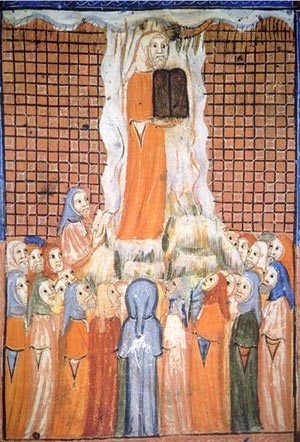
Menachem Wecker in the Jewish Press surveys the shape of the Decalogue in Jewish art, especially late medieval illuminated manuscripts. Though the stereotypical round-topped double tablets appear in the Sarajevo Haggadah (right, ca. 1350), he also finds rectangles, single tablets, and framed texts. No standard shape or depiction carries the day, though Wecker observes that

the claim Jews envision the tablets in the rectangular while Christians hold them to have been rounded does not stand. For the most part, Jewish artists do seem to have followed the grammar of the biblical phrase luchot avanim (tablets of stone) or luchot ha'brit (tablets of the law), which is always presented in the plural, while many Christian artists attached the two tablets to each other.


Perhaps the most interesting depiction is in the Alba Bible (left). Wecker comments:

The tablets seem positioned to squash Moses' head, and if one examines them carefully, one notices that the text - which is not carved into the rock, but painted on top of it - sometimes overflows the allotted space and hangs midair, particularly in the third commandment. It is almost tempting to read the white space surrounding the letters as empty space, in which case the artist has interpreted the forms of the letters as all being miraculously suspended.

Sunday, February 14, 2010

Mayan Book online


BiblioOdyssey reproduces a number of panels from a 13th century Mayan manuscript called the Dresden Codex. They are culled from the online exhibit by the Sachsische Landesbibliothek and the Foundation for the Advancement of Mesoamerican Studies (FAMSI).

Saturday, November 14, 2009

Books of Visual Omens


Douglas Galbi provides a review of the Sackler Gallery's exhibit, Falnama: Book of Omens. The Gallery's website describes the exhibit:

Whether by consulting the position of the planets, casting horoscopes, or interpreting dreams, the art of divination was widely practiced throughout the Islamic world. The most splendid tools ever devised to foretell the future were illustrated texts known as the Falnama (Book of omens). Notable for their monumental size, brilliantly painted compositions, and unusual subject matter, the manuscripts, created in Safavid Iran and Ottoman Turkey in the sixteenth and early seventeenth centuries, are the center piece ... of the exhibition [which] comprises more than sixty works of art from international public and private collections.

Galbi notes that:

The construction of the books prioritizes seeing. Like the Hamzanama of Akbar, these monumental Falnamas have large images framed to form complete pages. The books open to an image on the right page and text on the left page. Since reading in Persian and Turkish progresses from right to left, the image is read before the text. Visually, the images are colorful and ornate. The texts on the facing pages are also highly decorative. At least with these books, taking an augury was an impressive sight.

He argues that the books were probably be used by ruling elites to read omens for common people:

Recognizing the augury texts to be bureaucratic work suggests that the monumental Falnamas were for elite use, but not for elite reading. These Falnamas obviously are lavish, expensive works. ... The Falnamas seem to me to make most sense as a tool for an elite's bureaucracy to provide auguries for ordinary persons who seek them from the elite person.

The exhibit will be at the Sackler Gallery in Washington, D.C., until January 24th.

Tuesday, October 20, 2009

Weird Testament: The Bible Gets the R. Crumb Treatment

I've been waiting for Crumb's "Genesis" to come out and thinking about teaching it next semester to my "Pop Culture/Pop Religion" course. He's not the only one who has put parts of the Bible in comic form (as McKee notes in this good write up), but what Crumb does do is raise the prickles between words and images. I'm a fan of his drawing skills and styles, but the almost "literalism" he uses here makes one wonder again whether all of this must remain literary.

Weird Testament: The Bible Gets the R. Crumb Treatment RDBook ReligionDispatches

Shared via AddThis

Saturday, October 10, 2009

"The Great Omar"

Stephen Gertz on Book Patrol posted the following, which is worth reproducing in full:


"In 1912, bookbinder Francis Sangorski decided to produce the most elaborate binding of all time, a jeweled edition of The Rubáiyát of Omar Khayyám with illustrations by Elihu Vedder. The magnificent binding was a masterwork and contained almost 1,200 jewels. But the book and its binder were doomed.


The Harry Ransom Center recently held a stunning exhibition based upon the book and this masterpiece of bookbinding art, The Persian Sensation: The Rubáiyát of Omar Khayyám in the West.

The Ransom Center has also produced a video telling the tragic story of what happened to the greatest binding ever created:"

Saturday, September 19, 2009

Carl Jung's Red Book


Sara Corbett wrote a long article for the New York Times Magazine about the publication of Carl Jung's Liber Novus, "New Book," better known as his "Red Book." The Times also provides a photographic sample of its handwritten pages including many full-page paintings by Jung of what Corbett calls

a kind of phantasmagoric morality play, driven by Jung’s own wish not just to chart a course out of the mangrove swamp of his inner world but also to take some of its riches with him.

Jung wrote and illustrated the book by hand over a sixteen-year period to record his dreams, active imaginations and self-induced hallucinations. These experiences became the basis for much of his later theorizing about myths, dreams, and the unconscious.

Jung never published the book and his family refused to publish it or even let very many people see it. Corbett's description of the book's history presents a detailed case study of the three dimensions of an important text and their social consequences.

The book itself is beautiful and imposing, as an iconic book should be:

There sunbathing under the [photographer's] lights, sat Carl Jung’s Red Book, splayed open to Page 37. One side of the open page showed an intricate mosaic painting of a giant holding an ax, surrounded by winged serpents and crocodiles. The other side was filled with a cramped German calligraphy that seemed at once controlled and also, just given the number of words on the page, created the impression of something written feverishly, cathartically.

... The Red Book had an undeniable beauty. Its colors seemed almost to pulse, its writing almost to crawl.

Here we find a paradigmatic description of an iconic book, even a relic book. Its iconic status derives from its impressive physical appearance and one-of-a-kind nature, but also from legendary stories about its origins (what Dori Parmenter calls "the myth of the book"). That iconic/relic status precedes and lays the basis for its inspirational reading (performance) and semantic significance.

[Jungian analyst Stephen Martin] added “It gives me goose bumps just thinking about it.” He had at that point yet to lay eyes on the book, but for him that made it all the more tantalizing. His hope was that the Red Book would “reinvigorate” Jungian psychology, or at the very least bring himself personally closer to Jung. “Will I understand it?” he said. “Probably not. Will it disappoint? Probably. Will it inspire? How could it not?” He paused a moment, seeming to think it through. “I want to be transformed by it,” he said finally. “That’s all there is.”

Jung himself seems to have recognized the iconic power of textuality. One of his clients recorded his advice on how to process her inner life:

“I should advise you to put it all down as beautifully as you can — in some beautifully bound book,” Jung instructed. “It will seem as if you were making the visions banal — but then you need to do that — then you are freed from the power of them. . . . Then when these things are in some precious book you can go to the book & turn over the pages & for you it will be your church — your cathedral — the silent places of your spirit where you will find renewal. If anyone tells you that it is morbid or neurotic and you listen to them — then you will lose your soul — for in that book is your soul.”


The first and chief semantic interpreter of the Red Book is its translator, Prof. Sonu Shamdasani who teaches at University College, London. In the classic tradition of textual experts of any tradition and era, he emphasizes semantic expertise:

He tends to be suspicious of interpretive thinking that’s not anchored by hard fact — and has, in fact, made a habit of attacking anybody he deems guilty of sloppy scholarship — and also maintains a generally unsentimental attitude toward Jung. Both of these qualities make him, at times, awkward company among both Jungians and Jungs.

... Having lived more or less alone with the book for almost a decade, Shamdasani — who is a lover of fine wine and the intricacies of jazz — these days has the slightly stunned aspect of someone who has only very recently found his way out of an enormous maze. When I visited him this summer in the book-stuffed duplex overlooking the heath, he was just adding his 1,051st footnote to the Red Book.

As with other relic books the world over, the iconic claims of private owners and public scholarship come into conflict:

The relationship between historians and the families of history’s luminaries is, almost by nature, one of mutual disenchantment. One side works to extract; the other to protect. One pushes; one pulls.

... To talk to Jung’s heirs is to understand that nearly four decades after his death, they continue to reel inside the psychic tornado Jung created during his lifetime, caught between the opposing forces of his admirers and critics and between their own filial loyalties and history’s pressing tendency to judge and rejudge its own playmakers.

As a result of all of these factors, the Red Book's publication next month seems to arouse apprehension as much as excitement from everyone involved. Corbett observes that its publication

is a victory for someone, but it is too early yet to say for whom.

... The relationship between the Jungs and the people who are inspired by Jung is, almost by necessity, a complex symbiosis. The Red Book — which on one hand described Jung’s self-analysis and became the genesis for the Jungian method and on the other was just strange enough to possibly embarrass the family — held a certain electrical charge. Martin recognized the descendants’ quandary. “They own it, but they haven’t lived it,” he said, describing Jung’s legacy. “It’s very consternating for them because we all feel like we own it. ... This is the greatest psychic explorer of the 20th century, and this book tells the story of his inner life.”

... The Red Book is not an easy journey — it wasn’t for Jung, it wasn’t for his family, nor for Shamdasani, and neither will it be for readers. The book is bombastic, baroque and like so much else about Carl Jung, a willful oddity, synched with an antediluvian and mystical reality. The text is dense, often poetic, always strange. The art is arresting and also strange. Even today, its publication feels risky, like an exposure.

The book will be reproduced for mass consumption (as every icon should) early next month by W. W. Norton. The original Red Book will soon be on public exhibit (as every relic should) at the Rubin Museum of Art in New York.

Saturday, August 29, 2009

The Secret of Kells


Meghan Rinn called my attention to an animated movie, The Secret of Kells, that came out earlier this year. She points out that

The film ... uses the Book of Kells as a major plot point for a coming of age story. The book itself is shown several times and the movie ends with several pieces of the text being animated themselves and the film itself takes major design cues from the text.

It would be interesting in this age of electronic texts being designed with movie culture in mind to see a movie taking design cues from an (early medieval!) illuminated manuscript. Has anyone else seen the movie? What do you think of it?

Monday, October 20, 2008

Illuminated Manuscript Collection at Hebrew University

The Jerusalem Post highlights the work of Section of Hebrew Illuminated Manuscripts at the Center for Jewish Art at the Hebrew University.
The CJA manuscript sleuths have documented more than 1,000 manuscripts, as part of the mission of the Center for Jewish Art founded by Israel Prize-winner Bezalel Narkiss more than 30 years ago to create a virtual museum of Jewish art through the ages that would be accessible to all.
Section head Michal Sternthal notes "There are hardly any surviving Jewish artifacts from the Middle Ages besides illuminated manuscripts. As such, they provide us with important visual history."

Friday, October 10, 2008

Copying the Koran


Two very interesting looking exhibits at the Asia Society (725 Park Ave, New York, NY) highlight practically all of the themes of iconic books. From the opening lines of the NY Times review:

“Say it!” the angel Gabriel commanded Muhammad, who had been chosen to channel the message of Allah to mankind. “Write it,” the angel might have said, because the words the prophet recited became a book, the Koran. And in the hands of artists over the centuries that book became a devotional object of surpassing beauty.
The article includes a slide show of various elements, tools, and furniture used in Qur'anic calligraphy here.

Information about the exhibit is at the bottom of the article.

Thursday, October 9, 2008

Illuminated Books in the 21st Century (4)

It’s not just the Bible producers discussed in my three previous posts (here, here, and here) who are re-imagining the illuminated manuscript for the 21st century. Other publishers employ striking visuals to get their books noticed and their contents read. We’ve already mentioned the lavish photographs illustrating Harun Yahya's Atlas of Creation that has kept this creationist tract out of many recycle bins, as well as the respect that comic books garner by taking traditional codex “book” form (see Cordell Waldron’s comment to the post on Yahya).

New York fractal artist Martin Alberti has also embraced the model of illuminated manuscripts (and the “iconic books” label!). His manifesto declares:

Illuminated manuscripts are the iconic books of our past. A Renaissance of iconic books will be one of the first signs of our Awakening. Iconic books invite us to let go of our egos and open our hearts to God. ...

A moderate book need not be moderate in its Beauty. Moderate books written by people with moderate views should be the best-looking. ...

Iconic books are conversation triggers. “What do you see?” they ask. “And what does it mean?” We are at the dawn of a Great Conversation.

To create iconic books and believe that they can really make a difference is what it means for people in the book world to "Give the impossible a go!" as Tony Blair likes to say.

Alberti’s motives echo precisely those behind the St. John's Bible and the Bible Illuminated. His texts, though, are much shorter, such as a speech by Tony Blair on “Faith and Globalization.” Each double-page spread contains only twenty to sixty words of text, juxtaposed with full-page fractal images. Single words and word-fragments in a wild array of fonts catch and focus attention. The small volume is hard bound in a blue velour cover with gold lettering, and comes inside a red-velour zippered pouch with “.Christ” stitched on it. As Mr. Alberti wrote to me, “In this age of information overload, a short book has the best chance of getting read and having maximum impact.” He produces limited-edition works on commission. Like Yahya, he puts words in a form that is hard to ignore.

Even some digital media advocates have been infected with nostalgia for illuminated manuscripts. According to Christ Meade, if:book london is launching a joint project with the Arts Council of England

to create an illuminated book online, containing the poetry of William Blake, new writing, art and song inspired by Blake’s work, and the voices of many readers as they debate some of Blake’s key concerns and their relevance in the digital age. ...

Songs of Imagination & Digitisation will involve working with a range of those people, commissioning new writing and art, providing incentives for new voices to submit work and for readers to give us their ideas. We will mingle film, text and image, reader response and author interviews – and once we’ve gathered enough ingredients on our blog we hope to transmute them into something that feels like a proper, substantial, networked book. ...

We want the Songs to be a springboard into all kinds of reading.

Meade’s rhetoric speaks of “inspiration” at both personal and public levels, very similar to the language of Alberti and the people behind the St. John’s Bible and the Bible Illuminated. Once again, though the aesthetic paradigms to which they subscribe and the media they use diverge sharply, the same underlying model (the medieval illuminated manuscript) and motivations (personal transformation and public appeal) seem to be fueling quite a trend. I hesitate, though, to call it a “new” trend: people have been doing similar things for similar reasons for a very long time and I see little evidence to support the notion that modern print culture every suppressed this impulse (but for the contrary view, see the publicity for this book on Alberti’s website).