Iconic books are texts revered as objects of power rather than just as words of instruction, information, or insight. In religious and secular rituals around the globe, people carry, show, wave, touch and kiss books and other texts, as well as read them. This blog chronicles such events and activities. (For more about iconic books, see the links to the Iconic Books Project at left.)

Showing posts with label miniatures. Show all posts

Monday, November 22, 2021

15th c. gold book pendant


The Smithsonian reports that a metal detector turned up a tiny gold pendant in the shape of an open book in a field near York, England. On its leaves are engraved images of Saints Leonard and Margaret, patron saints of childbirth. the pendant dates from the fifteenth century.

Monday, October 14, 2019

Miniature Books


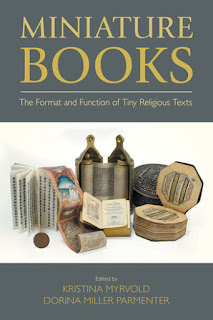
Miniature Books: The Format and Function of Tiny Religious Texts, edited by Kristina Myrvold and Dorina Miller Parmenter, has now been published by Equinox. 
Miniature Books

Miniature books, handwritten or printed books in the smallest format, have fascinated religious people, printers, publishers, collectors, and others through the centuries because of their unique physical features, and continue to captivate people today. The small lettering and the delicate pages, binding, and covers highlight the material form of texts and invite sensory engagement and appreciation. This volume addresses miniature books with a special focus on religious books in Jewish, Christian, Muslim, Hindu and Buddhist traditions. The book presents various empirical contexts for how the smallest books have been produced, distributed, and used in different times and cultures and also provides theoretical re ections and comments that discuss the divergent formats and functions of books.

Contents
Religious Miniature Books: Introduction and Overview
– Kristina Myrvold, Dorina Miller Parmenter
1. Ritualizing the Size of Books – James W. Watts
2. On the Functions of Miniaturizing Books in Jewish Religion
– Marianne Schleicher
3. Words in a Nutshell: Miniaturizing Texts in Early Modern England
– Lucy Razzall
4. Small Things of Greatest Consequence: Miniature Bibles in America
– Dorina Miller Parmenter
5. Diminutive Divination and the Implications of Scale: A Miniature Quranic Falnama
of the Safavid Period – Heather Coffey
6. Mite Qurans for Indian Markets: David Bryce in the Late Nineteenth and Early
Twentieth Century – Kristina Myrvold
7. Miniature Qurans in the First World War: Religious Comforts for Indian Muslim
Soldiers – Kristina Myrvold, Andreas Johansson
8. Size Matters! Miniature Mushafs and the Landscape of Affordances
– Jonas Svensson
9. Gitamahatmya! Paratexts in Miniature Bhagavad Gitas with Special Reference to
Pictures and Gender – Jon Skarpeid
10. Sutras Working in Buddha’s Belly and Buddhists’ Pockets: Miniature Sutras in
Korean Buddhism – Yohan Yoo, Woncheol Yun
Index


Wednesday, September 16, 2009

Miniatures too small to read


Julia O'Brien blogs about seeing the exhibit of miniature books at Baltimore's Walters Art Museum.

There were small mosaics, small sculptures, small shipping guides, but mostly small religious texts. Small Psalters. Small Qurans. And small Bibles.

Some of these miniatures were functional, actually used by readers even before the days of bifocals. They allowed people to have words that were portable and private-- pocket editions.

But many were clearly too small to be read. It's hard to imagine how they were even produced. These texts weren't reading material; they functioned atropaically--as amulets , talismans, good luck pieces. These Bibles were owned, touched, tucked away, treasured. But not read. The idea of the Bible mattered more than its content
.

Indeed! But the fact that more texts than just the Bible get subjected to such miniaturization shows that the iconic potential of books is not limited to scriptures, though they provide the most extreme examples.

Sunday, December 23, 2007

Unreadably Small Bibles (again)

Nanotechnology experts in Haifa, Israel, have etched the entire text of the Hebrew Bible on to a 0.01 inch square surface, "less than half the size of a grain of sugar," according to the AP. " They chose the Jewish Bible to highlight how vast quantities of information can be stored on minimum amounts of space. " The Jerusalem Post adds that "The fact that the Bible contains a large amount of text - about 10 million bits - was a major factor in choosing to store it at high density on silicon."

Friday, September 7, 2007

Miniature Guru Granth

newKerala.com describes a miniature (1x1 inch) Guru Granth Sahib (the Sikh scripture) in Agra, India. According to Kashmir Singh, the head cleric there, it "was specially made by the British for the convenience of Sikh soldiers during World War I, as they could not carry a normal sized book in the battlefield to pray. It was manufactured in Germany." The date and location can't both be right (Germans printing Sikh scripture for the British during WWI?), but I suppose the printing may have occurred in the years before 1914.

This account supports previous posts on this blog that suggested practical motives behind the production of miniatures. Do I remain skeptical only because my weak eyes, peering through prescription reading glasses, can't imagine anyone regularly reading such small print?

Friday, July 6, 2007

Qur'ans as Islamic Art

The Australian provides a review by Sebastian Smee of "The Arts of Islam," an exhibit in Sydney of part of the private collection Nasser D. Khalili. Among many other things are a group of Qur'ans that illustrate several features of iconic and relic texts that we have been discussing on this blog:

"... the show opens with a display of Korans, big and small, from Iran, China, North Africa, Egypt and Sicily. Later on, there is a fragment from a Koran believed to have been inscribed by a one-handed, left-handed calligrapher from the central Asian city of Samarkand. Trying to impress the great ruler Tamerlane, he had written a Koran so small that it could fit under a signet ring. The ploy failed so he turned around and made a giant Koran: each page almost 1m long and 1.8m high, with only seven lines per page.

"A single line is on show here. Impressive as it is, it serves as a reminder that many of Islam's greatest cultural treasures -- a high proportion of them in book form -- have been split up or otherwise tampered with in the name of profit. The practice continues unabated today, with random pages from previously whole manuscripts and individual tiles ripped from the walls of buildings appearing at auction on a regular basis."

Tuesday, June 19, 2007

Miniature Emancipation Proclamation


NPR's All Things Considered had an interesting report yesterday on a miniature edition of Lincoln's Emancipation Proclamation that was carried by Union soldiers. This report discusses why it was important for soldiers to have a small book to carry (i.e., it is less cumbersome than a scroll!) but I think there must be an iconic aspect to this, as a pamphet edition would probably be more readable. I'd appreciate hearing from others who might know more about this edition, or who have any pictures of the tiny book. NPR's segment is also about an exhibit of miniature books on display at the Grolier Club in New York City.

Friday, June 1, 2007

Tiny books

Books seem to lend themselves to experiments in miniaturization--and in marketing. LabNewsOnline reports that Canadian physicists have created a 0.07 x 0.10 mm book with thirty silicon chip pages and letters 40 nanometers high (cost per copy: £10,000). Unlike this case, miniature books frequently take the form of scriptures. WNG-GraphiLux markets several scriptures, each inscribed in its entirety on the surface of a single crystal. Available and marketed separately are the entire Greek Bible, the Qur'an in Arabic, and Bhagavad Gita in Sanskrit, which are sold in pendants and other jewelry. The popularity of scriptures as amulets has long fueled the production of tiny scriptures. Miniature Bibles and Qur'ans are now widely marketed on the internet.