Iconic books are texts revered as objects of power rather than just as words of instruction, information, or insight. In religious and secular rituals around the globe, people carry, show, wave, touch and kiss books and other texts, as well as read them. This blog chronicles such events and activities. (For more about iconic books, see the links to the Iconic Books Project at left.)

Showing posts with label desecration. Show all posts

Tuesday, August 11, 2020

Burning Bibles and Russia's 2020 disinformation campaign

Tuesday, June 25, 2019

How and Why Books Matter


 https://www.equinoxpub.com/home/books-matter/
What I have learned from 18 years of the Iconic Books Project—now collected together in one place:


Religious and secular communities ritualize some books in one, two, or three dimensions. They ritualize the dimension of semantic interpretation through teaching, preaching, and scholarly commentary. This dimension receives almost all the attention of academic scholars. Communities also ritualize a text’s expressive dimension through public reading, recitation, and song, and also by reproducing its contents in art, theatre and film. This dimension is receiving increasing scholarly attention, especially in religious studies and anthropology. A third textual dimension, the iconic dimension, gets ritualized by manipulating the physical text, decorating it, and displaying it. This dimension has received almost no academic attention, yet features prominently in the most common news stories about books, whether about e-books, academic libraries, rare manuscript discoveries, or scripture desecrations. By calling attention to the iconic dimension of books, James Watts argues that we can better understand how physical books mediate social value and power within and between religious communities, nations, academic disciplines, and societies both ancient and modern.

How and Why Books Matter will appeal to a wide range of readers interested in books, reading, literacy, scriptures, e-books, publishing, and the future of the book. It also addresses scholarship in religion, cultural studies, literacy studies, biblical studies, book history, anthropology, literary studies, and intellectual history.


Table of Contents: 
Introduction: The Iconic Books Project  1-5
Chapter 1 How Books Matter: The Three Dimensions of Scriptures  7-29
Chapter 2 Iconic Books and Texts  31-54
Chapter 3 Relic Texts  55-69
Chapter 4 Iconic Digital Texts: How Rituals Materialize Virtual Texts  71-81
Chapter 5 Desecrated Scriptures and the News Media  83-98
Chapter 6 Ancient Iconic Texts  99-115
Chapter 7 Rival Iconic Texts: Ten Commandments Monuments and the U.S. Constitution  117-134
Chapter 8 Book Aniconism: The Codex, Translation and Beliefs about Immaterial Texts  135-159
Chapter 9 Mass Literacy and Scholarly Expertise  161-166
Chapter 10 Why Books Matter: Preservation and Disposal  167-188

Saturday, February 21, 2015

Bibliography additions

Recent additions to the alphabetical and topical bibliographies on iconic books include:

On iconic books and Islam:
  • George, Kenneth M. "Designs on Indonesia's Muslim Communities," The Journal of Asian Studies 57/3, (1998), 693-713, a description of the artistic, political and religious choices involved in making a uniquely Indonesian copy (mushaf) of the Qur'an. George takes up these same issues more broadely in:
  • George, Kenneth M. "Ethics, Iconoclasm and Quranic Art in Indonesia," Cultural Anthropology 24/4 (2009), 589-621.
  • George, Kenneth M. Picturing Islam: Art and Ethics in a Muslim Lifeworld. London: Wiley Blackwell, 2010. 

On ancient book destruction and iconoclasm:
  • May, Natalie N., ed. Iconoclasm and Text Destruction in the Ancient Near East and Beyond. Chicago: Oriental Institute, 2012. 
  • Levtow, Nathaniel B. "Text Production and Destruction in Ancient Israel: Ritual and Political Dimensions." In Saul M. Olyan, ed. Social Theory and the Study of Israelite Religion. Atlanta: SBL, 2011. 111-39.

Monday, April 1, 2013

Religious Book Destruction in Central Asia


Bradford Anderson calls my attention to legal actions to suppress religious literature in several countries of Central Asia. Russian authorities have ordered the destruction of modern books tauting the views of Muslims, Hare Krishnas, and Seventh Day Adventist. Protestants and their libraries have been targeted in Uzbekistan and Kazakhstan. Christianity Today interprets this news in the context of Christian revivals in Central Asia in the last several years.

Much of our attention to book desecration and destruction on this blog has focused on highly symbolic actions at attacks on religious legitimacy. But book destruction has in past ages been an effective means used by states to suppress entire religious movements and their memory (e.g. the Manicheans). Governments and courts are still trying this tactic, despite the increasing difficulties posed by two information revolutions--print and digital.

Sunday, September 2, 2012

Framed for Blasphemy with Books

Scripture desecration is in the news again, because of the charges against a young, Christian (and possibly mentally disabled) girl in Pakistan. Pakistan's draconian blasphemy laws make such news unfortunately routine. Three years ago, I surveyed furors over scripture descration around the world. It was obvious that local laws make a greater difference than religious sensibilities, and that charges of scripture desecration thrive in environments of political instability. Pakistan has both, and I since completing my article I've resisted blogging repetitiously about the drumbeat of additional cases coming from that country, even when they led to the assassination of a governor who advocated for the law's reform. The pattern seemed monotonously and brutally consistent, even as it got worse.

But now something may be changing. Pakistani police have arrested the girl's accuser. ABC reports:
The cleric, Khalid Chishti, was arrested late Saturday for allegedly planting pages of a Quran in a shopping bag containing burned papers and ash that had been carried by the Christian girl, said Munir Jaffery, an investigating officer in the case. The bag was then submitted as evidence to the police.

Jaffery said a member of the mosque where the cleric works came forward Saturday and said man said the imam had placed the evidence in the bag. According to police, the man claimed Chishti said it was a way to get rid of the Christians.

The man's testimony only surfaced more than two weeks after the girl was originally arrested, raising questions about why he did not come forward sooner.
Though the girl's defense attorney's quickly assured the press that they do not oppose the blasphemy laws, perhaps this is the first sign that the tide is turning. The willingness to prosecute those who use the blasphemy law to frame others may begin to restore some sanity. Charges of blasphemy can be too easily abused in this way, not just to persecute religious minorities but also to exascerbate political feuds, business disagreements and marital conflicts, as my previous research documented. When communities feel empowered by law to defend their touchy sensibilities, whether they be iconic books or iconic buildings (see the recent Pussy Riot trial), an individual's right to justice and due process gets trampled (see Chloe Breyer's a propos essay).

September 3: And now the Chairman of All Pakistan Ulema Council, an influential group of Islamic clerics, has hailed the Christian girl as a "daughter of the nation" and stated that "our heads are bowed in shame" because of the Imam's attempts to frame her. Things are changing!
 

Saturday, June 23, 2012

More from the land of Book Art: Guy Laramee

Books used as artistic medium continues to be a shaping trend in visual arts and design.

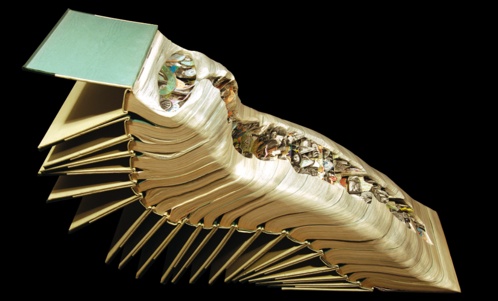
Guy Laramee, Prajna Paramita, 2011.
I recently came across the work of Montreal artist Guy Laramee who, like Brian Dettmer, Stephen Doyle, and others noted in these pages (click the "book art" label below), carves books into sculptures and installations. Unlike the others, Laramee has an interest in the connection between sacred texts and landscapes. These would be stunning images if made with plaster and painted, but the medium layers a number of meanings and affects.

Laramee's recent project "Guan Yin" evokes the titular bodhisattva of compassion, but much else as well, such as the Himalayan landscape brought out through carving a bound copy of the Prajna Paramita sutras. There is also a "stupa" carved from a Tibetan-Chinese dictionary that may contain some political undertones. And the captivating cave carved through a copy of John Brown's "self-interpreting" family bible remains enigmatic.

Guy Laramee, Stupa, 2011
Guy Laramee, Brown, 2011
"CBS This Morning" did a brief interview with Laramee this Spring. The CBS correspondent asks whether he's had any negative reactions to what he does, because, after all "books are sacred." Laramee says, intriguingly, "I'm making them even more sacred, because they are a sacrifice." Any elaboration on that was edited down, though I'd suggest this is an example of de-con-secration" as opposed to desecration.

Much of his earlier work points toward interests in Romanticism and mysticism, and my sense is that a glimmer of the mysterious, perhaps even sublime, comes through books as well as landscapes.

Wednesday, February 22, 2012

Afghan protests over accidental Qur'an burning


The accidental burning of Qur'an's by U.S. personnel in Afghanistan have provoked two days of violent protest so far and led to U.S. bases and offices being locked down for security. Scripture desecrations, including Qur'ans, has been a frequent subject of commentary on this blog as well as the topic of my 2009 online case study.

Tuesday, December 20, 2011

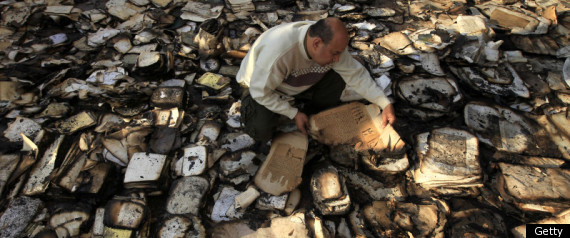
Thousands of rare books go up in flames in Cairo


Huffington Post has reported today that the "Institute d'Egypte, a research center set up by Napoleon Bonaparte during France's invasion in the late 18th century, caught fire during clashes between protesters and Egypt's military over the weekend. It was home to a treasure trove of writings, most notably the handwritten 24-volume Description de l'Egypte, which began during the 1798-1801 French occupation."

Thousands of volumes have been damaged, and many are burned beyond recovery. "This is equal to the burning of Galileo's books," Zein Abdel-Hady, who runs the country's main library, said.

The full Huffington Post article can be accessed here.

Friday, December 31, 2010

Rallies Defend Pakistan's Blasphemy Laws

I have already had reason to comment that Pakistan's draconian blasphemy laws fuel the invention of charges of Qur'an desecration in that country (see also my case study comparing different cultures). However, the efforts of human rights organizations to change the law seem to be suffering setbacks this month. The New York Times reports:

A crippling strike by Islamist parties brought Pakistan to a standstill on Friday as thousands of people took to the streets and forced businesses to close to head off any change in the country’s blasphemy law ....

The general strike and protests Friday are an indication of the power Islamists hold on the streets of Pakistan. It is also a sharp contrast to the campaigns by rights activists and opponents of the blasphemy laws who have vented their opposition and discontent mostly on the Internet and social networks like Facebook and Twitter. Protest rallies by rights activists have been ineffective and relatively small.

... the huge show of force by religious parties, and even the attention local news media outlets gave them on Friday, would only embolden the religious elements in the country, analysts said. The dynamic was such that “the government may not be able to make any changes in the blasphemy laws in the coming years,” Mr. Rais predicted.

Saturday, October 9, 2010

Toilets, papers, and writing

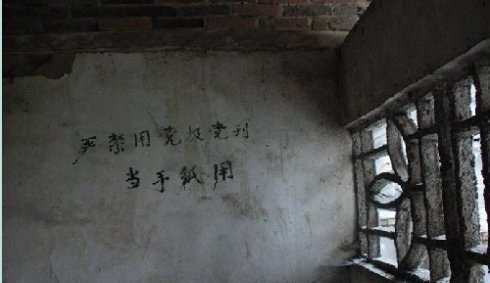
Victor Mair on Language Log posts the following picture, with translation and commentary:


He translates: “Use of Party newspapers and magazines as toilet paper is strictly forbidden.”
And comments: "It is evident that some types of paper with writing on it are more precious than other kinds. In old China, one was not to wrap fish or wipe oneself with any paper that had writing on it, because writing itself was to be respected, no matter what the content or who the author was."
(h/t to Ayse Tuzlak)

Monday, September 13, 2010

Virtual Book Burning and Its Consequences

On Religion Dispatches, Laurie Patton uses the idea of iconic books to meditate on last week's Virtual Book Burning and Its Consequences. She notes as I did in my last post that Pastor Terry Jones played on long-established tropes of book-burning that go back to antiquity. But she also points out the new effects of media and electronic communication:

... the Gainesville event might be the final culmination of the age of hijackers, where a small group’s manipulation of a powerful vehicle has far-reaching disastrous effects. Only in this case, the vehicle is the Qur’an, not an airplane. And the manipulation need only be virtual. Never has book burning been so effective without even occurring. Symbolic actions on the internet and their consequences in the real world now occur almost simultaneously. And the threat of a symbolic gesture and an actual one become one and the same.

Let me go even one step further. One could even say that the suggestion of book-burning is the only possible form of effective action today—far more effective than the book burning itself. In the twenty-first century it is virtually impossible (pun intended) to destroy books as a way of entirely eradicating a class of information, as Diocletian and many other emperors wanted to do. This is impossible to do because books are no longer physical objects but also electronic ones. It is also impossible to do because even electronic destruction may not be effective. At best, no matter how widespread a computer virus (a contemporary version of book-burning), there is no guarantee that such destruction would be complete.

Sunday, September 12, 2010

Threats to Burn Qur'ans

Now that the 9/11 anniversary has passed, no Qur'ans were burned, and the media hype is dwindling, I feel free to blog about Pastor Terry Jones's threat to burn Muslim scriptures. I have written before about scripture desecrations, especially of Qur'ans, and this incident bears out many of those conclusions. It provides a vivid example of

1. the power of scripture desecration, or talk about it, to focus media attention and therefore political discourse;

2. the difficulties that religious and political authorities have in controlling such talk and actions (in this case, the threat of desecration was diverted, but only after extraordinarily unified efforts by political and religious leaders of all kinds);

3. the degree to which mass publication of scriptures has placed the means for such acts in many people's hands;

4. the mass media's amplification of the effects of scripture desecration.

The chief difference between last week's news and previous reportage about desecrated Qur'ans is that this time, the news was generated by threats to burn them at a future time. Whereas the strict anti-blasphemy laws of countries such as Pakistan and Israel make charges of past scripture desecration potent weapons of political or personal conflict, American legal protections of free-speech allow threats of future scripture desecrations to polarize public opinion.

With that addendum, the story unfortunately shows again that “the prevalence of modern news media means that iconic scriptures provide convenient tools for both giving offense and taking offense, and today’s politics give many people reasons to do both” (Watts 2009).

Friday, January 8, 2010

Fine Art of Book Destruction


A Mixed Media Work Created By Lee Child For Speaking Volumes: Transforming Hate.
(Photo Courtesy Of Linda Thompson For The Missoulian.)

Nancy Mattoon on Book Patrol describes the exhibit, "Speaking Volumes: Transforming Hate" which opened January 7th at the University of Montana's Mansfield Library. She provides an excellent analysis of the controversy over it. The books in question were written by white supremacist Ben Klassen (died 1993) and circulated by his Church of the Creator. When 4000 copies fell into the hands of the Montana Human Rights Network, they commissioned area artists "to provoke discussion about racism, anti-Semitism, and intolerance."

Works created for the exhibit include a re-edit of one book's text by Charles Gute, which reverses the original message; a short story--which completely ignored the books-- about racism written and illustrated by children's book author Faith Ringgold; a book with every word individually cut out, leaving only a lacy, white series of spider-webbed pages by Ariana Boussard-Reifel; and “Hate Begins At Home,” a 10-by-10-foot house constructed from the books--nearly 3,000 of them-- by Dana Boussard.

This year's debut of the expanded exhibit has drawn fire from those on both ends of the political spectrum. An article praising the exhibit as a positive transformation of hate into art, akin to making lemons into lemonade, has drawn 18 online comments so far
.


Mattoon quotes many of the comments before drawing her conclusion:

Censorship is always a tricky topic. Most of us find it very easy to be against it, until we are confronted with something we find completely unacceptable. Then the conversation changes, and freedom of the press no longer applies to whatever it is we've decided is simply intolerable. Too bad that what is objectionable to one person might be the gospel of another.

Right. The story illustrates vividly how the incipient iconicity of (most) books is mobilized to generate political outrage.

Saturday, August 8, 2009

Manipulating Mobs with Desecration Charges

In Gorja, Pakistan, 100 Christian villagers were burned out of their homes and 8 killed by mobs angry over rumors that Qur'ans had been desecrated. I have written here already that scripture's iconic dimension can exert a particularly powerful effect on popular sentiment and that charges of scripture desecration easily lead to mob action. This is especially true in Pakistan with its draconian laws against insulting Islam, the Qur'an, or Muhammed.

The news now that the attacks were orchestrated by extremist groups underscores the point, except with a twist. It demonstrates that the iconic dimension of scriptures provides a convenient lever for manipulating mob sentiment. But in this case, the organizers were no doubt aiming at a larger political audience and are depending on media coverage to get their message across.

August 9: Kunwar Idris, writing in Dawn.com, traces the origins of Pakistan's anti-blasphemy laws and, especially, their capital penalties to the policies of General Ziaul Haq (President, 198 ).

Relevant to the Gojra episode would be the two sections he added to the penal code (295-B & C) which made the offences of defiling the Quran or the name of the Prophet punishable with life imprisonment or death. Ziaul Haq’s aim in enacting these laws was to exploit the religious sentiments of the people for his own power and glory. The fanatics have used them to persecute the minorities and dissidents, the politicians to promote their political ends.

Dying at the hands of fanatical mobs for (allegedly) defiling the Holy Quran or Holy Prophet have been a hafiz-i-Quran at one extreme and an old Hindu woman at the other. The toll runs into hundreds. Then there is the instance of four brothers who languished in jail for five years until a judge found they were maliciously accused of blasphemy or desecration by a villager who coveted their land and the headship of the village. Though acquitted, fearing mob violence they sought asylum abroad. The false accusers got what they had desired.

Sad stories of innocent victims and vile motives of their tormentors abound. A fact hard to deny, however, is that no one has ever been imprisoned for life or hanged under Zia’s laws but a large number have fallen victim to mob fury
.

Saturday, July 25, 2009

Controversy over Writing in a Bible


Many Christians, especially in Evangelical circles, consider writing notes in their personal Bibles as a responsible form of study and devotion. However, an invitation to the public to do so in Glasgow has created controversy, reports the Daily Mail:

Next to the copy of the Bible at the Gallery of Modern Art (Goma) in Glasgow is a container of pens and a notice, which says: 'If you feel you have been excluded from the Bible, please write your way back into it.'

The exhibit, entitled Untitled 2009, was put forward by the Metropolitan Community Church with the aim of reclaiming the Bible as a sacred text. But its pages have been scrawled with comments including 'F*** the Bible' and 'I am Bi, Female & Proud. I want no god who is disappointed in this'.

The exhibition was created by artists Anthony Schrag and David Malone, alongside organisations representing gay Christians and Muslims
.

The description of the exhibit (actually titled "Made in God's Image") on the museum's website argues:

While some of the works may be controversial from the more traditional and right-leaning positions, the exhibition challenges the assumption that one cannot lead a fully spiritual life while identifying as Lesbian, Gay, Bisexual, Transgendered and/or Intersexed.

It is part of an effort to "promote acceptance and understanding, encourage debate, and tackle questions about LGBT representation, place and history in today’s society." But the extent of the controversy seems to have caught the planners by surprise. Jane Clarke, a minister of the Metropolitan Community Church, "said she regretted the insults that had been written in the Bible. ... 'The Bible should never be used like that. It was our intention to reclaim it as a sacred text.'"

From an iconic books perspective, the controversy illustrates the fact that what counts as "desecrating scripture" is a very fluid standard and not just when the interface of religion and sexuality is involved. The negative reactions reported by the Daily Mail also show the mutual influence in today's media linked world between the standards applied within different religious traditions:

Andrea Minichiello Williams, director of the Christian Legal Centre, said: 'We have got to a point where we call the desecration of the Bible modern art. The Bible stands for everything this art does not: for creation, beauty, hope and regeneration.'

'A Church of Scotland spokesman said: 'We would discourage anyone from defacing the Bible.'

A spokesman for the Catholic Church said: 'One wonders whether the organisers would have been quite as willing to have the Koran defaced.'

(h/t Bite My Bible)

Thursday, May 7, 2009

US Army destroys Bibles in Afghan languages

Now here's a story I really don't know how to categorize: "Disposal"? "Desecration"? "Politics" for sure...

KABUL, May 5 (Reuters) - Bibles in Afghan languages sent to a U.S. soldier at a base in Afghanistan were confiscated and destroyed to ensure that troops did not breach regulations which forbid proselytising, a military spokeswoman said.

The U.S. military has denied its soldiers tried to convert Afghans to Christianity, after Qatar-based Al Jazeera television showed soldiers at a bible class on a base with a stack of bibles translated into the local Pashto and Dari languages.

U.S. Central Command's General Order Number 1 forbids troops on active duty -- including all those based in Iraq and Afghanistan -- from trying to convert people to another religion.

"I can now confirm that the Bibles shown on Al Jazeera's clip were, in fact, collected by the chaplains and later destroyed. They were never distributed," spokeswoman Major Jennifer Willis said at Bagram air base, north of Kabul.

Military officials have said the bibles were sent through private mail to an evangelical Christian soldier by his church back home. The soldier brought them to the bible study class where they were filmed.

Trying to convert Muslims to another faith is a crime in Afghanistan. An Afghan man who converted to Christianity was sentenced to death for apostasy in 2006 but was allowed to leave the country after an international uproar.

"It certainly is, from the United States military's perspective, not our position to ever push any specific kind of religion, period," chairman of the U.S. Joint Chiefs of Staff Admiral Mike Mullen told a Pentagon briefing on Monday. (Reporting by Peter Graff)

Destroying the Bibles could well fuel a backlash, but so far it is limited. Mission Network News quotes Carl Moeller of Open Doors, USA (which apparently supplied the Bibles) saying
the Bibles didn't need to be destroyed. "There's certainly many organizations that could put them to good use. Any time you see a Bible destroyed, it really should shake the core of every Christian to realize that this is the kind of desecration that can happen to God's Word."

American Family News Network quotes "a Pentagon adviser," Bob Maginnis:

"By and large, soldiers should have the right to share their faith wherever they are," he contends, "and for the political correctness crew to come aboard and declare that we're going to destroy Bibles because of the sensitivity of the local command, I find egregious."

Saturday, April 18, 2009

From desecration to arson

The Yemen Post reports that charges of desecrating a Qur'an led to crowds ransacking the alleged perpetrators' house and burning his cars:

On Tuesday, citizens destroyed the three-storey house of a Yemeni, who lived in the Al-Hasaba area, Sana'a, after they accused of desecrating the Quran.

Eyewitnesses said the man tore the Quran and treaded on it before citizens but the reason for his violation has not been identified.

Some people in the area called the police and informed them about a person who insulted the Quran.

Seeing that the police did not take action, citizens who rallied after the dawn prayers from a number of mosques broke into the offender's house and destroyed it.

They also burned his two cars which were parked at the house and the furniture inside the house
.

A parliament committee has been set up to investigate the incident.

(For similar incidents involving the scriptures of several different religions, see my recent comparative analysis of scripture desecration stories.)

Saturday, April 4, 2009

Desecrating Scriptures

My case study, "Desecrating Scriptures," has been published online by the Luce Project in Religion, Media and International Relations here at Syracuse University.

The case study analyzes news media reports of scripture desecrations from the last decade through the lens of my three-dimensional theory of scriptures. The stories show how iconic books get used in inter- and intra-religious conflicts in Muslim, Sikh, Jewish and Christian cultures. Their comparison reveals many common features, but also a notable difference: the iconicity of scriptures tends to be more controversial among Christians. I trace this difference to the fact that, unlike Jewish, Muslim and Sikh scriptures,
there is no common language and its recognizable sounds and no common text and its recognizable script to distinguish the Christian scriptures from other books and texts. Though the external binding may take stereotypical forms, the look and sound of the contents vary from culture to culture and denomination to denomination. ... linguistic diversity reinforces among Christians the notion that the essential nature of the Bible lies in its semantic meaning alone.

The Iconic Books Blog provided much of the material for writing this case study. It was my first test of the usefulnes of this research blog, and I'm quite happy with the experience. By listing here stories of scripture desecration as we've noticed them over the last two years, I had a ready database to start from. The blog's label function and Blogger's search feature made it very easy to pull the material together. It really made doing this kind of comparative case study feasible. So the blog passed its first test as a research tool with flying colors!

Friday, March 20, 2009

Altered Books and Memories


Brian Dettmer's new show of altered books prompts if:book's Sabastian Mary to wonder about "deeply-held taboos around the sanctity of books as objects":

Recycling, reimagining, repurposing the cultural glut amidst which we currently exist feels in many ways an appropriate artistic mode for today. Is authorship really so sacred that remixed works cannot themselves be things of beauty and value? Or, like European villages dismantling local medieval chateaux to build outhouses, are we taking our cultural history so completely for granted that we're in danger of forgetting or destroying millennia of culture in a thoughtless reappropriation of its materials for our current preoccupations?

Thursday, March 19, 2009

Arson burns Sikh scriptures

An arsonist set fire to London's Gurdwara Sikh Sangat on Tuesday, but it was the fate of the scriptures in the building that drew the emphatic attention of the Sikh and Indian press.

World Sikh News led it's story with: "As flames leapt and smoke billowed out, Sikh hearts cried at the thought of holy scriptures of Sri Guru Granth Sahib getting burnt inside this most famous of the London gurdwaras." It noted in the fourth paragraph that "The blaze, which caused the gurdwara’s roof to collapse, also engulfed all but one of the eight holy books it had housed" and quoted an onlooker: “It is like one of my gods is burning down—we worship our holy books as steps to God.”

Sify News also highlighted the scriptures in its lead: "One of London's most important gurdwara, housing priceless religious books, has been gutted in a suspected racist attack in Britain, a news report said on Tuesday."

Sindh Today included more information: "Singh said the women managed to save just one of the temple’s eight holy books before the flames took hold. 'I cannot describe how important those holy books were to the Sikh community,' he added."