Iconic books are texts revered as objects of power rather than just as words of instruction, information, or insight. In religious and secular rituals around the globe, people carry, show, wave, touch and kiss books and other texts, as well as read them. This blog chronicles such events and activities. (For more about iconic books, see the links to the Iconic Books Project at left.)

Tuesday, September 29, 2009

Scholem's Mechanically Reproduced Relic Zohar


A few years ago, the Hebrew University's Magnes Press published a special edition of the Zohar (The Book of Splendor – probably the most important Kabbalic text, dating from the Thirteenth Century). This edition of the Zohar wasn't a scholarly edition, but rather a facsimile of one of the old editions. However this is no ordinary facsimile – this mass reproduced edition is based on a Relic Zohar – the one owned by the famous Kabbalah scholar Gershom Scholem since he was seventeen till his demise, filled with comments in his own handwriting. The book's title is "Gershom Scholem's Zohar". Its six volumes may be bought for 367$.

The idea of publishing handwritten comments of prominent scholars taps an old rabbinic concept. The locution "be'ezem ktav yad kodsho" (something like "in the very holiness of his handwriting") is a technical term of sorts that denotes the writing in an original manuscript of an important rabbinic author as opposed to its copies and/or printed editions. This phrase conveys a sense of originality, but also a sense of sacrality – the very act of writing by an important rabbi is considered holy.

In what ways does the Magnes Press manipulate this traditional concept? The act of reproducing Scholem's handwritten comments in their original form tries to place Scholem somehow within the rabbinic tradition – it tells us "here is a modern scholar worthy of the mantle of a rabbinic sage". This says something about the complicated relationship between modern Jewish Studies and the traditional mode of Jewish learning. There's much more to be said about that, but it is not our issue here.

Our issue is the way that this message is conveyed. Scholem's comments aren't reproduced in printed Hebrew – they are presented to the reader in their handwritten form, alongside the Zohar's printed text (in Hebrew the difference between cursive script and printed script is very large – amounting to a different alphabet). The reader is faced with two kinds of mass reproduced text – the original printed form of the Zoharic text, and the mass-reproduced-but-pretending-not-to-be text of Scholem's comments. This is not a Relic book – it is a book pretending to be a relic by way of mass reproduction. What are the conceptual mechanisms involved here?

These are very similar to the conceptual manipulation used in an advertisement trying to play on the old fashioned and homely traits of a mass produced commodity (like this one). Such an advertisement tries to conceal the mass production by conceptually coloring the commodity in an atmosphere of old fashioned production. In a similar manner, the mass reproduced quality of the text of the Zohar is shaded by the pseudo-handwritten signs of Scholem's comments.

But there's a two sided bargain here. On the one hand the pretension to reproduced-relic status involves an oxymoron – if it's reproduced it ain't a relic. That is to say reproduction reduces the relic's "aura" in Walter Benjaminian parlance. But on the other hand the mass reproduction in this instance rescues the handwriting from its original ephemerality - And here Lisa Gitelman's presentation in the Second Iconic Book Symposium comes to mind. As in the example she discussed – the book Day – we are faced here with Walter Benjamin turned upside down – mass reproduction creates the aura instead of diminishing it.

How does this project generally on the category of a Relic Book? It introduces a new concept – the Pseudo-Relic. A Pseudo-Relic Book is a book which reproduces two distinct things – the text of the original relic book, but also the relicness of the original relic book. The text is reproduced in a straightforward manner; whereas the relicness has to do with an extra-textual feature which is also reproduced. I would define both Scholem's Zohar and the copies of Jung's red book as Pseudo-Relics.

Saturday, September 19, 2009

Carl Jung's Red Book


Sara Corbett wrote a long article for the New York Times Magazine about the publication of Carl Jung's Liber Novus, "New Book," better known as his "Red Book." The Times also provides a photographic sample of its handwritten pages including many full-page paintings by Jung of what Corbett calls

a kind of phantasmagoric morality play, driven by Jung’s own wish not just to chart a course out of the mangrove swamp of his inner world but also to take some of its riches with him.

Jung wrote and illustrated the book by hand over a sixteen-year period to record his dreams, active imaginations and self-induced hallucinations. These experiences became the basis for much of his later theorizing about myths, dreams, and the unconscious.

Jung never published the book and his family refused to publish it or even let very many people see it. Corbett's description of the book's history presents a detailed case study of the three dimensions of an important text and their social consequences.

The book itself is beautiful and imposing, as an iconic book should be:

There sunbathing under the [photographer's] lights, sat Carl Jung’s Red Book, splayed open to Page 37. One side of the open page showed an intricate mosaic painting of a giant holding an ax, surrounded by winged serpents and crocodiles. The other side was filled with a cramped German calligraphy that seemed at once controlled and also, just given the number of words on the page, created the impression of something written feverishly, cathartically.

... The Red Book had an undeniable beauty. Its colors seemed almost to pulse, its writing almost to crawl.

Here we find a paradigmatic description of an iconic book, even a relic book. Its iconic status derives from its impressive physical appearance and one-of-a-kind nature, but also from legendary stories about its origins (what Dori Parmenter calls "the myth of the book"). That iconic/relic status precedes and lays the basis for its inspirational reading (performance) and semantic significance.

[Jungian analyst Stephen Martin] added “It gives me goose bumps just thinking about it.” He had at that point yet to lay eyes on the book, but for him that made it all the more tantalizing. His hope was that the Red Book would “reinvigorate” Jungian psychology, or at the very least bring himself personally closer to Jung. “Will I understand it?” he said. “Probably not. Will it disappoint? Probably. Will it inspire? How could it not?” He paused a moment, seeming to think it through. “I want to be transformed by it,” he said finally. “That’s all there is.”

Jung himself seems to have recognized the iconic power of textuality. One of his clients recorded his advice on how to process her inner life:

“I should advise you to put it all down as beautifully as you can — in some beautifully bound book,” Jung instructed. “It will seem as if you were making the visions banal — but then you need to do that — then you are freed from the power of them. . . . Then when these things are in some precious book you can go to the book & turn over the pages & for you it will be your church — your cathedral — the silent places of your spirit where you will find renewal. If anyone tells you that it is morbid or neurotic and you listen to them — then you will lose your soul — for in that book is your soul.”


The first and chief semantic interpreter of the Red Book is its translator, Prof. Sonu Shamdasani who teaches at University College, London. In the classic tradition of textual experts of any tradition and era, he emphasizes semantic expertise:

He tends to be suspicious of interpretive thinking that’s not anchored by hard fact — and has, in fact, made a habit of attacking anybody he deems guilty of sloppy scholarship — and also maintains a generally unsentimental attitude toward Jung. Both of these qualities make him, at times, awkward company among both Jungians and Jungs.

... Having lived more or less alone with the book for almost a decade, Shamdasani — who is a lover of fine wine and the intricacies of jazz — these days has the slightly stunned aspect of someone who has only very recently found his way out of an enormous maze. When I visited him this summer in the book-stuffed duplex overlooking the heath, he was just adding his 1,051st footnote to the Red Book.

As with other relic books the world over, the iconic claims of private owners and public scholarship come into conflict:

The relationship between historians and the families of history’s luminaries is, almost by nature, one of mutual disenchantment. One side works to extract; the other to protect. One pushes; one pulls.

... To talk to Jung’s heirs is to understand that nearly four decades after his death, they continue to reel inside the psychic tornado Jung created during his lifetime, caught between the opposing forces of his admirers and critics and between their own filial loyalties and history’s pressing tendency to judge and rejudge its own playmakers.

As a result of all of these factors, the Red Book's publication next month seems to arouse apprehension as much as excitement from everyone involved. Corbett observes that its publication

is a victory for someone, but it is too early yet to say for whom.

... The relationship between the Jungs and the people who are inspired by Jung is, almost by necessity, a complex symbiosis. The Red Book — which on one hand described Jung’s self-analysis and became the genesis for the Jungian method and on the other was just strange enough to possibly embarrass the family — held a certain electrical charge. Martin recognized the descendants’ quandary. “They own it, but they haven’t lived it,” he said, describing Jung’s legacy. “It’s very consternating for them because we all feel like we own it. ... This is the greatest psychic explorer of the 20th century, and this book tells the story of his inner life.”

... The Red Book is not an easy journey — it wasn’t for Jung, it wasn’t for his family, nor for Shamdasani, and neither will it be for readers. The book is bombastic, baroque and like so much else about Carl Jung, a willful oddity, synched with an antediluvian and mystical reality. The text is dense, often poetic, always strange. The art is arresting and also strange. Even today, its publication feels risky, like an exposure.

The book will be reproduced for mass consumption (as every icon should) early next month by W. W. Norton. The original Red Book will soon be on public exhibit (as every relic should) at the Rubin Museum of Art in New York.

Wednesday, September 16, 2009

Miniatures too small to read


Julia O'Brien blogs about seeing the exhibit of miniature books at Baltimore's Walters Art Museum.

There were small mosaics, small sculptures, small shipping guides, but mostly small religious texts. Small Psalters. Small Qurans. And small Bibles.

Some of these miniatures were functional, actually used by readers even before the days of bifocals. They allowed people to have words that were portable and private-- pocket editions.

But many were clearly too small to be read. It's hard to imagine how they were even produced. These texts weren't reading material; they functioned atropaically--as amulets , talismans, good luck pieces. These Bibles were owned, touched, tucked away, treasured. But not read. The idea of the Bible mattered more than its content
.

Indeed! But the fact that more texts than just the Bible get subjected to such miniaturization shows that the iconic potential of books is not limited to scriptures, though they provide the most extreme examples.

Monday, September 14, 2009

Google Imitates Print

Google is introducing FastFlip, a new interface for online publications that, according to the Associate Press,
is meant to duplicate the look and feel of perusing a printed publication. The stories are displayed on electronic pages that can be quickly scrolled through by clicking on large arrows on the side instead of a standard Web link that requires waiting several seconds for a page to load. Readers can sort through content based on topics, favorite writers and publications.

The rest of the story focuses on FastFlip's potential for diverting more advertising dollars to publishers. Of interest to this blog, though, is Google's embrace of technology to reproduce the experience (but certainly not the "feel"!) of print magazines and books. The "flipping" feature suggests that magazines are the real inspiration. Much more elaborate software to reproduce turning the pages of books has been used by the British Library for some time now to present rare books and manuscripts online. Much publicity recently surrounded the addition to this collection of the fourth-century C.E. manuscript of the Christian Bible, Codex Sinaiticus.

All of which illustrate the strength of the urge to reproduce the physical page in electronic form. In the case of rare manuscripts, there is at least a functional advantage to turning the electronic pages: codex books frustrate museum and library curators because only two pages can be shown at any one time. Visitors who would never be allowed to turn these rare pages can now do so electronically, often on a computer screen in the vicinity of the real manuscript.

But Google seems to be extending the principle to magazines purely in hopes of appealing to more readers. The iconic page exerts a strong pull on the electronic imagination!

Sunday, September 13, 2009

Synopsis of Symposium 2009

Last week-end's Iconic Books Symposium was wonderful! Hamilton College welcomed us to its beautiful campus with fantastic weather. The presentations and discussions were lively and full of new information about how books and other texts function iconically in various cultures and contexts. There was a palpable sense among the participants that we've only touched the surface of this phenomenon and that this subject needs to explored much more thoroughly.

I have posted online a synopsis of the symposium discussions. Though it can't begin to reproduce the dynamics of the conversation, it will at least provide some idea of the materials and topics covered to those who couldn't be there.

Thursday, September 10, 2009

Now on Facebook!

The Iconic Books Project now has its own page on Facebook, thanks to Brent Plate. Look for us under Groups: "Iconic Books."

Friday, September 4, 2009

Iconic Books Symposium Today!

The second Iconic Books Symposium begins today at Hamilton College in Clinton, NY. I hope to see many of you there. For those who can't come, I will post a synopsis of the discussions online afterwards.

Tuesday, September 1, 2009

New International Version to be Updated

Biblica announced today that it is preparing an "update" of "the world's most popular Bible." The press release accompanying the announcement presents an array of points worth considering in the transmission of an iconic text, including the positioning of the new NIV in the tradition (and on the 400th anniversary) of the KJV, the expressed goals of the new translation, and the claim to the authority to make the translation:
"We want to reach English speakers across the globe with a Bible that is accurate, accessible and that speaks to its readers in a language they can understand," said Keith Danby, Global President and CEO of Biblica. "This is why we are recommitting ourselves today to the original NIV charter, complete with its charge to monitor and reflect developments in English usage and Biblical scholarship by regularly updating the NIV Bible text.

"As time passes and English changes, the NIV we have at present is becoming increasingly dated. If we want a Bible that English speakers around the world can understand, we have to listen to, and respect, the vocabulary they are using today."

The CBT [Committee on Bible Translation] represents the very best in evangelical biblical scholarship and its members are drawn from denominations across the world. As an independent body, it alone has the authority to revise and update the text of the NIV Bible.

"The committee exists to ensure that the NIV continues to articulate the words of God, as we find them recorded in the original languages, in a form of English that is comprehensible to the broadest possible audience," said CBT Chairman, Professor Douglas Moo.

"As a committee, our response to this challenge has always been to follow the example of the original Bible writers who wrote in forms of Hebrew, Aramaic, and Greek that reflected the language spoken by the everyday working people of their day. Just as the New Testament is written in 'Koine' or 'common' Greek, our aim with the NIV Bible is — and has always been — to translate the Bible into what you might call 'Koine' or 'common' English.

"So it is fitting that the new edition of the NIV Bible will be coming out in 2011, the year which marks the 400th anniversary of the King James Version," said Moo. "Our goal in the NIV Bible translation mirrors that of the 17th Century translators themselves: to produce a Bible that removes all unnecessary obstacles to comprehension by drawing on the best available scholarship."

Saturday, August 29, 2009

The Secret of Kells


Meghan Rinn called my attention to an animated movie, The Secret of Kells, that came out earlier this year. She points out that

The film ... uses the Book of Kells as a major plot point for a coming of age story. The book itself is shown several times and the movie ends with several pieces of the text being animated themselves and the film itself takes major design cues from the text.

It would be interesting in this age of electronic texts being designed with movie culture in mind to see a movie taking design cues from an (early medieval!) illuminated manuscript. Has anyone else seen the movie? What do you think of it?

Thursday, August 27, 2009

The Social Life of Scriptures


The second book in the Signifying on Scriptures series from Rutgers Press has appeared: The Social Life of Scriptures, edited by James S. Bielo. The blurb reads:

What do Christians do with the Bible? How do they—individually and collectively—
interact with the sacred texts? Why does this engagement shift so drastically among and between social, historical, religious, and institutional contexts? Such questions are addressed in a most enlightening, engaging, and original way in The Social Life of Scriptures.

Contributors offer a collection of closely analyzed and carefully conducted ethnographic and historical case studies, covering a range of geographic, theological, and cultural territory, including: American evangelicals and charismatics; Jamaican Rastafarians; evangelical and Catholic Mayans; Northern Irish charismatics; Nigerian Anglicans; and Chinese evangelicals in the United States.

The Social Life of Scriptures is the first book to present an eclectic, cross-cultural, and comparative investigation of Bible use. Moreover, it models an important movement to outline a framework for how scriptures are implicated in organizing social structures and meanings, with specific foci on gender, ethnicity, agency, and power.

Saturday, August 22, 2009

Bibles sell well in garage sale

My wife just staged a three-day garage sale of household items left from her parents moved to a smaller apartment. Among the many pieces of small furniture, dishes and books were around a dozen Bibles. All the Bibles sold quickly, though ten boxes of other books were left over.

The iconic book maintains its appeal even in this bargain-hunting context.

Tuesday, August 11, 2009

Giant Wooden Qur'an


In Palembang, South Sumatra (Indonesia), it took six years for a team to carve a giant Qur'an on wooden planks 177x140 cms. The Arabic letters appear in gold against the dark tembesu wood, reports the Jakarta Post.

Saturday, August 8, 2009

Manipulating Mobs with Desecration Charges

In Gorja, Pakistan, 100 Christian villagers were burned out of their homes and 8 killed by mobs angry over rumors that Qur'ans had been desecrated. I have written here already that scripture's iconic dimension can exert a particularly powerful effect on popular sentiment and that charges of scripture desecration easily lead to mob action. This is especially true in Pakistan with its draconian laws against insulting Islam, the Qur'an, or Muhammed.

The news now that the attacks were orchestrated by extremist groups underscores the point, except with a twist. It demonstrates that the iconic dimension of scriptures provides a convenient lever for manipulating mob sentiment. But in this case, the organizers were no doubt aiming at a larger political audience and are depending on media coverage to get their message across.

August 9: Kunwar Idris, writing in Dawn.com, traces the origins of Pakistan's anti-blasphemy laws and, especially, their capital penalties to the policies of General Ziaul Haq (President, 198 ).

Relevant to the Gojra episode would be the two sections he added to the penal code (295-B & C) which made the offences of defiling the Quran or the name of the Prophet punishable with life imprisonment or death. Ziaul Haq’s aim in enacting these laws was to exploit the religious sentiments of the people for his own power and glory. The fanatics have used them to persecute the minorities and dissidents, the politicians to promote their political ends.

Dying at the hands of fanatical mobs for (allegedly) defiling the Holy Quran or Holy Prophet have been a hafiz-i-Quran at one extreme and an old Hindu woman at the other. The toll runs into hundreds. Then there is the instance of four brothers who languished in jail for five years until a judge found they were maliciously accused of blasphemy or desecration by a villager who coveted their land and the headship of the village. Though acquitted, fearing mob violence they sought asylum abroad. The false accusers got what they had desired.

Sad stories of innocent victims and vile motives of their tormentors abound. A fact hard to deny, however, is that no one has ever been imprisoned for life or hanged under Zia’s laws but a large number have fallen victim to mob fury
.

Thursday, August 6, 2009

Program for Symposium

The Iconic Books Symposium will take place just one month from now (September 4-6). The program has now been posted online. Go there also for the list of panelists, and information on registration and housing. We hope to see you then!

What Kindle can't do

Andrew Piper on the Book Report lists all the "booky" things a Kindle can't do or provide, including its visual and ritual functions:

The Kindle is not a visual experience. We are only just now remembering how visually significant the book and its history are. The Kindle takes almost two millennia of book design – from bindings to illustrations to typeface and layout — and ends the aesthetic experience of reading. ...

What do you buy when you buy a “book” on Kindle? This is a big question (with a nice recent scandal). As Baker says, “You buy the right to display a grouping of words in front of your eyes for your private use.” This too underthinks the way books have functioned as social objects throughout history. We share books, we excerpt from books, we quote books, we display books, we perform rituals with books. Kindle is not interested in any of this. Kindle relies on one feature of the book – that it is consumable – and makes that principle universal
.

Saturday, July 25, 2009

Controversy over Writing in a Bible


Many Christians, especially in Evangelical circles, consider writing notes in their personal Bibles as a responsible form of study and devotion. However, an invitation to the public to do so in Glasgow has created controversy, reports the Daily Mail:

Next to the copy of the Bible at the Gallery of Modern Art (Goma) in Glasgow is a container of pens and a notice, which says: 'If you feel you have been excluded from the Bible, please write your way back into it.'

The exhibit, entitled Untitled 2009, was put forward by the Metropolitan Community Church with the aim of reclaiming the Bible as a sacred text. But its pages have been scrawled with comments including 'F*** the Bible' and 'I am Bi, Female & Proud. I want no god who is disappointed in this'.

The exhibition was created by artists Anthony Schrag and David Malone, alongside organisations representing gay Christians and Muslims
.

The description of the exhibit (actually titled "Made in God's Image") on the museum's website argues:

While some of the works may be controversial from the more traditional and right-leaning positions, the exhibition challenges the assumption that one cannot lead a fully spiritual life while identifying as Lesbian, Gay, Bisexual, Transgendered and/or Intersexed.

It is part of an effort to "promote acceptance and understanding, encourage debate, and tackle questions about LGBT representation, place and history in today’s society." But the extent of the controversy seems to have caught the planners by surprise. Jane Clarke, a minister of the Metropolitan Community Church, "said she regretted the insults that had been written in the Bible. ... 'The Bible should never be used like that. It was our intention to reclaim it as a sacred text.'"

From an iconic books perspective, the controversy illustrates the fact that what counts as "desecrating scripture" is a very fluid standard and not just when the interface of religion and sexuality is involved. The negative reactions reported by the Daily Mail also show the mutual influence in today's media linked world between the standards applied within different religious traditions:

Andrea Minichiello Williams, director of the Christian Legal Centre, said: 'We have got to a point where we call the desecration of the Bible modern art. The Bible stands for everything this art does not: for creation, beauty, hope and regeneration.'

'A Church of Scotland spokesman said: 'We would discourage anyone from defacing the Bible.'

A spokesman for the Catholic Church said: 'One wonders whether the organisers would have been quite as willing to have the Koran defaced.'

(h/t Bite My Bible)

Bindings of Human Skin


I have recently been thinking about the close identification between people (authors, readers, devotees) and their books, but until now it did not occur to me to link them physically. While describing one book in the Philadelphia Athenaeum, however, Atlas Obscura provides a summary of the practice of binding books in human skin:

Anthropodermic bibliopegy or the practice of binding books in human skin has a curious history begining in the middle ages when parchments made of human skin began showing up. The first known books bound in human skin come from the French revolution when a number of copies of the French Constitution were bound in the skin of those who opposed the new republic. (These can be seen in the in the Museum Carnavalet in Paris.)

By the 19th century the practice become almost commonplace. Criminals such as James Allen, James Johnson, William Burke and William Corder, were hung, flayed and then bound onto books that cataloged their misdeeds. The other use of anthropodermic bibliopegy was by physicians. Dr. John Stockton Hough bound three medical volumes in the skin of a patient with the first diagnosed case of trichinosis. The doctors found the material to be "relatively cheap, durable and waterproof." Books such as the "The Dance of Death" were being bound in human skin as late as the 1890's. Many libraries, including Brown University's, Harvard's, the College of Physicians of Philadelphia and even the Cleveland Public Library contain examples of books bound with human skin.

Monday, June 29, 2009

Digitizing Relics

An international effort to preserve centuries-old Indonesian manuscripts has run into trouble getting access to privately owned texts. The Jakarta Globe reports that:

the surviving manuscripts were written in various languages and scripts, including Arabic, Malay, Javanese, Sundanese, Sasak, Balinese and the Wolio language of Buton Island. ... Jeje Abdul Rojak, the program coordinator for digitalization at Islamic pesantrens, said that many manuscripts from pesantren , or traditional Islamic boarding schools, have already been secured using digitalization. “The problem is that there are many more important ancient manuscripts in private hands,” he said. “The owners usually refuse us access to them because they consider them sacred relics that have been handed down for generations.”

This situation differs from the resistence to scholars of private owners of pieces of the Aleppo Codex in that here scholars only want access in order to make photographs and publish them digitally. The owners, however, seem to think this would desecrate the relic text and/or reduce its potency.

Thursday, May 21, 2009

Obama with Constitution

President Barack Obama's speech today about closing the Guantanamo Bay detention facility was carefully staged in front of the iconic American political text, the Constitution. (Images from Zimbio.)


He spoke in the Rotunda of the National Archives with the Constitution and Bill of Rights displayed right behind him.


From the side, he was framed by paintings of the Constitution's signers.


Former Vice President Dick Cheney presented a strong rebuttal speech immediately afterwards at the American Enterprise Institute. Pictures show him framed by the word "Enterprise." The debate over prisoner detention policy will no doubt continue for a long time, but the dueling pictures give a clear win to Obama.

Saturday, May 16, 2009

Reading Aloud

Verlyn Klinkenborg in the New York Times notes that while contemporary Americans listen to books almost as often as reading them,

But from the perspective of a reader in, say, the early 19th century, about the time of Jane Austen, there is something peculiar about it, even lonely.

In those days, literate families and friends read aloud to each other as a matter of habit
.

She points out that asking someone to read aloud is the best test of their understanding, and follows that with a wonderful description of how reading aloud embodies words:

Reading aloud recaptures the physicality of words. To read with your lungs and diaphragm, with your tongue and lips, is very different than reading with your eyes alone. The language becomes a part of the body, which is why there is always a curious tenderness, almost an erotic quality, in those 18th- and 19th-century literary scenes where a book is being read aloud in mixed company. The words are not mere words. They are the breath and mind, perhaps even the soul, of the person who is reading.


Klinkenborg holds out little hope that reading aloud will make a comeback, like listening has:

I suspect there is no going back. You can easily make the argument that reading silently is an economic artifact, a sign of a new prosperity beginning in the early 19th century and a new cheapness in books. The same argument applies to listening to books on your iPhone. But what I would suggest is that our idea of reading is incomplete, impoverished, unless we are also taking the time to read aloud.

Here, however, her focus on literature misleads here into drawing a false conclusion from a too limited database. Whether or not they read novels and poetry to each other, throughout history many people in many cultures have voiced aloud the words of their scriptures, laboring to pronounce unfamiliar names, archaic translations, even foreign and dead languages, and prizing the skills of those who do it well. They still do.

Monday, May 11, 2009

Digitizing the Past in the WSJ

"Next Age of Discovery," a recent Wall Street Journal article, provides a wonderful synopsis of the work going on to digitize ancient manuscripts. Prominent projects are mentioned (including many that have been chronicled here in the Iconic Books blog), and some of the techniques used to save these treasures to digital formats are described.

One of the things that stands out to me in this article is that the endeavor to preserve the past is not just the work of a few librarians or historians. It is a massive, uncoordinated effort being carried out by academic researchers, faith groups, and corporations. Important contributors range from archaeologists finding lost pieces of antiquity in an Egyptian garbage dump to NASA scientists developing multi-spectral photographic techniques that make visible things that were once invisible. Motives range from creating a marketable product to saving the textual artifacts of religious faith.

Slide 10 of the slideshow is particularly interesting. It shows the fruit of the labor of bringing space-age photography to medieval (and older) manuscripts. Studying a document through different spectra often reveals that a piece of writing material has been used and erased or scrubbed clean multiple times, but that all of those texts may still be read.

(Thanks go to Victoria Maloy of Mt. Mercy College for bringing this article to my attention.)

Friday, May 8, 2009

Female Torah Scribes


Jen Taylor Friedman, a Jewish woman in the Bronx, has mastered the skills of a Torah scribe and already completed two scrolls, according to the Riverdale Press:

Many consider Ms. Friedman, 29, an important feminist figure, holding her up as a pioneering example to young Jewish women. Other Jews, primarily in the Orthodox community, believe she is out of bounds, doing work meant only for men or — in the case of Tefillin Barbie — simply inappropriate.

Ms. Friedman sold her first two Torahs to synagogues in St. Louis and Michigan.

Now, as she undertakes a third Torah, she is still adjusting to her role as lightning rod in the Jewish community. She’s been named to the Forward’s list of 50 influential Jews and, just last week, to Jewish Week’s list of 30 influential Jews under 30
.

What that story does not say is that opposition to women scribes stems, at least in part, from the traditional purification rituals required of Torah scribes. Many believe that women cannot maintain the purity necessary to complete a scroll, a task that usually takes nearly a year. The issue, then, is not about skill and ability, but rather about the sanctity of a Torah scroll itself. However, the positive attention being shown Ms. Friedman also employs the legitimizing function of an iconic scripture, in this case to legitimize efforts for gender equality by putting a scribe among a select group of "influential Jews."

Thursday, May 7, 2009

US Army destroys Bibles in Afghan languages

Now here's a story I really don't know how to categorize: "Disposal"? "Desecration"? "Politics" for sure...

KABUL, May 5 (Reuters) - Bibles in Afghan languages sent to a U.S. soldier at a base in Afghanistan were confiscated and destroyed to ensure that troops did not breach regulations which forbid proselytising, a military spokeswoman said.

The U.S. military has denied its soldiers tried to convert Afghans to Christianity, after Qatar-based Al Jazeera television showed soldiers at a bible class on a base with a stack of bibles translated into the local Pashto and Dari languages.

U.S. Central Command's General Order Number 1 forbids troops on active duty -- including all those based in Iraq and Afghanistan -- from trying to convert people to another religion.

"I can now confirm that the Bibles shown on Al Jazeera's clip were, in fact, collected by the chaplains and later destroyed. They were never distributed," spokeswoman Major Jennifer Willis said at Bagram air base, north of Kabul.

Military officials have said the bibles were sent through private mail to an evangelical Christian soldier by his church back home. The soldier brought them to the bible study class where they were filmed.

Trying to convert Muslims to another faith is a crime in Afghanistan. An Afghan man who converted to Christianity was sentenced to death for apostasy in 2006 but was allowed to leave the country after an international uproar.

"It certainly is, from the United States military's perspective, not our position to ever push any specific kind of religion, period," chairman of the U.S. Joint Chiefs of Staff Admiral Mike Mullen told a Pentagon briefing on Monday. (Reporting by Peter Graff)

Destroying the Bibles could well fuel a backlash, but so far it is limited. Mission Network News quotes Carl Moeller of Open Doors, USA (which apparently supplied the Bibles) saying
the Bibles didn't need to be destroyed. "There's certainly many organizations that could put them to good use. Any time you see a Bible destroyed, it really should shake the core of every Christian to realize that this is the kind of desecration that can happen to God's Word."

American Family News Network quotes "a Pentagon adviser," Bob Maginnis:

"By and large, soldiers should have the right to share their faith wherever they are," he contends, "and for the political correctness crew to come aboard and declare that we're going to destroy Bibles because of the sensitivity of the local command, I find egregious."

Tuesday, May 5, 2009

Matching Bible & Purse


Tyndale House Publishers is marketing this "Veritas Journey Bible and Purse." The marketing copy states:

Introducing Veritas, the fashionable and smart new solution for women who crave something different. The Bible goes where they go with these stylish, full-size purses complete with a coordinating compact New Living Translation tucked away in its very own easy-to-access compartment. Veritas gives fashion-savvy women the freedom to conveniently and comfortably carry the Truth with them everywhere, every day.

Julia O'Brien, who drew my attention to this, comments:

For many, religious symbols and words are chosen for how they look and feel, rather than what the words themselves say. As in the illuminated Bibles of the past, words become art. Biblical texts have the additional benefit of feeling ancient and serious and important. It does something for people even when they don't read it.

Which is what keeps the Iconic Books Project in business!

Monday, May 4, 2009

Bible Reading Marathons Begin


Round-the-clock public readings of the Christian Bible from cover-to-cover have begun in various cities across the United States. Though continuous sequential reading of scripture is not characteristic of Christian rituals, unlike some other religious traditions, the practice has been spreading among American evangelicals. Such a reading has been performed annually since 1990 on the steps of the Capitol in Washington, DC, in the days leading up to the National Day of Prayer (May 7). This year, there are also marathon readings going on in Springfield OH, Troy AL, Hamilton NY, Ozark AL, and Murfreesboro TN (pictured above).

"It is very difficult to keep digital data moving forward in time"

If the preservation of granite monuments depends on social continuity and support (see previous post), that is all the more true of digital data. For yet another example of the difficulties in preserving digital texts, the Long Now Blog gathers reports about the strenous efforts needed to resurrect digital pictures of the Moon taken by pre-Apollo 11 robot spacecraft.

Sunday, May 3, 2009

The Preservation of Monumental Texts


The Georgia Guidestones were vandalized in early December. The mysterious Guidestones were built in 1980 and are inscribed in eight languages with tenets usually described as "new age." Randall Sullivan writes in Wired Magazine:

the stones had been splattered with polyurethane and spray-painted with graffiti, including slogans like "Death to the new world order." This defacement was the first serious act of vandalism in the Guidestones' history, but it was hardly the first objection to their existence.

(For pictures of the vandalism and a list of the tenets, along with paranoid commentary, see Prison Planet). Sullivan thinks the unknown people behind the Guidestones

knew what they were doing: The monument is a highly engineered structure that flawlessly tracks the sun. It also manages to engender endless fascination, thanks to a carefully orchestrated aura of mystery. And the stones have attracted plenty of devotees to defend against folks who would like them destroyed. Clearly, whoever had the monument placed here understood one thing very well: People prize what they don't understand at least as much as what they do.

Maybe, but I suspect they were mistaken in thinking that monuments survive due to their mystery and durable materials. Monuments rather survive due to social structures (political, religious or cultural) that guard and maintain them. As the Long Now Blog notes:

As for the Guidestones’ likelihood to survive, it is interesting to note that the surrounding mystery has been both a help and a hindrance. By instilling wonder and encouraging curiosity, the secretive creators have generated a good deal of interest in the monument. They’ve also, however, allowed some blanks to be filled by people offended by the little that is discernible about their agenda.


They note that interest in preserving and maintaining the monument seems to be come primarily from business interests represented by the local county tourism office.

UPDATE: The NY Times reported that an explosion destroyed the Guidestones on July 6, 2022. As of June 2026, the vandals have not been caught and the Guidestones have not been rebuilt. For full discussion, see Wikipedia, "Georgia Guidestones.

Sunday, April 19, 2009

Selling Books in Imperial Rome

Mary Beard has a fun article, "Scrolling Down the Ages," on the ancient Roman book trade in the New York Times.

Map of the Land of Books

Strange Maps has reproduced a fanciful map of the "land of books" drawn by German illustrator Alphons Woelfle in 1938.

Comments to the post have helpfully provided English translations to the various labels. The Blog points out that:

Plotting out imagined places on a map as if they were “real” countries is a favourite trope in curious cartography. The artificial equation of place and meaning allows for double-entendres and other humorous leaps of the imagination on which this allegorical form of cartography thrives. As a sub-genre of cartography, it has been around since at least La carte de tendre, an 18th-century French map of love’s topography (discussed in entry #245 of this blog). Other examples previously discussed include a Map on Temperance (#258) or a German map of the Empire of Love (#59).

I notice that the map pays almost as much attention to the material production of books as to their literary genres. The river that flows through the land of book sellers as called the "paper stream" and has sources in the land of papermills and the lake of tints...

Saturday, April 18, 2009

From desecration to arson

The Yemen Post reports that charges of desecrating a Qur'an led to crowds ransacking the alleged perpetrators' house and burning his cars:

On Tuesday, citizens destroyed the three-storey house of a Yemeni, who lived in the Al-Hasaba area, Sana'a, after they accused of desecrating the Quran.

Eyewitnesses said the man tore the Quran and treaded on it before citizens but the reason for his violation has not been identified.

Some people in the area called the police and informed them about a person who insulted the Quran.

Seeing that the police did not take action, citizens who rallied after the dawn prayers from a number of mosques broke into the offender's house and destroyed it.

They also burned his two cars which were parked at the house and the furniture inside the house
.

A parliament committee has been set up to investigate the incident.

(For similar incidents involving the scriptures of several different religions, see my recent comparative analysis of scripture desecration stories.)

Torah Scroll as sign of legitimacy


The AP's report of a Philadelphia synagogue's new Torah scroll emphasizes its significance as a sign of this African-American congregation's Jewish legitimacy:

The jubilation in Temple Beth’El’s packed sanctuary overflowed into the aisles, with members dancing, clapping and singing as they welcomed their first Torah from Israel.

A new sacred scroll, the holiest object in Judaism, is cause for celebration in any synagogue. But for this Philadelphia congregation, it meant much more. It signified a tentative step toward the mainstream of American Jewish life.

“We have been unable to sleep and to eat,” said Debra Bowen, who is the rabbi. “We have Torah fever!”

The article proceeds to tally the signs of links between this congregation and other Philadelphia Jews, which seems to be nation-wide trend.

This story provides a good example of the fact that the social function of the iconic dimension of scriptures is to convey legitimacy, whether religious or political.

Friday, April 17, 2009

Second Iconic Books Symposium!

The second Symposium on Iconic Books will be held at Hamilton College in Clinton, NY, on September 4-6. Though not all the panelists and speakers have been confirmed as yet, I've posted preliminary information the Iconic Books website. Please come and let others know who might be interested in this interdisciplinary endeavor!

Tuesday, April 14, 2009

JZ Smith calls for Study of Iconic Scriptures

J. Z. Smith’s SBL presidential address, “Religion and the Bible,” appears in this month’s Journal of Biblical Literature. When I heard it last November, I was delighted that Smith issue a clarion call for the study of scriptures as material objects very much along the lines that we have been developing in the Iconic Books Project. In the second-to-the-last paragraph, after summarizing the work of W. C. Smith on the performance of scriptures, he argues:

that alongside a focus on ritual, on performance, equal to that given to myth, to sacred text, there be an equivalent concern for sacred texts as embodied material objects commensurate with interests in those texts as documents of faith and history. After all, canonization, in the case of the Bible, is inseparable from modes of production, being as much an affair of technology as theology.

A footnote amplifies his proposal:

Without supplying either specific examples or supporting bibliography, the enterprise of studying sacred (canonical) texts as embodied material objects may be conceived in terms of five foci: (1) The study of the effects of modes of production should include not only technological processes but also economic factors (e.g., patronage) and entrepreneurial decisions that affect format, design, and the inclusion of supplementary matter. (2) One must consider the status of the material text as an icon, an element in what has come to be termed, by some scholars, “visible religion.” Here the text is not limited in its sacrality to its origin or referent, but is, itself, a ‘holy thing.’ (3) Closely related is the employment of the text as a ritual object. This is a different usage from (4) the lectionary use of a sacred text in a ritual context, or (5) the use of the text as a ritual handbook.

J. Z. Smith theorized rituals in the 1980s in ways that profoundly shaped my ideas of the ritualization of scripture. His endorsement of this line of research here is welcome support to our efforts.

Monday, April 13, 2009

The Alhambra's Inscriptions


The AP, along with many other media sources, reports on an effort to translate and catalog all the inscriptions on the walls of the Alhambra, in Grenada, Spain. Caligraphic carvings, estimated to number around 10,000, cover walls, columns, and fountains.

Through the centuries, the popular belief was that most of the writings were verses from the Quran or poetry. But on the basis of the Alhambra building that has been studied so far, the Comares Palace, those amount to less than 10 percent of the total, Castilla said.

In fact, the phrase repeated most often — hundreds upon hundreds of times — is a sentence considered the slogan of the Nazrid dynasty, one of the successions of rulers that passed through the Alhambra. It says: "There is no victor but God."

... "As you walk along, it seems as if you are opening a book of poetry and turning the pages," he said
.

The presumption that all the incriptions are Qur'anic shows the power that the convention of monumentalizing iconic scriptures exerts on popular expectations of any monumentally inscribed Arabic text.

Sunday, April 12, 2009

Exhibit Hall for China's Oldest Qur'an


These are photos from Aboutxinjiang of "the newly-built exhibition hall to display China's oldest handwritten copy of the Koran in Salar Autonomous County of Xunhua, northwest China's Qinghai Province. A handwritten copy of the Koran, the oldest of its kind known in China, is to open to public soon at the exhibition hall besides the Jiezi mosque. The Koran copy originally preserved in the Jiezi mosque was believed to be written between the eighth and the 13th century, according to experts of the State Administration of Cultural Heritage."

Saturday, April 4, 2009

Desecrating Scriptures

My case study, "Desecrating Scriptures," has been published online by the Luce Project in Religion, Media and International Relations here at Syracuse University.

The case study analyzes news media reports of scripture desecrations from the last decade through the lens of my three-dimensional theory of scriptures. The stories show how iconic books get used in inter- and intra-religious conflicts in Muslim, Sikh, Jewish and Christian cultures. Their comparison reveals many common features, but also a notable difference: the iconicity of scriptures tends to be more controversial among Christians. I trace this difference to the fact that, unlike Jewish, Muslim and Sikh scriptures,
there is no common language and its recognizable sounds and no common text and its recognizable script to distinguish the Christian scriptures from other books and texts. Though the external binding may take stereotypical forms, the look and sound of the contents vary from culture to culture and denomination to denomination. ... linguistic diversity reinforces among Christians the notion that the essential nature of the Bible lies in its semantic meaning alone.

The Iconic Books Blog provided much of the material for writing this case study. It was my first test of the usefulnes of this research blog, and I'm quite happy with the experience. By listing here stories of scripture desecration as we've noticed them over the last two years, I had a ready database to start from. The blog's label function and Blogger's search feature made it very easy to pull the material together. It really made doing this kind of comparative case study feasible. So the blog passed its first test as a research tool with flying colors!

Tuesday, March 31, 2009

Painting Bookshelves

Australian artist Victoria Reichelt has painted a series of paintings of bookshelves:


Reichert told the InsideOut Blog: "These works are a paradox to paint - as once the books are an image on canvas, they are shut forever and can never be read. In a painting, they serve a very different purpose from their intended function – they are purely objects like the others I paint and you’re forced to judge them by the covers."

After starting with staged bookshelves, more recently she has been painting the bookshelves of people as she finds them. Michael Lieberman on Book Patrol comments: "The leap from painting staged bookshelves to actual bookshelves is huge and opens up a whole new realm of possibilities. Imagine high-end collectors having portraits done of their collections to complement their own portraits ...."

Saturday, March 28, 2009

Paper as Storage Media

Digital media's reputation for impermanence is growing. In the New York Times, David Pogue presents his interview with Dag Spicer, curator of the Computer History Museum in Silicon Valley.

David Pogue: What is data rot?

Dag Spicer: Data rot refers mainly to problems with the medium on which information is stored. Over time, things like temperature, humidity, exposure to light, being stored not-very-good locations like moldy basements, make this information very difficult to read.

The second aspect of data rot is actually finding the machines to read them. And that is a real problem. If you think of the 8-track tape player, for example, basically the only way you can find 8-track cartridges is in a flea market or a garage sale.

The problem, strangely enough, is not so bad on the older stuff, but quite bad on the more recent stuff. So we can read tapes here at the museum that are 50 years old.

... The real problem lies in newer formats. With a CD or a DVD, if there's an error, often it's non-recoverable, and you've just lost all your information.

On the same theme, see the recent article in Lost Magazine on "Are We Losing Our Memory? or The Museum of Obsolete Technology."

Spicer offers suggestions for preserving digital data, which come down to constant updating, what Kevin Kelly calls "movage" of data from one medium and platform to another. But then he adds:

Consider paper as an archival medium. Some paper we have has lasted thousands of years.

DP: Hasn't anyone tried to create a truly permanent storage medium?

DS: One of the technologies for really long-term preservation was developed at Lawrence Livermore National Laboratory. It was, I think, a titanium disk about the size of a long-playing record, and it was supposed to last 10,000 years. But then they realized that there were some assumptions that weren't right, and that it would not last 1,000 years, it might only last 20.

Otherwise, as far as I know, no one is working on this problem. It's really in no one's interest, no manufacturer's interest; they want to keep selling you more hard drives every two to five years, or more blank CDs, and what have you.

And that's why it's almost like your retirement, it's something you have to take responsibility for yourself. No one is going to do it for you.

In fact, the Long Now Foundation is working on the problem, but their Rosetta Disk costs $25,000--not yet a solution for mass preservation.

Saturday, March 21, 2009

Burying Ukrainian Torahs

The government of Ukraine is returning old Torah scrolls to local synagogues, according to Radio Free Europe:

The Central State Historical Archive in the Ukrainian city of Lviv have returned 14 Torah fragments to a local Jewish congregation, RFE/RL's Ukrainian Service reports.

Mordehai Shlomo Bold, the chief rabbi of Lviv, told RFE/RL that the Torah fragments he received from the archive will be buried, in accordance with Jewish customs. Bold said Jewish tradition requires them to bury the holy book pieces in the same way a human is buried because it is considered "dead," or impossible to restore.

Four other Ukrainian cities are planning to give very old copies or portions of a Torah to Jewish communities based on a presidential decree signed in 2007.

Friday, March 20, 2009

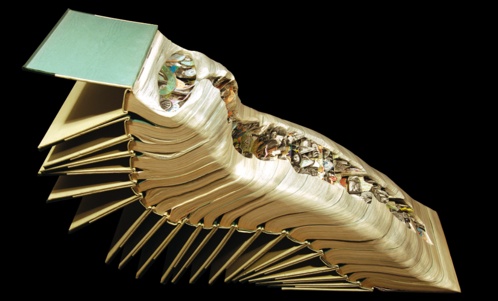
Altered Books and Memories


Brian Dettmer's new show of altered books prompts if:book's Sabastian Mary to wonder about "deeply-held taboos around the sanctity of books as objects":

Recycling, reimagining, repurposing the cultural glut amidst which we currently exist feels in many ways an appropriate artistic mode for today. Is authorship really so sacred that remixed works cannot themselves be things of beauty and value? Or, like European villages dismantling local medieval chateaux to build outhouses, are we taking our cultural history so completely for granted that we're in danger of forgetting or destroying millennia of culture in a thoughtless reappropriation of its materials for our current preoccupations?

Thursday, March 19, 2009

Tibetan books in Chinese media

The Chinese public relations campaign to influence Western views about Tibet includes--among headlines such as "Tibetans enjoy full religious freedom" and "Tibetan culture well preserved"--a couple of stories about Tibetan books and texts.

One video report from Xinhua Net shows the creation of a "Family Museum" to house a multi-volume Tibetan Buddhist classic after years of storage.


In another, Xinhua "China News" describes efforts to build "the largest stone sutra pagoda in Tibet" on Mount Chakpori opposite the Potala Palace in Lhasa, Tibet.

With a small mallet in one hand and a chisel in another, nine youngsters, sitting or squatting under a large piece of broken gray cloth shelter, are engraving lines of Tibetan sutra "Kangyur" into the stone slates. Less than 20 meters ahead is the pagoda, which is not yet completed after 14 years of construction, but embodies all their piety and faith to Buddha.

Tokdan Dawa Rinpoche, the sponsor of the pagoda, is sitting, with his legs crossed, on a carpet nearby the simple workshop, chanting sutras as throngs of devotees, with prayer wheels in hand, bowed to him and passed by, heading for the pagoda to pray along a dusty path.

As a tradition for centuries, Tibetan Buddhism believers engrave the sutras and Buddha images on stones as a way to keep the classics. It is also believed that the engravers, called "duoduo" in Tibetan, are able to achieve more happiness in their next lives through the toil of inscribing.

... usually a full set of Kangyur sutra includes 108 parts, each of which is written on a book of 200 to 400 pages. The engravers have finished inscribing the sutra and more than one million of stone slates piled into a 13-floor pagoda of more than 30 meters high.

... More than 100 engravers -- some from sophisticated stone-engraving families and some novices -- have volunteered to help build the pagoda. Most of them have worked here for five to six years though their pay for a whole-page Kangyur sutra is only 10 yuan (1.46 U.S. dollars).

... However, the beginning is always difficult.

As Zhoigar could not read, she just copied what she saw on the sutra book onto the stone.

"The characters were no more than some magic patterns to me at that time," recalled Zhoigar. "It also happened a lot that I had my fingers injured by the engraving tools, but the worst was that I wasted a lot of stone plates because of my mistakes, which made me cry a lot."

The tears are paid back after eight years of practicing. Zhoigar now can finish the engraving of an average of 20 stone slates every day at a speed of one Tibetan character in less than one second. She has also become a teacher for the newcomers.

"The more sutras I have engraved into the stones, the more Buddhism teachings I have engraved in my mind, which is far more important than how much money I have earned," said Zhoigar.

Arson burns Sikh scriptures

An arsonist set fire to London's Gurdwara Sikh Sangat on Tuesday, but it was the fate of the scriptures in the building that drew the emphatic attention of the Sikh and Indian press.

World Sikh News led it's story with: "As flames leapt and smoke billowed out, Sikh hearts cried at the thought of holy scriptures of Sri Guru Granth Sahib getting burnt inside this most famous of the London gurdwaras." It noted in the fourth paragraph that "The blaze, which caused the gurdwara’s roof to collapse, also engulfed all but one of the eight holy books it had housed" and quoted an onlooker: “It is like one of my gods is burning down—we worship our holy books as steps to God.”

Sify News also highlighted the scriptures in its lead: "One of London's most important gurdwara, housing priceless religious books, has been gutted in a suspected racist attack in Britain, a news report said on Tuesday."

Sindh Today included more information: "Singh said the women managed to save just one of the temple’s eight holy books before the flames took hold. 'I cannot describe how important those holy books were to the Sikh community,' he added."

Giant Qur'an sold


The Gulf News reports:

The third largest Quran in the world was sold in Abu Dhabi on Tuesday on the first day of the Abu Dhabi International Book Fair.

The manuscript which is 80cm by 120cm was displayed in the Antiquarian Book Fair which is being hosted for the first time at the event. The Quran, which was produced in 1890 in Indonesia, came about as a result of a request from wealthy people in Arabia. Indonesian calligraphers were known at that time for their high quality artwork, Ebergard B. Talke, a German antiquarian who was selling the Quran told Gulf News.

Thursday, March 12, 2009

Who owns Torah scrolls?

A dispute over ownership of four Torah scrolls has spilled out of the confidential confines of Jewish courts into Los Angeles District court, reports the Jewish Journal. The case pits a rabbi's widow, who claims the scrolls belong to her, against the rabbi who succeeded her husband who claims the scrolls belong to his congregation.

The case raises interesting questions regarding the Torah's iconic status as something more and different than just another book. The congregation's current rabbi,

Ohana disputes the very notion that the scrolls belong to Pauker, questioning whether they ever were family scrolls. Besides, he said, Torahs are owned by a community, not by a rabbi, a donor or anyone else. 'Sifrei Torah are not like money to change hands'.
(picture of Ohana from the LA Times)

He is refusing to accept the decision of a rabbinical court which disagreed with him and decided the case in favor of Mrs. Pauker. This pitting of community interests versus private ownership is reminiscent of the struggle to gather the fragments of the Aleppo Codex that remain in private hands.

April 9, 2009: The LA Superior Court judge reversed the rabbinical court's ruling and has awarded the scrolls to Rabbi Ohana and his congregation, according to the LA Times.

Friday, March 6, 2009

Cologne's Archives Collapse


Spiegel reported Tuesday on the sudden collapse of the building housing the city of Cologne's archives:

Disaster struck in Cologne on Tuesday, as the building housing the city's Historical Archive suddenly collapsed. According to city officials, two people are officially missing and believed dead. And hundreds of firefighters were on the scene Wednesday looking for survivors as Cologne historians and archivists mourned the apparent destruction of Germany's largest municipal archive.

... Cologne's archives are one of the only collections in Germany to have survived World War II completely intact. Because of Cologne's long history, much of its heritage was stored locally rather than in a state archive.

Cologne's history goes back more than 2000 years, when it was the Roman city of Colonia. In the Middle Ages, the city's prime spot along the Rhine River made it one of northern Europe's trading powerhouses, part of the Hanseatic League and a gateway between France and Germany. The Historical Archives contained extensive documentation from the city's Hanseatic period, as well as the archives of other Hanseatic League members, invaluable for historians looking at Europe's economic development.

The sheer numbers -- in total, the building had more than 18 kilometers of shelves -- reflect the rich history of what was once Germany's largest metropolis. The archive's collection of original documents included thousands from Cologne's golden age. The founding charter of the University of Cologne, signed in 1388, was inside, along with the documents that established Cologne as a free imperial city under Emperor Friedrich III in 1475. Two of the four manuscripts in the hand of Albertus Magnus, considered the greatest German theologian of the Middle Ages, were kept in the archive's rare books collection.

For historians trying to reconstruct the past, the greatest loss may be the more quotidian papers: Tens of thousands of receipts issued by the city government between 1350 and 1450, for example, or the 358 volumes of decisions and minutes of the Cologne City Council dating back 700 years.

The archives also contained the personal papers of almost 800 prominent German authors, politicians and composers, including Konrad Adenauer, the first post-war chancellor of Germany. The manuscripts and letters of Nobel Prize winner Heinrich Böll and Jacques Offenbach, a 19th century cellist and opera composer, were stored at the archive. Weimar Republic politician Wilhelm Marx and German-Jewish composer Ferdinand Hiller were among the other notables whose collections have been buried under tons of concrete. "These are fragile papers, that are now ground to dust," Illner told the daily.


... There may be no way to recover the lost collections. Large parts of the pre-1945 documents were put on microfilm and stored in a bunker in the Black Forest, but according to Illner the microfilm is of poor quality. And the post-war collections -- including records from the Cologne Art Association used to track the provenance of artworks -- have no back-up at all.

From the outside, the Historical Archive certainly looked indestructible. The bunker-like concrete structure was built in 1971, with a raw concrete façade and slit-like windows. Designers hoped the mass of concrete would keep the temperature inside constant without expensive air conditioning systems, an archive design that became known as the "Cologne model."

... The collapse may be connected with the construction of a new subway line under the street out in front of the archive.