Iconic books are texts revered as objects of power rather than just as words of instruction, information, or insight. In religious and secular rituals around the globe, people carry, show, wave, touch and kiss books and other texts, as well as read them. This blog chronicles such events and activities. (For more about iconic books, see the links to the Iconic Books Project at left.)

Friday, July 18, 2008

Burning Books by Fishburn


Palgrave Macmillan has released Burning Books by Matthew Fishburn. John Sutherland reviews the book in the Telegraph:

Matthew Fishburn's fascinating chronicle follows ritual book-burning through the ages, from the Old Testament's Jeremiah to those latter-day descendants of the venerable Caliph, who burnt The Satanic Verses in Bradford in January 1989 (warming the publisher's hearts in the process - nothing gets a book headlines faster than angry flames licking round it).

Sutherland comments that book burning "doesn't feel illiberal: it feels blasphemous." Yes, that's what we've been trying to point out ...

Wednesday, July 16, 2008

Book Arts at SU

Some local book arts news from Syracuse University libraries:

Book Arts exhibition on Bird Library sixth floor
- - - - - - - - - - - - - - - - -
This new exhibition in the hall exhibit case on the sixth floor of E.S. Bird library features an exploration of the book by students in Foundation Bookmaking (FND 116) and Hand Paper Print/Book workshop (PRT 552) in the College of Visual and Performing Arts. The exhibition is open from 9:00 a.m. to 5:00 p.m. Monday through Friday through August 21.

During the first 2008 summer session, students in the Foundation Bookmaking class taught by Assistant Prof. Chris Wildrick learned to make books that are image-intensive from both art and design points of view. Students learned to create their own books using several book-binding techniques and approaches, including accordions and scrolls, pamphlet bindings, Japanese bindings, coptic bindings, altered books, and interactive books. The class investigated how books are structured, both within one single page and from page to page throughout the book. They also learned about digital layout techniques using InDesign as well as the options available for online self-publishing. Students in the class were drawn from diverse areas of the University, and came with a wide range of interests, experience, and skills.

One day in the month of April, the book artists of PRT 552, the book arts class in the College of Visual and Performing Arts taught by Associate Professor Holly Greenberg, were told to make an exchange of books with the sole requirement that they fit inside a wooden box. The students created two separate exchanges of eight books apiece, totaling sixteen books in all. In the end the groups came up with two greatly diverse exchanges: “Dirt,” based upon the concept of what things we may want to keep hidden or secret, and “Home,” which played off the theme of rooms in a house and associations made with the space. All students were encouraged to use a variety of binding techniques and materials, as well as raise the question of “what is a book?” Both groups collaborated with the PRT 552 teaching assistant on the exterior design of their boxes.

Monday, July 14, 2008

Virtual shelves in virtual bookstore

As one more instance of virtual books imitating physical books as much as possible, Zoomii Books offers access to Amazon's books through an interface that looks like books on bookstore shelves. Sebastian Mary on if:book comments:

It's the most bookshop-like experience I've encountered online. Within seconds I'd been reminded of several books I've been meaning to read. ...

It's debatable, though, whether this kind of heavily-mediated pseudo-serendipity, while a pleasant change from the messy Amazon experience, isn't one metaphor too far. After all, how 'serendipitous' are the book thumbnails I find on its digitally-rendered 'shelves'?

From my perspective, this is another reminder that the iconicity of books has spread to social institutions, not just libraries and museums, but also bookstores. So as they become aware of it, web retailers will of course try to assimilate it and capitalize on it.

Saturday, June 14, 2008

Eternal Books

Though I share the Bibliophile Bullpen’s skepticism about Microsoft’s repeated claims that e-media will soon replace print media, the ancient historian in me has to take issue with her assertion that “PRINT is the longest lived media humanity has managed to create.”

Leaving aside media such as stones and metals too expensive for anything but monumental or ritual use, the honor for most durable written media must go to the clay tablet—the chief carrier of cuneiform script and the literatures of Mesopotamian and surrounding cultures for more than 2,000 years. Though easily broken, a fired ceramic tablet is otherwise virtually immune to the ravages of time. As a result, more documentation of daily life in second and first millennium B.C.E. Mesopotamia has survived than of most subsequent cultures who switched to using ink on parchment or papyrus, which were more convenient but much less durable.

In fact, changes in written media over the five-thousand-year history of writing have always tended towards greater impermanence. From clay tablets to parchment to papyrus (admittedly in use in Egypt as early as cuneiform tablets in Mesopotamia) to rag paper to wood-pulp paper and now to electronic media, the materials have become easier to use but less and less permanent.

Nevertheless, complaints about electronic media’s impermanence and mutability points to an important aspect of the book’s iconic status: texts are supposed to preserve their contents for the future. They represent an author’s hopes for immortality, a nation’s desire for permanence, a religion’s claim to eternal truth. Conscious of our heritage from previous generations, we cherish old texts as relics that connect us to the past. Conscious of our own mortality, we hope that “our” books will live on indefinitely.

The traditional codex makes that realistically possible and verifiably true of many texts. Electronic media show no sign of being able to offer the same hope.

Bible Recycling

Susan Olasky in World Magazine asks:

What should you do with old or damaged Bibles you no longer need? Michigan-based Christian Resources International (CRI) suggests several ways to put them to use. Operation Bare Your Bookshelf allows you to send used Bibles in good condition to people who need them overseas.

CRI is responding to what seems to be a widely felt need, at least as evidenced by the remarkable number of websites providing advice on disposing of Bibles: Wikihow, Answerbag, Everything2, Yahoo, Allexperts, Ehow, and Catholic Forum. Since unlike Jewish, Muslim and Sikh traditions, Christian denominations for the most part have no prescribed teachings on Bible disposal, this wide-spread concern may be produced by the obvious, if usually implicit, analogy between Christianity's iconic book and other sacred objects and/or by the influence of prominent media stories about controversies over the treatment of scriptures of other religious traditions.

Kindle: Smoldering in the Uncanny Valley?

Brian Cassidy on Book Patrol wonders if the Kindle e-book reader is too good to be readily acceptible:
Perhaps some of the resistance among bookaholics to e-readers such as the Kindle was due in part to a kind of biblio-version of The Uncanny Valley:

The uncanny valley is a hypothesis that when robots and other facsimiles of humans look and act almost, but not entirely, like actual humans, it causes a response of revulsion among human observers. (Wikipedia)

Is the Kindle - in the words of this classic bit from 30 Rock - just a bit too much "Tom Hanks in Polar Express" and not enough "R2-D2"?

On this blog, we might rephrase this observation to wonder: will resistence to e-books increase, rather than decrease, the more they assume an iconic book's form? Our observations to date suggest that it will depend on the kind of book in question, and to what extent the e-application might be perceived as endangering its iconic status (or possibly even enhancing it).

iTouch in a Book


Charlie Sorrell on Wired explains and shows how to make an iPod Touch look and feel like "a real book." He explains his motive:

Imagine seeing an attractive girl (or boy) sitting outside a pavement café, drinking an espresso, smoking a Gauloise and reading a tatty paperback. It's a romantic image which is shattered when you swap the book for a PDA. I decided to disguise my iPod as a book, and if that wasn't pretentious enough, I put it in a modded Moleskine, the notebook of choice for fops and dandies the world over.

Chris Meade on if:book describes this as "Stationary fetishism and gadget love meet in perfect union." It could equally well be described as "Gadget fetishism meets stationary love." As always when it comes to books and technology, it's all in the eye of the beholder. The question is, are the eyes of most beholders changing as rapidly as the technology? The evidence for the continuing iconicity of books suggests not ...

Sunday, June 8, 2008

Doctor Who Among the Books


Chris Meade on if:book points out that "Doctor Who, Britain's favourite time traveller, is trapped on a gigantic planet-sized library on BBC 1 this week. Electronic librarians oversee rows of very conventional looking dusty tomes and death lurks in the shadows. The Doctor has already told us how, despite all the advances in technology, future life forms still love nothing better than the smell and feel of a proper old book."

Saturday, June 7, 2008

Decorating with Books


Michael Lieberman of BookPatrol brings to our attention Book Decor, "specializing in designer leather-bound books." Under the heading, "Decorating a Home Library," decorative book dealer Leni Leith explains:

Our Danish printed, European imported books are sold specifically with interior design in mind. Many people feel that it's silly to purchase books for pure decorative value. While we certainly understand this, we also savor the opportunity to change the mind of such individuals! Our books are so beautiful on the outside that their interior ceases to be important. What's more, they are available for purchase by the foot as well as the yard. In other words, no more spending hours in used bookstores looking for space fillers. At Book Décor, this process takes a matter of seconds!

Lieberman points out that Book Decor is not the first to aim at this market: the Strand bookstore in New York has sold decorator collections of books by the foot for years.

Wednesday, May 28, 2008

New Testaments Burned in Israel

Several news outlets are reporting on an incident in Israel in which New Testaments were burned about two weeks ago. According to CNN's coverage, the deputy mayor of Or-Yehuda collected them and when he was not present, someone set them on fire:
News accounts in Israel have quoted Uzi Aharon, the deputy mayor of Or-Yehuda, as saying he organized students who burned several hundred copies of the New Testament. The deputy mayor gave interviews to Israeli radio and television stations after word of the incident surfaced about two weeks ago.

Soon he was talking with Russian, Italian and French television stations, "explaining to their highly offended audiences back home how he had not meant for the Bibles to be burned, and trying to undo the damage caused by the news (and photographs) of Jews burning New Testaments," The Jerusalem Post reported.

Aharon told CNN on Wednesday that he collected New Testaments and other "Messianic propaganda" that had been handed out in the city but that he did not plan or organize a burning. Instead, he said, three teenagers set fire to a pile of New Testaments while he was not present. Once he learned what was going on, he said, he stopped the burning.

[. . .]

About 200 New Testaments were burned, Aharon said, but he saved another 200.

His goal was to stop attempts to distribute Christian literature in the city, he said.

[. . .]

Myers said his complaint will ask the authorities to investigate possible violations of two Israeli laws. One forbids the destruction or desecration of any religious icon or item that a group holds sacred. Another bans people from speaking publicly in a way that offends or humiliates a certain religion.

Both laws are meant to prevent people from inciting religious violence, he said.
This incident (like the one involving a Qur'an this blog noted on May 17), the laws that pertain to it, and the responses to it continue to demonstrate that violence against books is understood by all parties involved as being comparable to violence against people and/or ideas and that violence against a book can quickly lead to other forms of conflict.

Tuesday, May 27, 2008

Word Art & Book Art

Michael Lieberman on BookPatrol points out:

The current issue of ArtAsiaPacific features an in depth look at artists who employ text in their work.

Articles include:

-A great piece on contemporary calligraphy in China, "Square Words, Round Paradigms" by Eric Wear.

-A look at Yoko Ono's embrace of online communities (Ono averages 200 new 'friends' on MySpace a day) by HG Masters.

-Gregory Galligan's looks at Islamic text-based art in his piece, "Architecture in Script: From Without Boundaries to Archive Fever," and includes Shirin Neshat whose iconic work appears above.

Also in this issue is Eliza Gluckman's profile of Sharmini Pereira and her publishing imprint, Raking Leaves, which focuses exclusively on artists using the printed book as the medium.

Museum of Scribes in Safed

A new museum will open this summer in Safed, Israel. Kiryat Hasofrim "Palace of the scribes" is intended, according to Chabad.org News,
to educate visitors about the Jewish scribal arts. Some 30 scribes will produce Torah scrolls, mezuzahs and tefillin in a factory on the premises.

... The centerpiece of the visitors center – aptly named Letters of Experience – will be a three-roomed exhibit that will take tourists on a whirlwind tour of the scribal arts, beginning with G-d’s creation of the world through the power of speech.

A movie will explain the spiritual significance and history of each of the Hebrew alphabet’s 22 letters, while a three-dimensional show will illustrate how animal hides and plants become the various parchments, boxes and inks used in the preparation of mezuzahs, tefillin and Torah scrolls.

“The idea that physical things can attain holiness is a central concept in Judaism,” explained Kaplan. “The exhibit will show how we take the world around us and make it holy.”
... The factory operations will be decidedly technologically-based, as well, with supervisors scanning every parchment and entering it into a computerized database, providing a quality-control mechanism previously unknown to the scribal community.

The Value of the Research Library

Robert Darnton, writing in The New York Review of Books, considers the future of the Library in an essay that ranges from the beginnings of writing through newspaper journalism and early modern novels to Google Books. Some excerpts:

... In place of the long-term view of technological transformations, which underlies the common notion that we have just entered a new era, the information age, I want to argue that every age was an age of information, each in its own way, and that information has always been unstable. ...

... Piracy was so pervasive in early modern Europe that best-sellers could not be blockbusters as they are today. Instead of being produced in huge numbers by one publisher, they were printed simultaneously in many small editions by many publishers, each racing to make the most of a market unconstrained by copyright. Few pirates attempted to produce accurate counterfeits of the original editions. They abridged, expanded, and reworked texts as they pleased, without worrying about the authors' intentions. They behaved as deconstructionists avant la lettre. ...

... to put it positively, there is something to be said for both visions, the library as a citadel and the Internet as open space. ... Google Book Search, the largest undertaking of them all, will [not] make research libraries obsolete. On the contrary, Google will make them more important than ever. ... the totality of world literature—all the books in all the languages of the world—lies far beyond Google's capacity to digitize. ... Electronic enterprises come and go. Research libraries last for centuries. Better to fortify them than to declare them obsolete, because obsolescence is built into the electronic media. ...

... Unless the vexatious problem of digital preservation is solved, all texts "born digital" belong to an endangered species. The obsession with developing new media has inhibited efforts to preserve the old. We have lost 80 percent of all silent films and 50 percent of all films made before World War II. Nothing preserves texts better than ink imbedded in paper, especially paper manufactured before the nineteenth century, except texts written on parchment or engraved in stone. The best preservation system ever invented was the old-fashioned, pre-modern book. ...

... It is important to get the feel of a book—the texture of its paper, the quality of its printing, the nature of its binding. Its physical aspects provide clues about its existence as an element in a social and economic system; and if it contains margin notes, it can reveal a great deal about its place in the intellectual life of its readers.

Books also give off special smells. According to a recent survey of French students, 43 percent consider smell to be one of the most important qualities of printed books—so important that they resist buying odorless electronic books. CaféScribe, a French on-line publisher, is trying to counteract that reaction by giving its customers a sticker that will give off a fusty, bookish smell when it is attached to their computers. ...

... Meanwhile, I say: shore up the library. Stock it with printed matter. Reinforce its reading rooms. But don't think of it as a warehouse or a museum. While dispensing books, most research libraries operate as nerve centers for transmitting electronic impulses. They acquire data sets, maintain digital re-positories, provide access to e-journals, and orchestrate information systems that reach deep into laboratories as well as studies. Many of them are sharing their intellectual wealth with the rest of the world by permitting Google to digitize their printed collections. Therefore, I also say: long live Google, but don't count on it living long enough to replace that venerable building with the Corinthian columns. As a citadel of learning and as a platform for adventure on the Internet, the research library still deserves to stand at the center of the campus, preserving the past and accumulating energy for the future.

Saturday, May 17, 2008

U.S. Soldier Shoots at Qur'an

The gravity with which religious texts are handled is on full display in this CNN article about an American soldier in Iraq who used a Qur'an for target practice and the wide-reaching political responses following the act:
A soldier used the Quran -- Islam's holy book -- for target practice, forcing the chief U.S. commander in Baghdad to issue a formal apology on Saturday.

Maj. Gen. Jeffery Hammond, commander of U.S. forces in Baghdad, apologized to leaders in Radhwaniya, in the western outskirts of Baghdad, for the staff sergeant who was a sniper section leader assigned to the headquarters of the 64th Armored Regiment. He also read a letter of apology by the shooter.

[. . .]

Copies of the pictures of the Quran obtained by CNN show multiple bullet holes and an expletive scrawled on one of its pages.

[. . .]

Sheikh Hamadi al-Qirtani, in a speech on behalf of all tribal sheiks of Radhwaniya, called the incident "aggression against the entire Islamic world."

The Association of Muslim Scholars in Iraq also condemned the shooter's actions and the U.S. military's belated acknowledgment of the incident.

[. . .]
The incident provides another example that a book is often understood as much more than merely its contents, and that to damage a book is to wage war on the ideas articulated within its pages and on the people who value those ideas.

Thursday, May 15, 2008

Isaiah Scroll back in the Shrine of the Book


As part of the commemorations of the State of Israel's 60th anniversary, the Israel Museum will display major sections of the Qumran Isaiah scroll from May 16 through August 30th, reports ArtDaily. The permanent display for the Dead Sea Scrolls in "the Shrine of the Book" was designed in 1965 to present the Isaiah scroll in the elevated spindle at its center. Concerns for the preservation of the scroll, however, resulted in its being replaced by a facsimile for most of the past 40 years. Now it will reappear temporarily in the place designed for it.

Wednesday, May 14, 2008

For Sale: The Ten Commandments from the Ten Commandments


A very iconic copy of a very iconic text can now be yours! (for $60K or so)

NEW YORK (AP) — Thou shalt find the Ten Commandments up for bid this summer.

A pair of faux granite tablets that Charlton Heston cradled in the 1956 biblical epic "The Ten Commandments" is expected to fetch as much as $60,000, said Marc Kruskol, a publicist for the auction Profiles in History. It is the fourth set of tablets that remains from the film that featured Heston as Moses.

... The auction runs July 31-Aug. 1.

3D Book in Video


This video not only shows off an ingenious abecedary; it also suggests a good way to display (and advertise) book art. Books and book art do not fit well into the kind of static displays favored by museums and libraries, as I've noted before. Here video solves the problem of how to show people the whole book when they can't, or shouldn't, handle it themselves.

Click "menu" for videos of some other pop-up books. (h/t Lu Terceiro)

Monday, May 12, 2008

Private Libraries

Dan Visel, writing on if:book, tells of visiting a sumptuous private library at the invitation of the anonymous owner:

Just about every lavish book imaginable was present: an elephant folio of Audobon along with a full set of John Gould's more sumptuous prints of birds; a Kelmscott Chaucer; a page from a Gutenberg Bible; a first edition of Johnson's Dictionary; countless antique atlases of anatomy and cosmography; the Arion Press edition of Ulysses illustrated by Robert Motherwell; hand-illuminated Books of Hours. There were exquisite jeweled bindings, books woven entirely from silk, and doubtless many more things that couldn't be seen in a three-hour tour. The collector mentioned in passing that he was thinking of buying a Wyclif Bible for around $600,000 because he didn't have one yet.

... The collector can afford to let his visitors touch his books. In a way, the books in his collection are functioning as they are intended to function: as objects to be read and appreciated. They're also functioning as signifiers of luxury. His collection is a repository of wealth in a way less metaphorical than we usually talk about library as repositories. No library, private or public, exists entirely outside of this economic system; it's an integral part of the way we consider books.

I would gloss this statement only by deleting "also." The books "function as they were inteded to function, ... as signifiers of luxury." The iconic function of a sumptuous (or rare or old or popular) book conveys status and prestige, to individual collectors but also to institutions, whether libraries, universities or governments.

Visel goes on to describe how university libraries also restrict access and invest in security, and house their books in buildings like fortresses. Making an architectual show of limiting access is a time-honored way of drawing attention to the important treasures inside.

Thursday, April 17, 2008

Torah Scrolls Stolen

The Kenosha News reports that a Torah Scroll was stolen sometime in the last two weeks from an Orthodox synagogue in the Wisconsin town. The thieves seem to have understood the iconic value of the scroll since they took only it and a laptop computer, leaving behind silver handles and other objects of value. Ron Sanders, president of Congregation Bnai Zedek Chabad, "theorized that the theft might have been an attempt to sabotage the upcoming Passover holiday, which begins Saturday at sundown; members of the Orthodox congregation would not have been able to conduct complete services without their holy scrolls." Another synagogue, however, is loaning Bnai Zedek Chabad one of their Torahs so that Passover services can go ahead.

Thursday, April 10, 2008

"WE THE PEOPLE" and Glenn Beck's Look at the U.S. Constitution

In an editorial posted on CNN, TV political pundit Glenn Beck argues that America needs a Twelve Step Program to rid itself of certain faults. Of interest to this 'blog's area of study is his first step, which proposes a reading of the United States Constitution based primarily on visual cues in the manuscript.
Step One: Admit we are not powerless.

Take a look at our Constitution. Not just a transcript; find an actual picture of it. The first three words, "We the People," are at least four times larger than the others. Do you think that was an accident? Of course not. Our framers chose those words, and made them that size, because they knew they were the answer to any problem we would ever face.
Claiming to know the framers' intentions is a common move in interpreting the Constitution. Beck's use of that move here is reminiscent of the second assumption of the four that James L. Kugel identifies as common among readers of the Bible in his How to Read the Bible: "Interpreters also assumed that the Bible was a book of lessons directed to readers in their own day. It may seem to talk about the past, but it is not fundamentally history." For Beck, the choice to magnify those first three words signals an important timelessness and relevance transcending the document's 18th-century definition of a nation.

He is, however, curiously silent on the almost equally large "Article 1" that follows the Preamble.

Wednesday, April 9, 2008

Guru Granth's Anniversary Procession


To mark the 300th anniversary of the Sikh scripture later this year, an elaborate procession is traversing India. Large crowds come to catch a glimpse of an early hand-written copy of the Guru Granth carried in a glass-enclosed van. World Sikh News reports:
The historic march carrying the handwritten copy of Guru Granth Sahib scribed by Baba Deep Singh and the shastars (armory) of Guru Gobind Singh ji has the mission to spread the significance of the Shabad Guru concept from Nanded to the whole wide world. Traversing the length and breadth of India, the march has become a rallying point for Sikhs to focus on the upcoming celebrations.

Disposable Books


English Russia posts pictures of an abandoned library in Russia with the comment: "Years before, during the Soviet Rule, books were considered to be the greatest treasure. Children in schools were taught to treat the books with care and love. It seems now this doesn’t work. At least at some libraries."

The pictures find a broader context in a post-Soviet industrial wasteland on Trouble World. But it's the pictures of rooms full of discarded books that are catching blogger's attention (see here and here and here). With comments like "book graveyard" and "something is terribly wrong" in addition to English Russia's "greatest treasure ... care and love," they illustrate again the iconic status of books.

Tuesday, April 8, 2008

Favorites vs. Best Sellers

A Harris Poll released April 7th asked "What is your favorite book of all time?" The 2,513 American adults surveyed mentioned the Bible most often, followed by nine novels starting with Gone With the Wind.

It's interesting that when people think of their "favorite books," they think of scripture and novels. Sales figures suggest that they actually buy a much wider range of genres. Wikipedia's list of all-time best sellers ("most published" would be more accurate, since many of these are often given away) also starts with the Bible, but novels have to compete for space in the rest of the list not only with other scriptures (unlike the Harris Poll, this list attempts to span the globe) but also with prayer books, scouting manuals, dictionaries, etc. Wikipedia's list unaccountably omits cookbooks, which are perennial sales leaders.

The difference between "favorites" and best sellers points again to the relative iconicity of different kinds of books. Scriptures and novels have the most iconic status, while handbooks, dictionaries, and especially phone books may have little or virtually none.

Friday, April 4, 2008

Book Cart Art?


Book art we know about, but now there's book cart art. Unshelved presents the second annual "pimp my bookcart" competition winners.

Tuesday, April 1, 2008

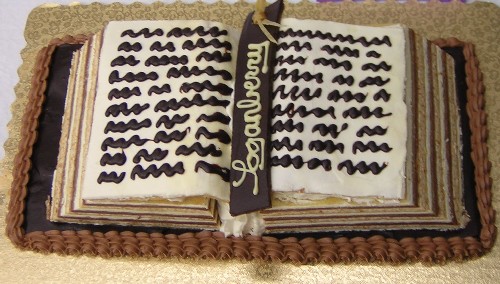
April 1: Edible Book Festivals!

Since 1999, April 1st has been celebrated by increasing numbers of libraries and bookstores with "Edible Book Festivals." According to International Edible Books Festival, the date was chosen because:

April 1st is the birthday of French gastronome Jean-Anthelme Brillat-Savarin (1755-1826), famous for his book Physiologie du goût, a witty meditation on food. April fools' day is also the perfect day to eat your words and play with them as the "books" are consumed on the day of the event. This ephemeral global banquet, in which anyone can participate, is shared by all on the internet and allows everyone to preserve and discover unique bookish nourishments. This festival is a celebration of the ingestion of culture and a way to concretely share a book; it is also a deeper reflexion on our attachment to food and our cultural differences.

I have not found sites posting pictures of this year's entries yet, but for past years' constructions, among many others see:

Yale University Arts Library

Duke University Libraries

Logenberry Books


(h/t Wendy Bousfield)

Tuesday, March 25, 2008

The UnIconic Book


Paul Collins in Slate Magazine asks “Why won’t phone books die?” The question was prompted by Microsoft Chairman Bill Gates’ claim that “Yellow Page usage among people, say, below 50, will drop to zero—or near zero—over the next five years” (Bill Gates: Reading to go "completely online"). Collins counters with industry figures:

Printed phone books are a maturing industry, with only about six in 10 businesses and individuals still regularly relying on them. Yet even as directories hemorrhage content to the Web and to unlisted cell numbers, enough oldsters—those, say, who still recall physically dialing numbers in a rotary motion—continue using them enough to keep profits rolling in.

The phone book’s physical and economic ubiquity over the past century is undeniable:

The humble phone book spent the 20th century as the prince of print jobs. When AT&T gave all 2,400 local editions the same bicentennial-commemorative cover, the resulting run of 187 million copies probably became the most-reproduced book cover of all time. ... The phone book is the one book guaranteed to be present in every household, no matter how little else the occupants read. Even in a vacant apartment, you'll still find old phone books in the kitchen cabinet. ... Last year, according to the industry group the Yellow Pages Association, approximately 615 million directories were printed in the United States alone, generating revenues of $13.9 billion. Some quick math tells me that's more than $22 in revenue per copy. And, what's more, those revenue figures are growing.

By one meaning of the word “iconic,” people’s instant recognition of phone books by their size, shape and color as well as their ubiquity should make them a paradigmatic “iconic book.” But Collins points out:

Yet the phone book's ubiquity has given it an invisibility. ... despite being the most popular printed work ever, there's never been a single scholarly monograph on the phone book.

Those observations go to the heart of what makes a book iconic. It is ritual. By “ritual,” I mean practices that draw attention to books and makes people conscious of how they are using and reading them (applying the ritual theory of Jonathan Z. Smith). Religious processions with scriptures, political oath ceremonies, and sales of textual amulets all ritualize the physical form and image of books or other texts. But people also ritualize books—that is, they draw sustained and conscious attention to them—by interpreting their meaning (in scholarly monographs, among many other media) and also by performing the text through recitations, songs, art, theater, and film. People in different cultures, times and place ritualize different books to different degrees along each of these three dimensions.

Phone books, however, are ritualized in none of their dimensions. Not only has their semantic form and cultural significance remain uninterpreted, but the idea of “performing” their text or contents is ludicrous. As to their physical form, no one protests if they are burned, mutilated, or otherwise destroyed (unless it is out of concern for environmental impact, which as Collins notes must be considerable). By the analysis we’re employing here, phone books are the most uniconic of books.

Thinking about such uniconic books lets us nuance our theories. For one thing, I need to ditch my simple definition of an iconic book as “a book you can recognize from fifty feet away.” Phone books, especially Yellow Pages, can easily be recognized at a distance just as bibles can, but that characteristic has not endowed them with cultural worth and significance.

Uniconic books may also help us grasp the likely effects of transforming texts into digital media. To the degree that a book simply serves as an information source, like the phone book does, it can be replaced by computer searches without readers feeling any loss. That does not mean, however, that “reading will go completely online,” as Bill Gates maintains. To the degree that people ritualize books and other texts along the iconic dimension, that is, to the degree that they pay conscious attention to how they look and feel, how they carry them and their own posture as they read them, such iconic books will remain major features of human cultures.

That is not to say that iconic texts won’t be adapted to new media. I think biblical texts were digitized and marketed in electronically searchable forms sooner than phone books, and elicited no complaints from the devout (at least that I’ve heard). The difference lies rather in the fact that the disappearance of physical bibles is unimaginable, while the eventual disappearance of physical phones books seems very likely. As this blog is documenting, the iconic status of various kinds of books preserves and even enhances their appeal in the age of digital information.

Wednesday, March 19, 2008

J. K. Rowling's Tales of the Beedle Bard


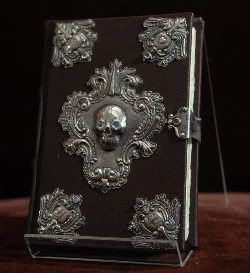
J.K. Rowling's Tales of the Beedle Bard began as a book referenced in one of the Harry Potter novels and now exists as seven iconic books. The book purchased by Amazon.com (for just under GBP£2 million/USD$4 million) draws on traditional medieval grimoire imagery, including silver ornaments and and a skull for an appropriately wizardly appearance. Amazon's announcement of its purchase of one of the seven books draws attention to its physical qualities in the second paragraph of the article:
The Tales of Beedle the Bard is extensively illustrated and handwritten by the bard herself--all 157 pages of it. It's bound in brown Moroccan leather and embellished with five hand-chased hallmarked sterling silver ornaments and mounted moonstones.
Bookbinders and collectors might be particularly interested in the large, detailed photos following the Amazon article.

Shema on Golden Amulet

Ha'aretz reports that Austrian archeologists found a 3rd century C.E. silver pendant containing a golden scroll. Engraved on the scroll is the Shema (Deuteronomy 6:4) in Hebrew but transliterated in Greek letters: "suma Istrahl adwne elwh adawt n a" with alpha, the first letter in the Greek alphabet used as the numeral one substituting at the end for the Hebrew word echad "one." The pendent had been buried with a two-year old boy in a Roman graveyard at Halbturn. Its discovery provides evidence for Jewish migration to the area in this period or earlier.

Sunday, March 16, 2008

Iconic Books in New Double-Issue of Journal

A thematic double-issue (2.2-3) of the journal Postscripts: The Journal of Sacred Texts and Contemporary Worlds has just appeared (despite the cover date of 2006!). It focuses on the social functions of scriptures and features several articles specifically about iconic books. These ideas inform the rationale for this blog, since I edited the special issue and all the blog contributors wrote articles in it. The articles are therefore worth summarizing here to provide readers with a theoretical and comparative framework for the observations that regularly appear in this space. I think each article justifies a separate post:

Parmenter, "The Iconic Book"

Watts, "The Three Dimensions of Scriptures"

Malley, "The Bible in British Folklore"

Krause-Loner, "Be-Witching Scripture"

Waldron compares Homer with Tanakh

Heyman, "Canon Law and the Canon of Scripture"

Pasulka, "Pre-Modern Scriptures in Postmodern Times"

Yoo on Korean Scripture Reading Rituals

Castelli, on Horne's "The Tailenders"

Parmenter, "The Iconic Book"

Dorina Miller Parmenter, in “The Iconic Book: The Image of the Bible in Early Christian Rituals,” Postscripts 2 (2006): 160-189, describes the ritual display and manipulation of Bibles in Greek Orthodox and Protestant traditions. She argues that the Christian scripture functions in a manner precisely analogous to Orthodox icons. Bibles, therefore, are “iconic” in the strict sense—a fact recognized by medieval theologians engaged in the iconoclastic controversies of the seventh-ninth centuries. Dori argues that our recognition of this fact would enable us to better understand the social and religious function of scriptures in other periods and cultures as well. She concludes:

The iconophiles’ justifications for how icons function as mediators of the divine presence can help scholars today understand the veneration that has been shown to the Christian Bible in diverse, yet often unconscious, ways throughout Christian history. This reverence for the Bible as both text (Word) and object (Book) can be found in rituals that treat the book as if it were the divine presence itself and in myths that offer imagery of powerful divine books made available to humans. These rituals and myths linger in contemporary Christian attitudes, ideas, and practices: most overtly in formal liturgical rituals such as Gospel processions, but also in low-church Protestant displays of the Bible. The latter may be less formalized than the former, but they nevertheless manipulate the same image of the divine presence made possible through the medium of the book. (p. 184)

The full article is available in .pdf from Equinox publishing.

Watts, "Three Dimensions of Scriptures"

Failure to consider scriptures’ function as icons has left modern scholars of religion nonplussed by the continuing power and influence of scriptures in twenty-first century culture. In “The Three Dimensions of Scriptures,” Postscripts 2 (2006) 135-159, I build on Dori’s work by asking how the iconic nature of scriptures interacts with their other aspects. I argue that all texts function in three dimensions: iconic, performative and semantic. What distinguishes scriptures from other texts is that religious communities ritualize all three dimensions to a lesser or greater extent. Through ritual, scriptures’ dimensions convey different kinds of social power—the iconic dimension of scriptures conveys legitimacy, the performative dimension conveys inspiration, and the semantic dimension conveys authority. “The explanatory value of recognizing the three dimensions of scriptures does not depend on them being ritualized to the same degree in all times and places: they are not. It rather helps explain the religious tendency towards ritualizing scriptures in all three dimensions. It also provides a means for explaining the social effects of doing so” (p. 148).

The full article in .pdf is available here from Equinox publishing. It was reprinted in Iconic Books and Texts (ed. J. W. Watts; London: Equinox, 2013), 9-32. A pre-print repository version is available here from Syracuse University.

Malley, "Bible in British Folklore"

Brian Malley, in “The Bible in British Folklore,” Postscripts 2 (2006) 241-272, marshals a great deal of archival evidence for the magical use of Bibles in early-modern Britain. He concludes that “the British laity seem to have exploited the Bible as text and artifact in rather different ways than ecclesiastical Christianity.”

The evidence shows that (1) in contrast to the church’s emphasis on the Bible’s meaning, the laity exploited the Bible’s textual and artifactual properties as supernatural means to practical ends; (2) charmers made use of particular biblical (or taken-for-biblical) texts, whereas the Bible generally was used in exorcisms, which seem to have remained the purview of clergy; (3) lay traditions about the Bible seem to have been focused on specific issues, though a general uncertainty about what powers Bibles might have is also indicated. (p. 241)

The full article is available in .pdf from Equinox publishing.

Krause-Loner, "Be-Witching Scripture"

Shawn Krause-Loner, in “Be-Witching Scripture: The Book of Shadows as Scripture within Wicca/Neopagan Witchcraft,” Postscripts 2 (2006) 273-292, describes the history, contents and ritual function of grimoires in Neo-Pagan/Wiccan practice. Through a review of their history, form and uses, he employs the three-dimensional model of scriptures to show that the Book of Shadows functions for practitioners analogously to how other scriptures function for their religious communities. Shawn argues that, despite the fluid and personalized contents of a Book of Shadows, its iconic status is rapidly promoting the textualization and fixation of this primarily ritual tradition. Thus the development of the Book of Shadows in contemporary Neo-Pagan/Wiccan traditions parallels the development and social function of the Torah in ancient Judaism, when it also evolved from an iconic ritual scroll to become a fixed text with authority over much more than just ritual practices. I find this conclusion particularly intriguing, because it shows the value of comparative scriptures studies by illustrating some of the models of scripture formation in antiquity with much more easilty documented contemporary examples.

The full article is available in .pdf from Equinox publishing.

Waldron compares Homer with Tanakh

The remaining essays take up the functional uses of scriptures and other texts in various cultures and contexts. Cordell M. Waldron, in “From Performance to Casket Copy: Comparing the Homeric Epics with the Tanakh as Scriptures,” Postscripts 2 (2006) 190-208, asks why Homeric epics, despite their unrivaled influence in ancient Greek society, did not function as scripture in the way that the Jewish Torah did and does. Though the Homeric poems shaped the imagination of vase painters and even, in Hellenistic times, functioned occasionally as iconic material books, oral performance dominated Greek use of their national epic:

While both Greeks and Jews formulated their national identities around their favored stories, they did so in very different ways. The Jewish Tanakh commands and exemplifies a text-centered community in which that which is written is most important. The Greek Homeric poems portray a world characterized by oral performance in the Iliad’s tearful conversation between Priam and Achilles and the Odyssey’s bards. Writing is suspect; orality is privileged. Greece had no great collection of commentary upon commentary around Homer to compare to the Mishnah and midrash, but neither does ancient Judaism have an Aeschylus or Euripides. (p. 206)

The full article is available in .pdf from Equinox publishing.

Heyman, "Canon Law and the Canon of Scripture"

George Heyman, in “Canon Law and the Canon of Scripture,” Postscripts 2 (2006) 209-225, charts similar developments in Roman Catholic teachings about the Bible on the one hand and canon law on the other. He argues that using the common term “canon” for each betrays their common interest in social control. On the basis of M. B. ter Borg’s theory of canon, Heyman argues:

The success of a canon follows not from the assent or agreement of the populace, but rather from the embedded quasi-personal relationship that produces a sense of belonging and identity. The objectified canon takes over this quasi-personal feature, which guarantees a canon’s sanctity. Calling scripture or law “canonical” thus transcendentalizes a text and allows it to retain a sacred quality that in turn effects social control through a shared sense of belonging. This thesis is confirmed and elaborated through a review of the conceptions of canon operative in the Catholic Church during the thirteenth, the sixteenth, and the late nineteenth and twentieth centuries. In all these periods, the Catholic Church modified its conception of the canonical nature of both its scriptures and its laws in order to strengthen corporate identity and to establish order and control within and without its perimeter. (p. 209)

The full article can be read here in .pdf from Equinox publishing.

Pasulka, "Pre-Modern Scriptures in Postmodern Times"

Three essays focus particular attention on the function of performative readings of scriptures. In “Pre-modern Scriptures in Postmodern Times: The Philosophical Movement to Revive Traditional Reading Practices,” Postscripts 2.2-3 (2006) 293-315, Diana Walsh Pasulka notes that reading as a kind of individual devotional performance has been the subject of much recent theorizing. She provides a review and critical analysis of philosophical attempts by Wesley Kort, Paul Griffiths and Catherine Pickstock to revive pre-modern scriptural reading practices. These thinkers argue “that is it the very loss of scripture as performance that has inaugurated a loss of the sacred in modernity. This development thus tackles the philosophical issues at stake between secularism and theology and moves beyond the localized analysis of the meaning of specific scriptures” (p. 293). Diana compares their theoretical move to Martin Heidegger’s attempt to use ancient notions of art to similarly recover a sense of the sacred. Like him, Kort, Griffiths, and Pickstock “each hopes to instill in his or her readers a belief that the experience of the sacred is possible in the present. In this way, each is part of a movement within contemporary Christian religious thought that is reassessing the function of scriptures in conveying sacred presence” (p. 313).

The full article is available here from Equinox publishing.

Yoo on Korean Scripture Reading Rituals

Yohan Yoo, in “Public Scripture Reading Rituals in Early Korean Protestantism: A Comparative Perspective,” Postscripts 2.2-3 (2006) 226–240, describes the importance of public Bible readings for the spread of Christianity in early twentieth-century Korea. His case study shows clearly how the performative dimension of scriptures can aid cross-cultural transferals of scriptures.

The particular ways in which the Bible was read in the Korean context contributed to the growing number of converts to Christianity. Bible readings in the context of study groups in early Korean Protestantism facilitated the absorption of Christianity into Korean culture by building on traditional religious practices and by offering a way for native Koreans to take the lead in the growth of the new religion. (p. 226)

In the Korean Bible study meetings, the contents of the read words was given performative force by the ritualization of the reading experience and the ritualization of the Bible itself. (p. 237)

The full article can be read here from Equinox publishing.

Castelli, on Horne's "The Tailenders"

The performative dimension of scriptures is also the subject of the final essay, Elizabeth Castelli’s interview with film-maker, Adele Horne (Postscripts 2 [2006] 316–327). Horne’s 2006 documentary, The Tailenders, explores missionaries’ distribution of extremely low-tech recordings of Bible stories and their reception by communities in crisis.

Focusing on oral transmission by working with native speakers of indigenous languages, [Global Recordings Network] makes recordings of the stories and distributes them in low-tech formats using “hand-crank” technologies. The film emphasizes the linkages between Christian missionary groups and processes of capitalist globalization, between Protestant values and the technologies of modernity. (p. 316).

The full interview can be read here from Equinox publishing.

Monday, March 10, 2008

Lecture on Iconic Books

I will be lecturing on "Iconic Books: The Power of the Image of the Text" at the Vero Beach Museum of Art this Wednesday (March 12th) at 3:30 pm.

Saturday, March 8, 2008

Why do we blog?

A “meme” circulating among bibliobloggers (e.g. Biblicalia, Iyov) asks “Why do you blog?” I want to answer this one because I think the motives behind the Iconic Books Blog are somewhat unusual. It may help readers to have them spelled out.

This is a research blog. By that, I mean it’s primary purpose is data collection about iconic books. Sometimes we also provide some preliminary analysis of that data; more often we refer readers to longer discussions elsewhere. But the main point of this effort is to collect and catalog references to iconic books and texts on the web.

Why iconic books on the web? Many of us who study this subject (including all four of the contributors to this blog) tend to research the iconic uses of texts in cultures both long ago and far away. We note the prominence of books in ancient rituals and art and spin theories about their social significance. This kind of research can leave the impression that these practices distinguish ancient cultures from modern ones, that book magic and rituals are dying if not already dead in the “information age,” that a focus on textual meaning rather than material form characterizes modern culture.

I think those conclusions are quite wrong. Attention to books, book forms, and book images in contemporary culture remains very strong. This blog aims to demonstrate that claim by compiling examples wherever we find them on the internet of the iconicity of books and texts.

Why the blog format? Constructing a visual and textual database presents problems of organization, indexing, collaboration and presentation—problems which the Iconic Books Project has to face in deciding how to use and distribute the database we’ve been building for six years. Blogs provide convenient tools for compiling and cataloging materials on the web and simultaneously sharing them with other researchers. So this blog is an experiment in the use of blogging as a collaborative research tool.

Of course, the blog format can probably not resolve all of our databasing issues. Copyrighted printed materials should not be reproduced on a public blog. Web materials move or disappear at an alarming rate, so older links rapidly go dead. And, despite its size and diversity, the web does not evenly represent cultural phenomena, but slices of cultures biased by language, technological access, and selective interests, among other things.

But the Iconic Books Blog can at least highlight the web evidence for the larger claim that iconic books and texts remain a powerful and under-studied religious and secular phenomenon.

Friday, March 7, 2008

Athenaeum Article in the NYTimes

Where does one keep that special kind of books? In a special kind of library, of course.

The March 7 online issue of the New York Times presents "Where Greek Ideals Meet New England Charm," an article about several New England athenaeums. The article includes several examples of the users of these "bookish sanctuaries" remarking that it is often the physical appearance of a book that is important, and that the right physical appearance can reveal something about the contents. Some athenaeums catalog their books based on physical qualities rather than by content.
[Richard Wendorf, director and librarian of the Boston Athenaeum] added that athenaeum methods of stacking books (by size or by several different or proprietary systems) also promote serendipitous discoveries.

“This is browsing at its very best,” he said, emphasizing that the entire book stock of the Boston Athenaeum, save for rare vaulted materials, is available for members to explore. “The physicality of books often is very important.”

[. . .]

“Some members look for novels with the most-tattered covers,” Ms. [Jean Marie] Procious [director of the Salem Athenaeum] explained. “They figure these were the most widely read and must be the best.”

Jim Watts: The LA Times recently featured a story on home libraries that also emphasized book display: "In a city derided for its cerebral shortcomings, the home library -- once merely a quaint signature of old money -- is asserting itself as a showcase for personal taste, designers say...."

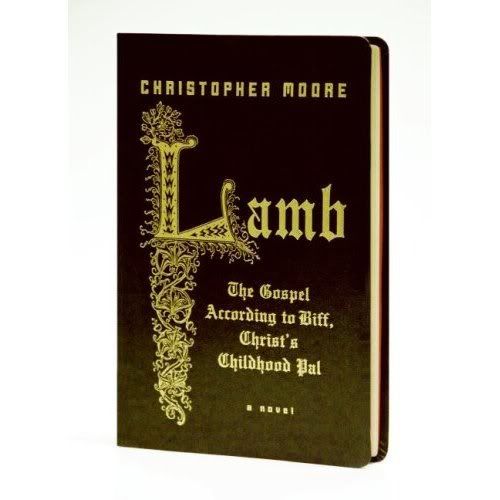
Christopher Moore's Lamb: Special Gift Edition


Christopher Moore's humorous novel Lamb: The Gospel According to Biff, Christ's Childhood Pal has been republished in a new Special Edition binding that should be familiar to fans of iconic books. This edition has the floppy faux-leather cover, the gilt-edged pages, and the red ribbon bookmark that typically set off a traditional Bible as a different kind of book. Here we see that at least one kind of iconicity is common enough to make parody effective.


Monday, March 3, 2008

Bookshelf Design

Michael Lieberman on Book Patrol observes that bookshelf design seems to be flourishing (see this gallery of recent designs, Lu Terceiro's regular "shelf of the day" feature, and the new blog, Bookshelf). He wonders:

Has bookcase design exploded or has the internet simply brought us all closer together with visual (and commercial) opportunities unheard of a generation ago?

Is it possible for the internet to be both withering and strengthening the book at the same time?

I don't know the answer to his first question. The evidence amassed on this blog suggests, though, that the answer to his second question is: "Rumors of the death of the book have been vastly exaggerated ..."

Wednesday, February 27, 2008

Lunacy and the Arrangement of Books

Lynn Wienck on BookPatrol calls attention to Terry Belanger's slim volume, Lunacy and the Arrangement of Books (Oak Knoll, 2003). The publisher calls it an "essay on the idiosyncrasies of book arrangements by collectors over the centuries," such as in this selection:

One promising method for detecting madness among book dealers, book collectors, and librarians is to examine the manner by which they arrange their books on their shelves. As a modest contribution to the literature of this subject, I propose to discuss the lunatic arrangement of books according to principles of color, size, number, aesthetics, subject order, Grangerization, and kleptomania.

Various sorts of books have, either formally or informally, taken advantage of color in their titles: think of Andrew Lang's multi-colored fairy books, of The Yellow Book (or of the Yellow Pages, for that matter), or of governmental White Papers. Meanings can become complicated: by Blue Book, for example, we might mean a guide to the prices of used cars, a college examination writing book, a handbook of contract bridge bids, the Social Register, or a book of etiquette; and determining the intended meaning depends on context. To a politician, a Blue Book is a government report; and because Blue Books tend to proliferate like Mediterranean fruit flies, one can understand the reply made by an Edinburgh bookseller to a woman who came into his shop one day and said she wanted a set of Blue Books: "I don't keep any, but 1 will procure what you want from the Stationery Office, What is the subject?"

"The subject? The subject doesn't matter, I want them in blue,"

With the help of a piece of blue tapestry which the customer had in her hand, the bookseller at length grasped that it was books of a certain shade of blue binding that she desired-books to match her carpet and the curtains in her living room. Once his mind "had coped with the initial absurdity of the idea of buying books for the colour of their binding," he found her an easy and profitable client. The blue books he sold her included E. H. Young's The Misses Mallett, Somerset Maugham's The Moon and Sixpence, and Kenneth Grahame's Wind in the Willows.

The Edinburgh bookseller concluded that he was a house decorator as well as a bookseller: he decorated minds and rooms.

My only quibble has to do with labeling such behavior "madness." Concern for how books look and how they should be displayed are as old as the invention of writing, and remain very widespread, as this blog continues to document. Such common behaviors must be motivated by more than insanity ...

Monday, February 25, 2008

Books Changing Galleries

Several entries here have already commented on the long-standing influences of books' iconicity on library architecture. Now there's a first sign that the rise of book art may influence, if not the architecture than at least the furnishing of art galleries.

Tom Sowden and Lucy May Schofield created "sitting rooms" for book art in the touring exhibition they curated at several galleries in 2007. Sowden explains:

We both wanted to present a show where we could lose the preciousness that can surround an artist’s book. Let them become the tactile and interactive objects that they are usually conceived as being. Take them out of glass cases, out of libraries and away from the artist’s book fairs, resituating them in an environment that was conducive to reading and engaging with the books.

To both of us and to many who choose to work with the book form, handling is of prime importance. The ideas and experience are only available to a viewer if it is picked up and leafed through. We felt we had to create an easier atmosphere for the visitor to spend time with the books. In discussing the components that we would like in the show (comfy chairs, rug, lamps, bookcase or shelves) we quickly realized that what we were hoping to re-create was a sitting room, or perhaps more specifically the impression of a sitting room from a bygone age.

(h/t BookPatrol)

Saturday, February 23, 2008

A House for the Mind


Fiona MacCarthy, in The Guardian, profiles Colin St. John Wilson (1922-2007), the architect of the (new) British Library.

The driving force for the library was his own bookishness. Colin (always known as Sandy) St John Wilson was born in 1922, the year of Ulysses and The Waste Land, Wittgenstein's Tractatus, Mandelstam's Tristia and the last volume of Proust. For him, an ideal library had a certain aura close to that of the solemn sacred spaces of the Anglican churches and cathedrals he grew up in. His father was a notably radical bishop of Chelmsford and an expert on the 17th-century Divines. He was brought up understanding that books were a protected species and libraries were bastions of intellectual freedom. As he wrote: "One has only to recall the destruction of the library in Alexandria or, akin to that fire, the blasphemy that underlay the burning of the books by Nazi decree, for one to be aware that the library and what it houses embody and protect the freedom and diversity of the human spirit in a way that borders on the sacred."

His first ambition would have been to build a great cathedral, but a library came second. He retained a childlike vision of a "magic mountain of all the knowledge in the world".

Pallant House Gallery in Chichester is exhibiting Wilson's art collection in a gallery that he designed, and reflects on his career in the exhibit, "Colin St John Wilson: Collector and Architect."

Friday, February 22, 2008

"Living off the Bible"

Jeff Sharlet on The Revealer reviews Brett Grainger's new memoir of his Plymouth Brethren family, In The World But Not Of It: One Family's Militant Faith and the History of Fundamentalism in America (Walker, 2008). Sharlet comments: "Most compelling is Grainger's insider/outsider observations of his grandparents' everyday religion, such as the following passage describing in terms as perceptive as any I've read the relationship between religion and media, the ways in which the physical embodiments of faith reveal the nuances of a religion that from the outside may appear to be nothing more than a blunt cudgel of doctrine. It's worth reproducing in full:

Everything in the daily life of the Brethren revolved around reading and digesting the Word. They lived off the Bible the way the Great Plains Indians lived off the buffalo. No part was waste. Horns, spleen, tail -- everything had its proper use and purpose. All Scripture was inspired of God and worthy for instruction. Even the vast intestinal stretches of I Chronicles, the endless coils of begats, were laid in the sun to dry, then used to carry water. Not a day passed when they did not search the Scriptures for comfort or correction. The Word waited on the nightstand. It stared down from bookcases and dozed in glove compartments. Women carried a small, tidy volume in their purses. The men's were considerably larger. A believer's Bible was expected to age at roughly the same pace as his body. Elderly brothers carried copies that were battered and falling to pieces, with sagging spines and missing pages. Such Bibles were highly prized. They marked a man well acquainted with the Word. My grandfather's Bible was little more than a patch of rawhide wrapped around a ragged sheaf of pages. The binding was broken and whole chapters were missing or out of order, but he always seemed to be able to find what he needed.
"

Sunday, February 17, 2008

High Design Bible Mag


Graphically innovative Bibles do not just appear in the style of graphic novels and comics, manga or otherwise. The Wall Street Journal reports on The Bible Illuminated:

The Swedish-language Bible marries the standard text to glossy magazine-style design. Full-color pages are illustrated with a striking combination of news and dramatized photographs: a homeless child wrapped in a sweater on the streets of Bogotá, Colombia, illustrates the book of Job; a man who drowned trying to enter Europe, for Deuteronomy; and models posing in stylized scenes convey joy or despair. Bible passages are pulled out as captions.

... "There are 40 million [glossy] magazines sold each year in Europe," says Dag Söderburg, creative director at the edition's Swedish publishers, Förlaget Illuminated. "But the Bible, a literary treasure, stays on the bookshelf."

The work is aimed not at a religious audience but rather at readers concerned with ethical and philosophical questions surrounding issues such as global warming and religious fundamentalism.

The article also mentions other bibles in various graphic formats, including Thomas Nelson's glossy magazine version aimed at teenage girls. It notes that such innovative publishing formats have aroused little religious controversy, either in Sweden or America.

That observations stands in stark contrast to the media attention some of these innovations get (see my previous post about manga bibles). There seems to be a disjunction between what the media think Christians should find outrageous, and the indifference that actually meets such marketing ploys. In fact, innovative marketing of Bibles is often applauded as Christian outreach, just as the Swedish publisher presents it. In the case of the Bible, at least, the book's iconic status seems unaffected by its ever changing formats.

Thursday, February 14, 2008

Theorizing Scriptures

Rutgers University Press has published Theorizing Scriptures: New Critical Orientations to a Cultural Phenomenon. This volume, edited by Vincent Wimbush, inaugurates the Signifying on Scriptures book series. It contains Wimbush's introduction setting forth a programatic agenda for scripture studies and twenty-seven essays by scholars representing diverse fields of expertise and perspectives.

Tuesday, February 12, 2008

Book-binder's Ritual Art


Maybe Quarterly (Spring, 2006) features the grimoire bindings of Paul Tronson. In an interview, the master book-binder describes his ritual practices when creating a grimoire's binding:

The main problem was that in order for it to become active and remain a very powerful tool I would need to be completely faithful in consecrating each seal and sigil which would need to be produced within the day and hour of it’s planet. Also a different Latin verse corresponding to each seal was chanted so the book was blessed and empowered during every part of it’s creation ...
Compare my previous post on restoring sacred objects. Tronson's own website provides considerably more information (and pictures) of the book-binders art, including his restoration of a Geneva Bible.

Sunday, February 10, 2008

Another Manga Bible

Following a trend we've already mentioned with Tyndale House's Manga Messiah and Manga Bible, Doubleday has also released a graphic novel, The Manga Bible: From Genesis to Revelation. The New York Times profile of the book and author includes reactions from academics, including this:

“It is the end of the Word as we know it, and the end of a certain cultural idea of the Scriptures as a book, as the Book,” Timothy Beal, professor of religion at Case Western Reserve University, said of the reworking of the Bible in new forms, including manga. “It opens up new ways of understanding Scripture and ends up breaking the idols a bit.”

That opinion sounds distinctly odd, given the long tradition of illuminating Bibles, including entirely graphic "Pauper's Bibles," from the Middle Ages on, and more recent illustrated children's Bibles (usually heavily edited and paraphrased), not to mention renderings of biblical stories in art, drama and film. I find nothing new in this development except for the employment of a new artistic style. Outside the studies of some theologians, publishing and using Bibles has rarely been just about words, as the article's short history of Bible publishing demonstrates. Its divergent contents reveal the gap between much academic thinking about writing and books on the one hand, and the material reality of their production, sale and use on the other.
(Thanks to Andrew for the tip.)

Saturday, February 9, 2008

Is there growing contempt for books?

A news story and a blog entry both raise this question, though in opposite ways that are interesting.

Emilia Askari reports in the Detroit Free Press that "even the most popular libraries have some books on the back shelves or in the basement that no one ever wants to read." Discomfort with discarding or destroying books leads many libraries and people to find alternative means of disposal. So besides selling them at rummage sales and giving them away, the Bloomsfield Public Library decided to exhibit art works made from these unwanted volumes. One of the artists found the experience of sculpting with books and branches very positive: "I love sculptural things, and I love books, and I love trees."

But blogger Lynn Wienck on Book Patrol takes such book art as one piece of evidence of growing contempt for books.

I like books for themselves finding sufficient beauty in printed words, illustrations, and bindings. Atmosphere, mystery, and excitement are found among the simple black-and-white lines of text. Why then are books utilized to generate art, furniture, lamps, and clocks? The art is superb, creative, and fresh, but books are cut, drilled, and painted for a final product having nothing to do with reading skills. It seems a travesty, a mockery, of the original intent of the volume.

One could let this pass as yet another example of how different people have opposite values. However, both the news story and the blog account start with the wide-spread view that, due to cultural changes fueled in part by evolving technology and capitalistic commodification, books have lost value in many people's eyes.

The suspicion that this assumption is quite wrong led me to create this blog. All the varied instances of iconic books and texts indexed by the labels at left show that their veneration remains quite high, especially as measured by the crass scales of consumer culture, whether in terms of record auction prices or total numbers of books sold, but also as reflected in religious, political, and personal practices world-wide. Of course, many people dislike many of the uses to which books are put. But such disagreements, and especially the vehemence with which they are often expressed, only underscore the iconic status of books in the first place.

Tuesday, January 29, 2008

Free information, expensive books

Sotheby's sale of the Magna Carta last month led James Gleick the NYTimes Magazine to meditate insightfully in on the diverging value of information vis-a-vis physical documents and books:

Twenty-one million is, by far, the most ever paid for a page of text, and therein lies a paradox: Information is now cheaper than ever and also more expensive. Mostly, of course, information is practically free, easier to store and faster to spread than our parents imagined possible.

... The value of the particular item sold at Sotheby’s eight centuries later is entirely different. It’s a kind of illusion. We can call it magical value as opposed to meaningful value. It’s like the value acquired by one baseball when Bobby Thomson batted it out of the Polo Grounds. A physical object becomes desirable, precious, almost holy, by common consensus, on account of a history — a story — that is attached to it. (If it turns out you’ve got the wrong baseball, the value vanishes just as magically.)

... In advance of the sale, Sotheby’s called Magna Carta “a lamp in the darkness, a glowing talisman of our human condition, a sacred icon of our human history.” Just so. It’s magic. Religious relics, like the Shroud of Turin, gleam invisibly with the same magic. On a smaller scale so do autographs, coins, rare photographs, Stradivari violins (unless you think you can recognize the tonal quality of 300-year-old wood) and clothing off the backs of celebrities, like the spare wedding dress (ivory silk taffeta) that Diana might have worn but didn’t (2005, $175,000).

... But the growth in the ranks of the superrich does not explain the hypertrophy in magical value. Just when digital reproduction makes it possible to create a “Rembrandt” good enough to fool the eye, the “real” Rembrandt becomes more expensive than ever. Why? Because the same free flow that makes information cheap and reproducible helps us treasure the sight of information that is not. A story gains power from its attachment, however tenuous, to a physical object. The object gains power from the story. The abstract version may flash by on a screen, but the worn parchment and the fading ink make us pause. The extreme of scarcity is intensified by the extreme of ubiquity.

Michael Lieberman of BookPatrol connects Glieck's observations to recent news that books sales, both on the internet and in stores, are up substantially around the world. He comments:

So while the race is on to free the content from the book, the actual book itself, the original house for the content, becomes in fact more desirable.

Precisely. Despite the electronic revolution in information, the iconic value of books in general, and of relic books and texts in particular, has never been higher.

Monday, January 28, 2008

Soundprint Radio "Who Needs Libraries?"

"Books to me were magical physical objects, as well as magical literary ones."

Soundprint Radio's Lisa Simeone's sense that books have a magical quality is one that I think this 'blog's users are pretty familiar with. Last weekend's broadcast "Who Needs Libraries?" is not specifically about scripture, but it does contain a number of points that might be of interest regarding iconic books, including the host's childhood impressions of the smell and magic of books and and a great description of the shrine-like Folger Shakespeare Library vault (complete with stained glass windows, church architecture, a crypt, and 79 copies of the iconic First Folio). The program goes on to consider the challenges posed to libraries in an age of digitization, Google, and Internet books.

The audio program may be streamed through RealPlayer, and the links for RealPlayer are provided on the Soundprint site linked above.

Saturday, January 26, 2008

Review of People of the Book

Jeremy Dibbell, of PhiloBiblos, writes a beautiful review of Geraldine Brooks new novel, People of the Book (Viking, 2008). The novel features the 14th-century Sarajevo Haggadah, interweaving its history into the contemporary plot. Dibbell comments:

There's a message here for those of us who study books as artifacts - there are stories there, real people's stories, and although they may be impossible to get at really, we should think of them.

As Hanna is preparing her essay about the Haggadah to accompany the exhibition catalogue, Brooks has her say "I wanted to give a sense of the people of the book, the different hands that had made it, used it, protected it. I wanted it to be a gripping narrative, even suspenseful" (pp. 264-265).

Saturday, January 19, 2008

PhD program in "Texts, Contexts, Cultures"

Mark Bertrand, on Bible Design & Binding, points out a new set of PhD scholarships in Ireland:

"Dr Crawford Gribben, who is the Long Room Hub Senior Lecturer in Early Modern Print Culture at Trinity College in Dublin -- as well as a reader of this blog -- e-mailed me with some news that will be of interest to academics in the audience. He's directing a new PhD program at Trinity College and has twelve fully-funded scholarships to award. Here are the details:

12 fully-funded 4-year PhD scholarships are available for Arts and Humanities research in Trinity College Dublin

A new interdisciplinary and inter-institutional PhD pathway for research in Arts and Humanities has been launched by Trinity College Dublin in conjunction with NUI Galway and University College Cork. 12 four-year scholarships of fees plus €16,000 per annum are available for those who wish to pursue this pathway as students of Trinity College Dublin. Other scholarships are being offered by NUI Galway and University College Cork. The scholarship competition at Trinity College Dublin is open to both EU and non-EU applicants. The closing date for entry is 1 March 2008.

Texts, Contexts, Cultures has been designed to prepare students for life in academia – and beyond. First-year students will develop their research through multi-institutional training elements in the pathway's core themes – History of the Book, Imaging Ireland and Renaissance intellectual history – much of which training will be delivered through audiovisual and online networks. Research will be supervised by multi-institutional scholarly panels. Students will also be provided with the opportunity for work placement in the knowledge economy sector.

Dr John Hegarty, Provost of Trinity College Dublin, commented that the Texts, Contexts, Cultures pathway "represents an exciting new beginning for higher education in Ireland and for higher education itself."

Full details can be found on www.textscontextscultures.ie . All enquiries should be directed to Dr Crawford Gribben, the Director of Texts, Contexts, Cultures at Trinity College Dublin (crawford.gribben@tcd.ie).

Dr. Gribben teaches a course focusing on Renaissance Bibles, including their design and binding! There's a PDF course description online that gives a flavor -- "Group exercises will include the preparation of an online annotated edition of part of an individual Biblical book, which edition will compare the forms and contents of
various early modern texts, translations and multimedia receptions"."

Friday, January 18, 2008

Bullet in My Breast Pocket

From the early standup of Woody Allen:

Years ago, my mother gave me a bullet...a bullet, and I put it in my breast pocket. Two years after that, I was walking down the street, when a berserk evangelist heaved a Gideon bible out a hotel room window, hitting me in the chest. Bible would have gone through my heart if it wasn't for the bullet.

For contemporary manifestations of the Bible/bullet scenario, see Cordell's previous post.

Monday, January 14, 2008

Warehousing Books

Some time ago, the Guardian reported on the British Library's construction of a warehouse to house surplus volumes. " The British Library's UK national collection is currently expanding at the rate of 12.5 kilometres of shelf space a year, and somewhere has to be found to put it all." The warehouse, which will provide "262 linear kilometres of high-density, fully automated storage in a low-oxygen environment ... is being meticulously constructed to house things that no one wants."

Geoff Manaugh, writing on BldgBlog, comments that this warehouse and others like it being built by Oxford and Cambridge "aren't libraries, of course; they're stockpiles. Text bunkers. ... No matter if no one actually visits these places; they're our era's equivalent of pharaonic tombs. They're time capsules." Elsewhere he notes the religious influence on library construction: " Interesting, though, that religious beliefs could affect both the shape and the very existence of libraries."

Yes, but what is this religion that values books by the kilometer?