

 Posts
Posts


Thursday, April 17, 2008
Torah Scrolls Stolen
The Kenosha News reports that a Torah Scroll was stolen sometime in the last two weeks from an Orthodox synagogue in the Wisconsin town. The thieves seem to have understood the iconic value of the scroll since they took only it and a laptop computer, leaving behind silver handles and other objects of value. Ron Sanders, president of Congregation Bnai Zedek Chabad, "theorized that the theft might have been an attempt to sabotage the upcoming Passover holiday, which begins Saturday at sundown; members of the Orthodox congregation would not have been able to conduct complete services without their holy scrolls." Another synagogue, however, is loaning Bnai Zedek Chabad one of their Torahs so that Passover services can go ahead.


Thursday, April 10, 2008
"WE THE PEOPLE" and Glenn Beck's Look at the U.S. Constitution
In an editorial posted on CNN, TV political pundit Glenn Beck argues that America needs a Twelve Step Program to rid itself of certain faults. Of interest to this 'blog's area of study is his first step, which proposes a reading of the United States Constitution based primarily on visual cues in the manuscript.
He is, however, curiously silent on the almost equally large "Article 1" that follows the Preamble.
Step One: Admit we are not powerless.Claiming to know the framers' intentions is a common move in interpreting the Constitution. Beck's use of that move here is reminiscent of the second assumption of the four that James L. Kugel identifies as common among readers of the Bible in his How to Read the Bible: "Interpreters also assumed that the Bible was a book of lessons directed to readers in their own day. It may seem to talk about the past, but it is not fundamentally history." For Beck, the choice to magnify those first three words signals an important timelessness and relevance transcending the document's 18th-century definition of a nation.
Take a look at our Constitution. Not just a transcript; find an actual picture of it. The first three words, "We the People," are at least four times larger than the others. Do you think that was an accident? Of course not. Our framers chose those words, and made them that size, because they knew they were the answer to any problem we would ever face.
He is, however, curiously silent on the almost equally large "Article 1" that follows the Preamble.
Wednesday, April 9, 2008
Guru Granth's Anniversary Procession

To mark the 300th anniversary of the Sikh scripture later this year, an elaborate procession is traversing India. Large crowds come to catch a glimpse of an early hand-written copy of the Guru Granth carried in a glass-enclosed van. World Sikh News reports:
The historic march carrying the handwritten copy of Guru Granth Sahib scribed by Baba Deep Singh and the shastars (armory) of Guru Gobind Singh ji has the mission to spread the significance of the Shabad Guru concept from Nanded to the whole wide world. Traversing the length and breadth of India, the march has become a rallying point for Sikhs to focus on the upcoming celebrations.
Disposable Books

English Russia posts pictures of an abandoned library in Russia with the comment: "Years before, during the Soviet Rule, books were considered to be the greatest treasure. Children in schools were taught to treat the books with care and love. It seems now this doesn’t work. At least at some libraries."
The pictures find a broader context in a post-Soviet industrial wasteland on Trouble World. But it's the pictures of rooms full of discarded books that are catching blogger's attention (see here and here and here). With comments like "book graveyard" and "something is terribly wrong" in addition to English Russia's "greatest treasure ... care and love," they illustrate again the iconic status of books.
Tuesday, April 8, 2008
Favorites vs. Best Sellers
A Harris Poll released April 7th asked "What is your favorite book of all time?" The 2,513 American adults surveyed mentioned the Bible most often, followed by nine novels starting with Gone With the Wind.
It's interesting that when people think of their "favorite books," they think of scripture and novels. Sales figures suggest that they actually buy a much wider range of genres. Wikipedia's list of all-time best sellers ("most published" would be more accurate, since many of these are often given away) also starts with the Bible, but novels have to compete for space in the rest of the list not only with other scriptures (unlike the Harris Poll, this list attempts to span the globe) but also with prayer books, scouting manuals, dictionaries, etc. Wikipedia's list unaccountably omits cookbooks, which are perennial sales leaders.
The difference between "favorites" and best sellers points again to the relative iconicity of different kinds of books. Scriptures and novels have the most iconic status, while handbooks, dictionaries, and especially phone books may have little or virtually none.
It's interesting that when people think of their "favorite books," they think of scripture and novels. Sales figures suggest that they actually buy a much wider range of genres. Wikipedia's list of all-time best sellers ("most published" would be more accurate, since many of these are often given away) also starts with the Bible, but novels have to compete for space in the rest of the list not only with other scriptures (unlike the Harris Poll, this list attempts to span the globe) but also with prayer books, scouting manuals, dictionaries, etc. Wikipedia's list unaccountably omits cookbooks, which are perennial sales leaders.
The difference between "favorites" and best sellers points again to the relative iconicity of different kinds of books. Scriptures and novels have the most iconic status, while handbooks, dictionaries, and especially phone books may have little or virtually none.
Friday, April 4, 2008
Book Cart Art?

Book art we know about, but now there's book cart art. Unshelved presents the second annual "pimp my bookcart" competition winners.
Tuesday, April 1, 2008
April 1: Edible Book Festivals!
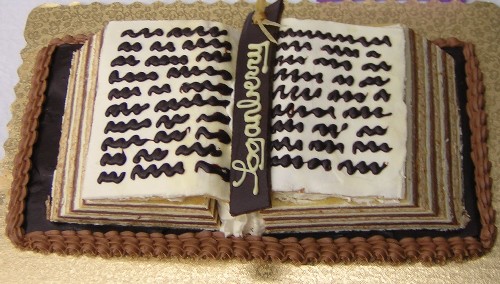
Since 1999, April 1st has been celebrated by increasing numbers of libraries and bookstores with "Edible Book Festivals." According to International Edible Books Festival, the date was chosen because:
April 1st is the birthday of French gastronome Jean-Anthelme Brillat-Savarin (1755-1826), famous for his book Physiologie du goût, a witty meditation on food. April fools' day is also the perfect day to eat your words and play with them as the "books" are consumed on the day of the event. This ephemeral global banquet, in which anyone can participate, is shared by all on the internet and allows everyone to preserve and discover unique bookish nourishments. This festival is a celebration of the ingestion of culture and a way to concretely share a book; it is also a deeper reflexion on our attachment to food and our cultural differences.
I have not found sites posting pictures of this year's entries yet, but for past years' constructions, among many others see:
Tuesday, March 25, 2008
The UnIconic Book

Paul Collins in Slate Magazine asks “Why won’t phone books die?” The question was prompted by Microsoft Chairman Bill Gates’ claim that “Yellow Page usage among people, say, below 50, will drop to zero—or near zero—over the next five years” (Bill Gates: Reading to go "completely online"). Collins counters with industry figures:
Printed phone books are a maturing industry, with only about six in 10 businesses and individuals still regularly relying on them. Yet even as directories hemorrhage content to the Web and to unlisted cell numbers, enough oldsters—those, say, who still recall physically dialing numbers in a rotary motion—continue using them enough to keep profits rolling in.
The phone book’s physical and economic ubiquity over the past century is undeniable:
The humble phone book spent the 20th century as the prince of print jobs. When AT&T gave all 2,400 local editions the same bicentennial-commemorative cover, the resulting run of 187 million copies probably became the most-reproduced book cover of all time. ... The phone book is the one book guaranteed to be present in every household, no matter how little else the occupants read. Even in a vacant apartment, you'll still find old phone books in the kitchen cabinet. ... Last year, according to the industry group the Yellow Pages Association, approximately 615 million directories were printed in the United States alone, generating revenues of $13.9 billion. Some quick math tells me that's more than $22 in revenue per copy. And, what's more, those revenue figures are growing.
By one meaning of the word “iconic,” people’s instant recognition of phone books by their size, shape and color as well as their ubiquity should make them a paradigmatic “iconic book.” But Collins points out:
Yet the phone book's ubiquity has given it an invisibility. ... despite being the most popular printed work ever, there's never been a single scholarly monograph on the phone book.
Those observations go to the heart of what makes a book iconic. It is ritual. By “ritual,” I mean practices that draw attention to books and makes people conscious of how they are using and reading them (applying the ritual theory of Jonathan Z. Smith). Religious processions with scriptures, political oath ceremonies, and sales of textual amulets all ritualize the physical form and image of books or other texts. But people also ritualize books—that is, they draw sustained and conscious attention to them—by interpreting their meaning (in scholarly monographs, among many other media) and also by performing the text through recitations, songs, art, theater, and film. People in different cultures, times and place ritualize different books to different degrees along each of these three dimensions.
Phone books, however, are ritualized in none of their dimensions. Not only has their semantic form and cultural significance remain uninterpreted, but the idea of “performing” their text or contents is ludicrous. As to their physical form, no one protests if they are burned, mutilated, or otherwise destroyed (unless it is out of concern for environmental impact, which as Collins notes must be considerable). By the analysis we’re employing here, phone books are the most uniconic of books.
Thinking about such uniconic books lets us nuance our theories. For one thing, I need to ditch my simple definition of an iconic book as “a book you can recognize from fifty feet away.” Phone books, especially Yellow Pages, can easily be recognized at a distance just as bibles can, but that characteristic has not endowed them with cultural worth and significance.
Uniconic books may also help us grasp the likely effects of transforming texts into digital media. To the degree that a book simply serves as an information source, like the phone book does, it can be replaced by computer searches without readers feeling any loss. That does not mean, however, that “reading will go completely online,” as Bill Gates maintains. To the degree that people ritualize books and other texts along the iconic dimension, that is, to the degree that they pay conscious attention to how they look and feel, how they carry them and their own posture as they read them, such iconic books will remain major features of human cultures.
That is not to say that iconic texts won’t be adapted to new media. I think biblical texts were digitized and marketed in electronically searchable forms sooner than phone books, and elicited no complaints from the devout (at least that I’ve heard). The difference lies rather in the fact that the disappearance of physical bibles is unimaginable, while the eventual disappearance of physical phones books seems very likely. As this blog is documenting, the iconic status of various kinds of books preserves and even enhances their appeal in the age of digital information.
Wednesday, March 19, 2008
J. K. Rowling's Tales of the Beedle Bard
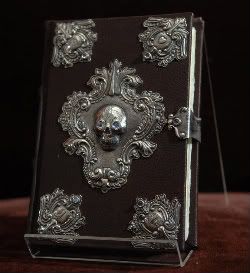
J.K. Rowling's Tales of the Beedle Bard began as a book referenced in one of the Harry Potter novels and now exists as seven iconic books. The book purchased by Amazon.com (for just under GBP£2 million/USD$4 million) draws on traditional medieval grimoire imagery, including silver ornaments and and a skull for an appropriately wizardly appearance. Amazon's announcement of its purchase of one of the seven books draws attention to its physical qualities in the second paragraph of the article:
The Tales of Beedle the Bard is extensively illustrated and handwritten by the bard herself--all 157 pages of it. It's bound in brown Moroccan leather and embellished with five hand-chased hallmarked sterling silver ornaments and mounted moonstones.Bookbinders and collectors might be particularly interested in the large, detailed photos following the Amazon article.
Shema on Golden Amulet
 Ha'aretz reports that Austrian archeologists found a 3rd century C.E. silver pendant containing a golden scroll. Engraved on the scroll is the Shema (Deuteronomy 6:4) in Hebrew but transliterated in Greek letters: "suma Istrahl adwne elwh adawt n a" with alpha, the first letter in the Greek alphabet used as the numeral one substituting at the end for the Hebrew word echad "one." The pendent had been buried with a two-year old boy in a Roman graveyard at Halbturn. Its discovery provides evidence for Jewish migration to the area in this period or earlier.
Sunday, March 16, 2008
Iconic Books in New Double-Issue of Journal
A thematic double-issue (2.2-3) of the journal Postscripts: The Journal of Sacred Texts and Contemporary Worlds has just appeared (despite the cover date of 2006!). It focuses on the social functions of scriptures and features several articles specifically about iconic books. These ideas inform the rationale for this blog, since I edited the special issue and all the blog contributors wrote articles in it. The articles are therefore worth summarizing here to provide readers with a theoretical and comparative framework for the observations that regularly appear in this space. I think each article justifies a separate post:
Parmenter, "The Iconic Book"
Watts, "The Three Dimensions of Scriptures"
Malley, "The Bible in British Folklore"
Krause-Loner, "Be-Witching Scripture"
Waldron compares Homer with Tanakh
Heyman, "Canon Law and the Canon of Scripture"
Pasulka, "Pre-Modern Scriptures in Postmodern Times"
Yoo on Korean Scripture Reading Rituals
Castelli, on Horne's "The Tailenders"
Parmenter, "The Iconic Book"
Watts, "The Three Dimensions of Scriptures"
Malley, "The Bible in British Folklore"
Krause-Loner, "Be-Witching Scripture"
Waldron compares Homer with Tanakh
Heyman, "Canon Law and the Canon of Scripture"
Pasulka, "Pre-Modern Scriptures in Postmodern Times"
Yoo on Korean Scripture Reading Rituals
Castelli, on Horne's "The Tailenders"
Parmenter, "The Iconic Book"
Dorina Miller Parmenter, in “The Iconic Book: The Image of the Bible in Early Christian Rituals,” Postscripts 2 (2006): 160-189, describes the ritual display and manipulation of Bibles in Greek Orthodox and Protestant traditions. She argues that the Christian scripture functions in a manner precisely analogous to Orthodox icons. Bibles, therefore, are “iconic” in the strict sense—a fact recognized by medieval theologians engaged in the iconoclastic controversies of the seventh-ninth centuries. Dori argues that our recognition of this fact would enable us to better understand the social and religious function of scriptures in other periods and cultures as well. She concludes:
The full article is available in .pdf from Equinox publishing.
The iconophiles’ justifications for how icons function as mediators of the divine presence can help scholars today understand the veneration that has been shown to the Christian Bible in diverse, yet often unconscious, ways throughout Christian history. This reverence for the Bible as both text (Word) and object (Book) can be found in rituals that treat the book as if it were the divine presence itself and in myths that offer imagery of powerful divine books made available to humans. These rituals and myths linger in contemporary Christian attitudes, ideas, and practices: most overtly in formal liturgical rituals such as Gospel processions, but also in low-church Protestant displays of the Bible. The latter may be less formalized than the former, but they nevertheless manipulate the same image of the divine presence made possible through the medium of the book. (p. 184)
The full article is available in .pdf from Equinox publishing.
Watts, "Three Dimensions of Scriptures"
Failure to consider scriptures’ function as icons has left modern scholars of religion nonplussed by the continuing power and influence of scriptures in twenty-first century culture. In “The Three Dimensions of Scriptures,” Postscripts 2 (2006) 135-159, I build on Dori’s work by asking how the iconic nature of scriptures interacts with their other aspects. I argue that all texts function in three dimensions: iconic, performative and semantic. What distinguishes scriptures from other texts is that religious communities ritualize all three dimensions to a lesser or greater extent. Through ritual, scriptures’ dimensions convey different kinds of social power—the iconic dimension of scriptures conveys legitimacy, the performative dimension conveys inspiration, and the semantic dimension conveys authority. “The explanatory value of recognizing the three dimensions of scriptures does not depend on them being ritualized to the same degree in all times and places: they are not. It rather helps explain the religious tendency towards ritualizing scriptures in all three dimensions. It also provides a means for explaining the social effects of doing so” (p. 148).
The full article in .pdf is available here from Equinox publishing. It was reprinted in Iconic Books and Texts (ed. J. W. Watts; London: Equinox, 2013), 9-32. A pre-print repository version is available here from Syracuse University.
The full article in .pdf is available here from Equinox publishing. It was reprinted in Iconic Books and Texts (ed. J. W. Watts; London: Equinox, 2013), 9-32. A pre-print repository version is available here from Syracuse University.
Malley, "Bible in British Folklore"
Brian Malley, in “The Bible in British Folklore,” Postscripts 2 (2006) 241-272, marshals a great deal of archival evidence for the magical use of Bibles in early-modern Britain. He concludes that “the British laity seem to have exploited the Bible as text and artifact in rather different ways than ecclesiastical Christianity.”
The full article is available in .pdf from Equinox publishing.
The evidence shows that (1) in contrast to the church’s emphasis on the Bible’s meaning, the laity exploited the Bible’s textual and artifactual properties as supernatural means to practical ends; (2) charmers made use of particular biblical (or taken-for-biblical) texts, whereas the Bible generally was used in exorcisms, which seem to have remained the purview of clergy; (3) lay traditions about the Bible seem to have been focused on specific issues, though a general uncertainty about what powers Bibles might have is also indicated. (p. 241)
The full article is available in .pdf from Equinox publishing.
Krause-Loner, "Be-Witching Scripture"
Shawn Krause-Loner, in “Be-Witching Scripture: The Book of Shadows as Scripture within Wicca/Neopagan Witchcraft,” Postscripts 2 (2006) 273-292, describes the history, contents and ritual function of grimoires in Neo-Pagan/Wiccan practice. Through a review of their history, form and uses, he employs the three-dimensional model of scriptures to show that the Book of Shadows functions for practitioners analogously to how other scriptures function for their religious communities. Shawn argues that, despite the fluid and personalized contents of a Book of Shadows, its iconic status is rapidly promoting the textualization and fixation of this primarily ritual tradition. Thus the development of the Book of Shadows in contemporary Neo-Pagan/Wiccan traditions parallels the development and social function of the Torah in ancient Judaism, when it also evolved from an iconic ritual scroll to become a fixed text with authority over much more than just ritual practices. I find this conclusion particularly intriguing, because it shows the value of comparative scriptures studies by illustrating some of the models of scripture formation in antiquity with much more easilty documented contemporary examples.
The full article is available in .pdf from Equinox publishing.
The full article is available in .pdf from Equinox publishing.
Waldron compares Homer with Tanakh
The remaining essays take up the functional uses of scriptures and other texts in various cultures and contexts. Cordell M. Waldron, in “From Performance to Casket Copy: Comparing the Homeric Epics with the Tanakh as Scriptures,” Postscripts 2 (2006) 190-208, asks why Homeric epics, despite their unrivaled influence in ancient Greek society, did not function as scripture in the way that the Jewish Torah did and does. Though the Homeric poems shaped the imagination of vase painters and even, in Hellenistic times, functioned occasionally as iconic material books, oral performance dominated Greek use of their national epic:
The full article is available in .pdf from Equinox publishing.
While both Greeks and Jews formulated their national identities around their favored stories, they did so in very different ways. The Jewish Tanakh commands and exemplifies a text-centered community in which that which is written is most important. The Greek Homeric poems portray a world characterized by oral performance in the Iliad’s tearful conversation between Priam and Achilles and the Odyssey’s bards. Writing is suspect; orality is privileged. Greece had no great collection of commentary upon commentary around Homer to compare to the Mishnah and midrash, but neither does ancient Judaism have an Aeschylus or Euripides. (p. 206)
The full article is available in .pdf from Equinox publishing.
Heyman, "Canon Law and the Canon of Scripture"
George Heyman, in “Canon Law and the Canon of Scripture,” Postscripts 2 (2006) 209-225, charts similar developments in Roman Catholic teachings about the Bible on the one hand and canon law on the other. He argues that using the common term “canon” for each betrays their common interest in social control. On the basis of M. B. ter Borg’s theory of canon, Heyman argues:
The full article can be read here in .pdf from Equinox publishing.
The success of a canon follows not from the assent or agreement of the populace, but rather from the embedded quasi-personal relationship that produces a sense of belonging and identity. The objectified canon takes over this quasi-personal feature, which guarantees a canon’s sanctity. Calling scripture or law “canonical” thus transcendentalizes a text and allows it to retain a sacred quality that in turn effects social control through a shared sense of belonging. This thesis is confirmed and elaborated through a review of the conceptions of canon operative in the Catholic Church during the thirteenth, the sixteenth, and the late nineteenth and twentieth centuries. In all these periods, the Catholic Church modified its conception of the canonical nature of both its scriptures and its laws in order to strengthen corporate identity and to establish order and control within and without its perimeter. (p. 209)
The full article can be read here in .pdf from Equinox publishing.
Pasulka, "Pre-Modern Scriptures in Postmodern Times"
Three essays focus particular attention on the function of performative readings of scriptures. In “Pre-modern Scriptures in Postmodern Times: The Philosophical Movement to Revive Traditional Reading Practices,” Postscripts 2.2-3 (2006) 293-315, Diana Walsh Pasulka notes that reading as a kind of individual devotional performance has been the subject of much recent theorizing. She provides a review and critical analysis of philosophical attempts by Wesley Kort, Paul Griffiths and Catherine Pickstock to revive pre-modern scriptural reading practices. These thinkers argue “that is it the very loss of scripture as performance that has inaugurated a loss of the sacred in modernity. This development thus tackles the philosophical issues at stake between secularism and theology and moves beyond the localized analysis of the meaning of specific scriptures” (p. 293). Diana compares their theoretical move to Martin Heidegger’s attempt to use ancient notions of art to similarly recover a sense of the sacred. Like him, Kort, Griffiths, and Pickstock “each hopes to instill in his or her readers a belief that the experience of the sacred is possible in the present. In this way, each is part of a movement within contemporary Christian religious thought that is reassessing the function of scriptures in conveying sacred presence” (p. 313).
The full article is available here from Equinox publishing.
The full article is available here from Equinox publishing.
Yoo on Korean Scripture Reading Rituals
Yohan Yoo, in “Public Scripture Reading Rituals in Early Korean Protestantism: A Comparative Perspective,” Postscripts 2.2-3 (2006) 226–240, describes the importance of public Bible readings for the spread of Christianity in early twentieth-century Korea. His case study shows clearly how the performative dimension of scriptures can aid cross-cultural transferals of scriptures.
The full article can be read here from Equinox publishing.
The particular ways in which the Bible was read in the Korean context contributed to the growing number of converts to Christianity. Bible readings in the context of study groups in early Korean Protestantism facilitated the absorption of Christianity into Korean culture by building on traditional religious practices and by offering a way for native Koreans to take the lead in the growth of the new religion. (p. 226)
In the Korean Bible study meetings, the contents of the read words was given performative force by the ritualization of the reading experience and the ritualization of the Bible itself. (p. 237)
The full article can be read here from Equinox publishing.
Castelli, on Horne's "The Tailenders"
The performative dimension of scriptures is also the subject of the final essay, Elizabeth Castelli’s interview with film-maker, Adele Horne (Postscripts 2 [2006] 316–327). Horne’s 2006 documentary, The Tailenders, explores missionaries’ distribution of extremely low-tech recordings of Bible stories and their reception by communities in crisis.
The full interview can be read here from Equinox publishing.
Focusing on oral transmission by working with native speakers of indigenous languages, [Global Recordings Network] makes recordings of the stories and distributes them in low-tech formats using “hand-crank” technologies. The film emphasizes the linkages between Christian missionary groups and processes of capitalist globalization, between Protestant values and the technologies of modernity. (p. 316).
The full interview can be read here from Equinox publishing.
Monday, March 10, 2008
Lecture on Iconic Books
I will be lecturing on "Iconic Books: The Power of the Image of the Text" at the Vero Beach Museum of Art this Wednesday (March 12th) at 3:30 pm.
Saturday, March 8, 2008
Why do we blog?
A “meme” circulating among bibliobloggers (e.g. Biblicalia, Iyov) asks “Why do you blog?” I want to answer this one because I think the motives behind the Iconic Books Blog are somewhat unusual. It may help readers to have them spelled out.
This is a research blog. By that, I mean it’s primary purpose is data collection about iconic books. Sometimes we also provide some preliminary analysis of that data; more often we refer readers to longer discussions elsewhere. But the main point of this effort is to collect and catalog references to iconic books and texts on the web.
Why iconic books on the web? Many of us who study this subject (including all four of the contributors to this blog) tend to research the iconic uses of texts in cultures both long ago and far away. We note the prominence of books in ancient rituals and art and spin theories about their social significance. This kind of research can leave the impression that these practices distinguish ancient cultures from modern ones, that book magic and rituals are dying if not already dead in the “information age,” that a focus on textual meaning rather than material form characterizes modern culture.
I think those conclusions are quite wrong. Attention to books, book forms, and book images in contemporary culture remains very strong. This blog aims to demonstrate that claim by compiling examples wherever we find them on the internet of the iconicity of books and texts.
Why the blog format? Constructing a visual and textual database presents problems of organization, indexing, collaboration and presentation—problems which the Iconic Books Project has to face in deciding how to use and distribute the database we’ve been building for six years. Blogs provide convenient tools for compiling and cataloging materials on the web and simultaneously sharing them with other researchers. So this blog is an experiment in the use of blogging as a collaborative research tool.
Of course, the blog format can probably not resolve all of our databasing issues. Copyrighted printed materials should not be reproduced on a public blog. Web materials move or disappear at an alarming rate, so older links rapidly go dead. And, despite its size and diversity, the web does not evenly represent cultural phenomena, but slices of cultures biased by language, technological access, and selective interests, among other things.
But the Iconic Books Blog can at least highlight the web evidence for the larger claim that iconic books and texts remain a powerful and under-studied religious and secular phenomenon.
This is a research blog. By that, I mean it’s primary purpose is data collection about iconic books. Sometimes we also provide some preliminary analysis of that data; more often we refer readers to longer discussions elsewhere. But the main point of this effort is to collect and catalog references to iconic books and texts on the web.
Why iconic books on the web? Many of us who study this subject (including all four of the contributors to this blog) tend to research the iconic uses of texts in cultures both long ago and far away. We note the prominence of books in ancient rituals and art and spin theories about their social significance. This kind of research can leave the impression that these practices distinguish ancient cultures from modern ones, that book magic and rituals are dying if not already dead in the “information age,” that a focus on textual meaning rather than material form characterizes modern culture.
I think those conclusions are quite wrong. Attention to books, book forms, and book images in contemporary culture remains very strong. This blog aims to demonstrate that claim by compiling examples wherever we find them on the internet of the iconicity of books and texts.
Why the blog format? Constructing a visual and textual database presents problems of organization, indexing, collaboration and presentation—problems which the Iconic Books Project has to face in deciding how to use and distribute the database we’ve been building for six years. Blogs provide convenient tools for compiling and cataloging materials on the web and simultaneously sharing them with other researchers. So this blog is an experiment in the use of blogging as a collaborative research tool.
Of course, the blog format can probably not resolve all of our databasing issues. Copyrighted printed materials should not be reproduced on a public blog. Web materials move or disappear at an alarming rate, so older links rapidly go dead. And, despite its size and diversity, the web does not evenly represent cultural phenomena, but slices of cultures biased by language, technological access, and selective interests, among other things.
But the Iconic Books Blog can at least highlight the web evidence for the larger claim that iconic books and texts remain a powerful and under-studied religious and secular phenomenon.
Friday, March 7, 2008
Athenaeum Article in the NYTimes
Where does one keep that special kind of books? In a special kind of library, of course.
The March 7 online issue of the New York Times presents "Where Greek Ideals Meet New England Charm," an article about several New England athenaeums. The article includes several examples of the users of these "bookish sanctuaries" remarking that it is often the physical appearance of a book that is important, and that the right physical appearance can reveal something about the contents. Some athenaeums catalog their books based on physical qualities rather than by content.
Jim Watts: The LA Times recently featured a story on home libraries that also emphasized book display: "In a city derided for its cerebral shortcomings, the home library -- once merely a quaint signature of old money -- is asserting itself as a showcase for personal taste, designers say...."
The March 7 online issue of the New York Times presents "Where Greek Ideals Meet New England Charm," an article about several New England athenaeums. The article includes several examples of the users of these "bookish sanctuaries" remarking that it is often the physical appearance of a book that is important, and that the right physical appearance can reveal something about the contents. Some athenaeums catalog their books based on physical qualities rather than by content.
[Richard Wendorf, director and librarian of the Boston Athenaeum] added that athenaeum methods of stacking books (by size or by several different or proprietary systems) also promote serendipitous discoveries.“This is browsing at its very best,” he said, emphasizing that the entire book stock of the Boston Athenaeum, save for rare vaulted materials, is available for members to explore. “The physicality of books often is very important.”
[. . .]
“Some members look for novels with the most-tattered covers,” Ms. [Jean Marie] Procious [director of the Salem Athenaeum] explained. “They figure these were the most widely read and must be the best.”
Jim Watts: The LA Times recently featured a story on home libraries that also emphasized book display: "In a city derided for its cerebral shortcomings, the home library -- once merely a quaint signature of old money -- is asserting itself as a showcase for personal taste, designers say...."
Christopher Moore's Lamb: Special Gift Edition
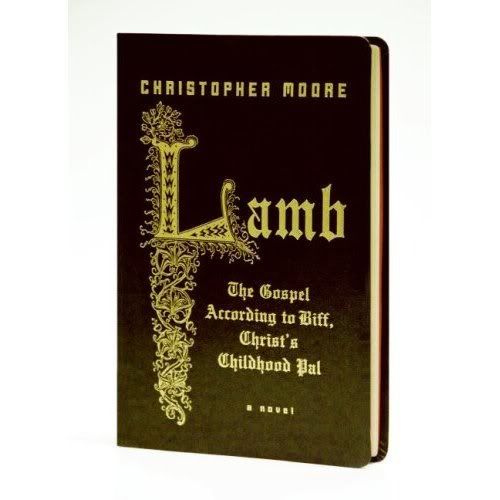
Christopher Moore's humorous novel Lamb: The Gospel According to Biff, Christ's Childhood Pal has been republished in a new Special Edition binding that should be familiar to fans of iconic books. This edition has the floppy faux-leather cover, the gilt-edged pages, and the red ribbon bookmark that typically set off a traditional Bible as a different kind of book. Here we see that at least one kind of iconicity is common enough to make parody effective.
Monday, March 3, 2008
Bookshelf Design

Michael Lieberman on Book Patrol observes that bookshelf design seems to be flourishing (see this gallery of recent designs, Lu Terceiro's regular "shelf of the day" feature, and the new blog, Bookshelf). He wonders:
Has bookcase design exploded or has the internet simply brought us all closer together with visual (and commercial) opportunities unheard of a generation ago?
Is it possible for the internet to be both withering and strengthening the book at the same time?
I don't know the answer to his first question. The evidence amassed on this blog suggests, though, that the answer to his second question is: "Rumors of the death of the book have been vastly exaggerated ..."
Wednesday, February 27, 2008
Lunacy and the Arrangement of Books
Lynn Wienck on BookPatrol calls attention to Terry Belanger's slim volume, Lunacy and the Arrangement of Books (Oak Knoll, 2003). The publisher calls it an "essay on the idiosyncrasies of book arrangements by collectors over the centuries," such as in this selection:
My only quibble has to do with labeling such behavior "madness." Concern for how books look and how they should be displayed are as old as the invention of writing, and remain very widespread, as this blog continues to document. Such common behaviors must be motivated by more than insanity ...
One promising method for detecting madness among book dealers, book collectors, and librarians is to examine the manner by which they arrange their books on their shelves. As a modest contribution to the literature of this subject, I propose to discuss the lunatic arrangement of books according to principles of color, size, number, aesthetics, subject order, Grangerization, and kleptomania.
Various sorts of books have, either formally or informally, taken advantage of color in their titles: think of Andrew Lang's multi-colored fairy books, of The Yellow Book (or of the Yellow Pages, for that matter), or of governmental White Papers. Meanings can become complicated: by Blue Book, for example, we might mean a guide to the prices of used cars, a college examination writing book, a handbook of contract bridge bids, the Social Register, or a book of etiquette; and determining the intended meaning depends on context. To a politician, a Blue Book is a government report; and because Blue Books tend to proliferate like Mediterranean fruit flies, one can understand the reply made by an Edinburgh bookseller to a woman who came into his shop one day and said she wanted a set of Blue Books: "I don't keep any, but 1 will procure what you want from the Stationery Office, What is the subject?"
"The subject? The subject doesn't matter, I want them in blue,"
With the help of a piece of blue tapestry which the customer had in her hand, the bookseller at length grasped that it was books of a certain shade of blue binding that she desired-books to match her carpet and the curtains in her living room. Once his mind "had coped with the initial absurdity of the idea of buying books for the colour of their binding," he found her an easy and profitable client. The blue books he sold her included E. H. Young's The Misses Mallett, Somerset Maugham's The Moon and Sixpence, and Kenneth Grahame's Wind in the Willows.
The Edinburgh bookseller concluded that he was a house decorator as well as a bookseller: he decorated minds and rooms.
My only quibble has to do with labeling such behavior "madness." Concern for how books look and how they should be displayed are as old as the invention of writing, and remain very widespread, as this blog continues to document. Such common behaviors must be motivated by more than insanity ...
Monday, February 25, 2008
Books Changing Galleries

Several entries here have already commented on the long-standing influences of books' iconicity on library architecture. Now there's a first sign that the rise of book art may influence, if not the architecture than at least the furnishing of art galleries.
Tom Sowden and Lucy May Schofield created "sitting rooms" for book art in the touring exhibition they curated at several galleries in 2007. Sowden explains:
(h/t BookPatrol)We both wanted to present a show where we could lose the preciousness that can surround an artist’s book. Let them become the tactile and interactive objects that they are usually conceived as being. Take them out of glass cases, out of libraries and away from the artist’s book fairs, resituating them in an environment that was conducive to reading and engaging with the books.
To both of us and to many who choose to work with the book form, handling is of prime importance. The ideas and experience are only available to a viewer if it is picked up and leafed through. We felt we had to create an easier atmosphere for the visitor to spend time with the books. In discussing the components that we would like in the show (comfy chairs, rug, lamps, bookcase or shelves) we quickly realized that what we were hoping to re-create was a sitting room, or perhaps more specifically the impression of a sitting room from a bygone age.
Saturday, February 23, 2008
A House for the Mind

Fiona MacCarthy, in The Guardian, profiles Colin St. John Wilson (1922-2007), the architect of the (new) British Library.
The driving force for the library was his own bookishness. Colin (always known as Sandy) St John Wilson was born in 1922, the year of Ulysses and The Waste Land, Wittgenstein's Tractatus, Mandelstam's Tristia and the last volume of Proust. For him, an ideal library had a certain aura close to that of the solemn sacred spaces of the Anglican churches and cathedrals he grew up in. His father was a notably radical bishop of Chelmsford and an expert on the 17th-century Divines. He was brought up understanding that books were a protected species and libraries were bastions of intellectual freedom. As he wrote: "One has only to recall the destruction of the library in Alexandria or, akin to that fire, the blasphemy that underlay the burning of the books by Nazi decree, for one to be aware that the library and what it houses embody and protect the freedom and diversity of the human spirit in a way that borders on the sacred."
His first ambition would have been to build a great cathedral, but a library came second. He retained a childlike vision of a "magic mountain of all the knowledge in the world".
Pallant House Gallery in Chichester is exhibiting Wilson's art collection in a gallery that he designed, and reflects on his career in the exhibit, "Colin St John Wilson: Collector and Architect."
Friday, February 22, 2008
"Living off the Bible"
Jeff Sharlet on The Revealer reviews Brett Grainger's new memoir of his Plymouth Brethren family, In The World But Not Of It: One Family's Militant Faith and the History of Fundamentalism in America (Walker, 2008). Sharlet comments: "Most compelling is Grainger's insider/outsider observations of his grandparents' everyday religion, such as the following passage describing in terms as perceptive as any I've read the relationship between religion and media, the ways in which the physical embodiments of faith reveal the nuances of a religion that from the outside may appear to be nothing more than a blunt cudgel of doctrine. It's worth reproducing in full:
Everything in the daily life of the Brethren revolved around reading and digesting the Word. They lived off the Bible the way the Great Plains Indians lived off the buffalo. No part was waste. Horns, spleen, tail -- everything had its proper use and purpose. All Scripture was inspired of God and worthy for instruction. Even the vast intestinal stretches of I Chronicles, the endless coils of begats, were laid in the sun to dry, then used to carry water. Not a day passed when they did not search the Scriptures for comfort or correction. The Word waited on the nightstand. It stared down from bookcases and dozed in glove compartments. Women carried a small, tidy volume in their purses. The men's were considerably larger. A believer's Bible was expected to age at roughly the same pace as his body. Elderly brothers carried copies that were battered and falling to pieces, with sagging spines and missing pages. Such Bibles were highly prized. They marked a man well acquainted with the Word. My grandfather's Bible was little more than a patch of rawhide wrapped around a ragged sheaf of pages. The binding was broken and whole chapters were missing or out of order, but he always seemed to be able to find what he needed."
Sunday, February 17, 2008
High Design Bible Mag

Graphically innovative Bibles do not just appear in the style of graphic novels and comics, manga or otherwise. The Wall Street Journal reports on The Bible Illuminated:
The Swedish-language Bible marries the standard text to glossy magazine-style design. Full-color pages are illustrated with a striking combination of news and dramatized photographs: a homeless child wrapped in a sweater on the streets of Bogotá, Colombia, illustrates the book of Job; a man who drowned trying to enter Europe, for Deuteronomy; and models posing in stylized scenes convey joy or despair. Bible passages are pulled out as captions.
... "There are 40 million [glossy] magazines sold each year in Europe," says Dag Söderburg, creative director at the edition's Swedish publishers, Förlaget Illuminated. "But the Bible, a literary treasure, stays on the bookshelf."
The work is aimed not at a religious audience but rather at readers concerned with ethical and philosophical questions surrounding issues such as global warming and religious fundamentalism.

The article also mentions other bibles in various graphic formats, including Thomas Nelson's glossy magazine version aimed at teenage girls. It notes that such innovative publishing formats have aroused little religious controversy, either in Sweden or America.
That observations stands in stark contrast to the media attention some of these innovations get (see my previous post about manga bibles). There seems to be a disjunction between what the media think Christians should find outrageous, and the indifference that actually meets such marketing ploys. In fact, innovative marketing of Bibles is often applauded as Christian outreach, just as the Swedish publisher presents it. In the case of the Bible, at least, the book's iconic status seems unaffected by its ever changing formats.
Thursday, February 14, 2008
Theorizing Scriptures
 Rutgers University Press has published Theorizing Scriptures: New Critical Orientations to a Cultural Phenomenon. This volume, edited by Vincent Wimbush, inaugurates the Signifying on Scriptures book series. It contains Wimbush's introduction setting forth a programatic agenda for scripture studies and twenty-seven essays by scholars representing diverse fields of expertise and perspectives.
Tuesday, February 12, 2008
Book-binder's Ritual Art

Maybe Quarterly (Spring, 2006) features the grimoire bindings of Paul Tronson. In an interview, the master book-binder describes his ritual practices when creating a grimoire's binding:
The main problem was that in order for it to become active and remain a very powerful tool I would need to be completely faithful in consecrating each seal and sigil which would need to be produced within the day and hour of it’s planet. Also a different Latin verse corresponding to each seal was chanted so the book was blessed and empowered during every part of it’s creation ...Compare my previous post on restoring sacred objects. Tronson's own website provides considerably more information (and pictures) of the book-binders art, including his restoration of a Geneva Bible.
Sunday, February 10, 2008
Another Manga Bible
 Following a trend we've already mentioned with Tyndale House's Manga Messiah and Manga Bible, Doubleday has also released a graphic novel, The Manga Bible: From Genesis to Revelation. The New York Times profile of the book and author includes reactions from academics, including this:
“It is the end of the Word as we know it, and the end of a certain cultural idea of the Scriptures as a book, as the Book,” Timothy Beal, professor of religion at Case Western Reserve University, said of the reworking of the Bible in new forms, including manga. “It opens up new ways of understanding Scripture and ends up breaking the idols a bit.”
That opinion sounds distinctly odd, given the long tradition of illuminating Bibles, including entirely graphic "Pauper's Bibles," from the Middle Ages on, and more recent illustrated children's Bibles (usually heavily edited and paraphrased), not to mention renderings of biblical stories in art, drama and film. I find nothing new in this development except for the employment of a new artistic style. Outside the studies of some theologians, publishing and using Bibles has rarely been just about words, as the article's short history of Bible publishing demonstrates. Its divergent contents reveal the gap between much academic thinking about writing and books on the one hand, and the material reality of their production, sale and use on the other.
(Thanks to Andrew for the tip.)
Saturday, February 9, 2008
Is there growing contempt for books?
A news story and a blog entry both raise this question, though in opposite ways that are interesting.
Emilia Askari reports in the Detroit Free Press that "even the most popular libraries have some books on the back shelves or in the basement that no one ever wants to read." Discomfort with discarding or destroying books leads many libraries and people to find alternative means of disposal. So besides selling them at rummage sales and giving them away, the Bloomsfield Public Library decided to exhibit art works made from these unwanted volumes. One of the artists found the experience of sculpting with books and branches very positive: "I love sculptural things, and I love books, and I love trees."
But blogger Lynn Wienck on Book Patrol takes such book art as one piece of evidence of growing contempt for books.
I like books for themselves finding sufficient beauty in printed words, illustrations, and bindings. Atmosphere, mystery, and excitement are found among the simple black-and-white lines of text. Why then are books utilized to generate art, furniture, lamps, and clocks? The art is superb, creative, and fresh, but books are cut, drilled, and painted for a final product having nothing to do with reading skills. It seems a travesty, a mockery, of the original intent of the volume.
One could let this pass as yet another example of how different people have opposite values. However, both the news story and the blog account start with the wide-spread view that, due to cultural changes fueled in part by evolving technology and capitalistic commodification, books have lost value in many people's eyes.
The suspicion that this assumption is quite wrong led me to create this blog. All the varied instances of iconic books and texts indexed by the labels at left show that their veneration remains quite high, especially as measured by the crass scales of consumer culture, whether in terms of record auction prices or total numbers of books sold, but also as reflected in religious, political, and personal practices world-wide. Of course, many people dislike many of the uses to which books are put. But such disagreements, and especially the vehemence with which they are often expressed, only underscore the iconic status of books in the first place.
Tuesday, January 29, 2008
Free information, expensive books
Sotheby's sale of the Magna Carta last month led James Gleick the NYTimes Magazine to meditate insightfully in on the diverging value of information vis-a-vis physical documents and books:
Michael Lieberman of BookPatrol connects Glieck's observations to recent news that books sales, both on the internet and in stores, are up substantially around the world. He comments:
Precisely. Despite the electronic revolution in information, the iconic value of books in general, and of relic books and texts in particular, has never been higher.
Twenty-one million is, by far, the most ever paid for a page of text, and therein lies a paradox: Information is now cheaper than ever and also more expensive. Mostly, of course, information is practically free, easier to store and faster to spread than our parents imagined possible.
... The value of the particular item sold at Sotheby’s eight centuries later is entirely different. It’s a kind of illusion. We can call it magical value as opposed to meaningful value. It’s like the value acquired by one baseball when Bobby Thomson batted it out of the Polo Grounds. A physical object becomes desirable, precious, almost holy, by common consensus, on account of a history — a story — that is attached to it. (If it turns out you’ve got the wrong baseball, the value vanishes just as magically.)
... In advance of the sale, Sotheby’s called Magna Carta “a lamp in the darkness, a glowing talisman of our human condition, a sacred icon of our human history.” Just so. It’s magic. Religious relics, like the Shroud of Turin, gleam invisibly with the same magic. On a smaller scale so do autographs, coins, rare photographs, Stradivari violins (unless you think you can recognize the tonal quality of 300-year-old wood) and clothing off the backs of celebrities, like the spare wedding dress (ivory silk taffeta) that Diana might have worn but didn’t (2005, $175,000).
... But the growth in the ranks of the superrich does not explain the hypertrophy in magical value. Just when digital reproduction makes it possible to create a “Rembrandt” good enough to fool the eye, the “real” Rembrandt becomes more expensive than ever. Why? Because the same free flow that makes information cheap and reproducible helps us treasure the sight of information that is not. A story gains power from its attachment, however tenuous, to a physical object. The object gains power from the story. The abstract version may flash by on a screen, but the worn parchment and the fading ink make us pause. The extreme of scarcity is intensified by the extreme of ubiquity.
Michael Lieberman of BookPatrol connects Glieck's observations to recent news that books sales, both on the internet and in stores, are up substantially around the world. He comments:
So while the race is on to free the content from the book, the actual book itself, the original house for the content, becomes in fact more desirable.
Precisely. Despite the electronic revolution in information, the iconic value of books in general, and of relic books and texts in particular, has never been higher.
Monday, January 28, 2008
Soundprint Radio "Who Needs Libraries?"
"Books to me were magical physical objects, as well as magical literary ones."
Soundprint Radio's Lisa Simeone's sense that books have a magical quality is one that I think this 'blog's users are pretty familiar with. Last weekend's broadcast "Who Needs Libraries?" is not specifically about scripture, but it does contain a number of points that might be of interest regarding iconic books, including the host's childhood impressions of the smell and magic of books and and a great description of the shrine-like Folger Shakespeare Library vault (complete with stained glass windows, church architecture, a crypt, and 79 copies of the iconic First Folio). The program goes on to consider the challenges posed to libraries in an age of digitization, Google, and Internet books.
The audio program may be streamed through RealPlayer, and the links for RealPlayer are provided on the Soundprint site linked above.
Soundprint Radio's Lisa Simeone's sense that books have a magical quality is one that I think this 'blog's users are pretty familiar with. Last weekend's broadcast "Who Needs Libraries?" is not specifically about scripture, but it does contain a number of points that might be of interest regarding iconic books, including the host's childhood impressions of the smell and magic of books and and a great description of the shrine-like Folger Shakespeare Library vault (complete with stained glass windows, church architecture, a crypt, and 79 copies of the iconic First Folio). The program goes on to consider the challenges posed to libraries in an age of digitization, Google, and Internet books.
The audio program may be streamed through RealPlayer, and the links for RealPlayer are provided on the Soundprint site linked above.
Saturday, January 26, 2008
Review of People of the Book
Jeremy Dibbell, of PhiloBiblos, writes a beautiful review of Geraldine Brooks new novel, People of the Book (Viking, 2008). The novel features the 14th-century Sarajevo Haggadah, interweaving its history into the contemporary plot. Dibbell comments:
There's a message here for those of us who study books as artifacts - there are stories there, real people's stories, and although they may be impossible to get at really, we should think of them.
As Hanna is preparing her essay about the Haggadah to accompany the exhibition catalogue, Brooks has her say "I wanted to give a sense of the people of the book, the different hands that had made it, used it, protected it. I wanted it to be a gripping narrative, even suspenseful" (pp. 264-265).
Saturday, January 19, 2008
PhD program in "Texts, Contexts, Cultures"
Mark Bertrand, on Bible Design & Binding, points out a new set of PhD scholarships in Ireland:
"Dr Crawford Gribben, who is the Long Room Hub Senior Lecturer in Early Modern Print Culture at Trinity College in Dublin -- as well as a reader of this blog -- e-mailed me with some news that will be of interest to academics in the audience. He's directing a new PhD program at Trinity College and has twelve fully-funded scholarships to award. Here are the details:
12 fully-funded 4-year PhD scholarships are available for Arts and Humanities research in Trinity College Dublin
A new interdisciplinary and inter-institutional PhD pathway for research in Arts and Humanities has been launched by Trinity College Dublin in conjunction with NUI Galway and University College Cork. 12 four-year scholarships of fees plus €16,000 per annum are available for those who wish to pursue this pathway as students of Trinity College Dublin. Other scholarships are being offered by NUI Galway and University College Cork. The scholarship competition at Trinity College Dublin is open to both EU and non-EU applicants. The closing date for entry is 1 March 2008.
Texts, Contexts, Cultures has been designed to prepare students for life in academia – and beyond. First-year students will develop their research through multi-institutional training elements in the pathway's core themes – History of the Book, Imaging Ireland and Renaissance intellectual history – much of which training will be delivered through audiovisual and online networks. Research will be supervised by multi-institutional scholarly panels. Students will also be provided with the opportunity for work placement in the knowledge economy sector.
Dr John Hegarty, Provost of Trinity College Dublin, commented that the Texts, Contexts, Cultures pathway "represents an exciting new beginning for higher education in Ireland and for higher education itself."
Full details can be found on www.textscontextscultures.ie . All enquiries should be directed to Dr Crawford Gribben, the Director of Texts, Contexts, Cultures at Trinity College Dublin (crawford.gribben@tcd.ie).
Dr. Gribben teaches a course focusing on Renaissance Bibles, including their design and binding! There's a PDF course description online that gives a flavor -- "Group exercises will include the preparation of an online annotated edition of part of an individual Biblical book, which edition will compare the forms and contents of
various early modern texts, translations and multimedia receptions"."
Friday, January 18, 2008
Bullet in My Breast Pocket
From the early standup of Woody Allen:
Years ago, my mother gave me a bullet...a bullet, and I put it in my breast pocket. Two years after that, I was walking down the street, when a berserk evangelist heaved a Gideon bible out a hotel room window, hitting me in the chest. Bible would have gone through my heart if it wasn't for the bullet.
For contemporary manifestations of the Bible/bullet scenario, see Cordell's previous post.
Years ago, my mother gave me a bullet...a bullet, and I put it in my breast pocket. Two years after that, I was walking down the street, when a berserk evangelist heaved a Gideon bible out a hotel room window, hitting me in the chest. Bible would have gone through my heart if it wasn't for the bullet.
For contemporary manifestations of the Bible/bullet scenario, see Cordell's previous post.
Monday, January 14, 2008
Warehousing Books
Some time ago, the Guardian reported on the British Library's construction of a warehouse to house surplus volumes. " The British Library's UK national collection is currently expanding at the rate of 12.5 kilometres of shelf space a year, and somewhere has to be found to put it all." The warehouse, which will provide "262 linear kilometres of high-density, fully automated storage in a low-oxygen environment ... is being meticulously constructed to house things that no one wants."
Geoff Manaugh, writing on BldgBlog, comments that this warehouse and others like it being built by Oxford and Cambridge "aren't libraries, of course; they're stockpiles. Text bunkers. ... No matter if no one actually visits these places; they're our era's equivalent of pharaonic tombs. They're time capsules." Elsewhere he notes the religious influence on library construction: " Interesting, though, that religious beliefs could affect both the shape and the very existence of libraries."
Yes, but what is this religion that values books by the kilometer?
Sunday, December 23, 2007
Unreadably Small Bibles (again)
Nanotechnology experts in Haifa, Israel, have etched the entire text of the Hebrew Bible on to a 0.01 inch square surface, "less than half the size of a grain of sugar," according to the AP. " They chose the Jewish Bible to highlight how vast quantities of information can be stored on minimum amounts of space. " The Jerusalem Post adds that "The fact that the Bible contains a large amount of text - about 10 million bits - was a major factor in choosing to store it at high density on silicon."
Saturday, December 22, 2007
Symposium on Iconic Books
The first Symposium on Iconic Books took place on October 18-20, 2007. Scholars from eight American and British universities gathered in Syracuse to discuss the phenomenon of iconic books and texts in a variety of cultures and time periods.
I have now put online a synopsis of the Symposium's presentations and discussions, which is also available by clicking the Symposium 2007 link at left.
Wednesday, December 19, 2007
Magna Carta Bought, Will Stay in U.S.
As predicted, the winning bidder for the 1297 Magna Carta auctioned by Sotheby's yesterday was motivated by the desire to keep it in the USA. The Guardian reports:
David Rubenstein, co-founder of the Carlyle Group private equity firm, paid $21.3m (£10.6m) for the document ...
Rubenstein, who worked in the White House during the Jimmy Carter administration, said: "Today is a good day for our country. I was moved when I saw the manuscript at Sotheby's and I was concerned that the only copy that was in America would escape. I was convinced that it needed to stay here.
"This document stands the test of time. There is nothing more important than what it represents. I am privileged to be the new owner, but I am only the temporary custodian. This is a gift to the American people. It is important to me that it stays in the United States."
However, lest the former colonies congratulate themselves too much, Oxfor'd Bodleian library indulged in what the Guardian characterizes as "scholarly one-upmanship" by displaying for one only day all four of its copies of the Magna Carta. Three date from 1217 and one from 1225, all older than than the copy auctioned yesterday. Hugh Doherty, an expert on medieval manuscripts working at Oxford, described the history of the trans-Atlantic rivalry:
His digging uncovered government records revealing the spluttering outrage of Lincoln cathedral when its copy was stranded in the United States on the outbreak of the second world war. Winston Churchill had the bright idea of presenting it to the Americans - without consulting the cathedral. The manuscript stayed in the States until after the war, but Lincoln then managed to retrieve it.
"It was an extraordinarily powerful document in its day and since. There are records of it being waved to assert rights in York within 10 years of its creation," Doherty said.
"It has had an extraordinary afterlife, particularly in the United States where in the War of Independence it seemed to chime with the assertion of rights against George III, in the 19th century when it was cited by Abraham Lincoln among many others, and on into the 20th century."
The New York Times reports that Rubenstein intends for his copy to go back on display in the National Archives in Washington, DC.
Sunday, December 16, 2007
The Bible According To Henry VIII
Arthur Freeman, writing in the Times Literary Supplement, describes a rare portable-sized Vulgate Bible published in London in 1535. It contains selected portions of the Latin Old Testament along with the entire New Testament. But the preface, though unsigned, indicates that the editor was Henry VIII himself.
Freeman's speculations about what led Henry to sponsor the publication and then, in turn, abandon the project include interesting observations about the political pros-and-cons of Bible publishing in the 16th century.
Given whatever doctrinal or theological thrust such editorial choices suggest, can we adduce any special purposes in the publication of Henry’s bible, beyond those he states, of fulfilling an obligation to God and serving “the necessity of the people”? Was it really directed to a popular readership, or was it more in the nature of a ceremonial performance? Ordinary “people”, after all, could rarely manage Latin, and those who could, would probably have preferred – like Henry’s scrupulous reader – a complete bible, which, if they could afford Henry’s, they no doubt already possessed. Here a few bibliographical observations may be helpful.
The volume is, to begin with, conspicuously rare: it now survives in only four complete copies, and three slightly imperfect ones, none of which bears any sign of ceremonial presentation, that is, a lavish contemporary binding or sententious inscription. Apparently it was never reprinted, ...
... perhaps the forthcoming availability of the complete scriptures in reader-friendly vernacular English left Henry’s and Berthelet’s curious Vulgate – still the “first” bible printed in England, no mean distinction – something of an anachronism, or throwback, and accounts for its virtual demise both in practical use and in (modern) historical memory. Another possibility, also linked to its date of appearance, is more prosaic, but evocative: July 1535 was not exactly a serene month in the religio-political history of the English monarchy and Church. Bishop John Fisher had been beheaded at Tower Hill on June 22, to the indignation of nearly all Europe, a furore compounded by the perfunctory trial of Sir Thomas More, who followed Fisher to the block on July 6. Henry had escaped the latter occasion with a long summer progress through the West Country. But in the light of impending reaction from the rest of the Christian world, including papal excommunication itself in August, the appearance of a somewhat self-congratulatory “personal” canon of scriptural law, via an eccentric edition of the Vulgate, might have seemed grotesquely ill-timed.
(Thanks to PhiloBiblos for the tip.)
Saturday, December 15, 2007
Death of a Book (Store)
For those interested in the deaths of books--or maybe suicide ...
(Thanks for the tip to Michael Lieberman at BookPatrol.)
(Thanks for the tip to Michael Lieberman at BookPatrol.)
Scrolls of Alexandrian Synagogue
A slide show on YouTube depicts the many scrolls of various sizes in the ark of the Hanabi Synagogue in Alexandria, Egypt. It was produced as part of a series of slide shows about the synagogues and Jewish cemetaries in the city.
Tuesday, December 11, 2007
Magna Carta Auction coming
As I reported previously, the 13th century copy of the Magna Carta displayed until this year in the U.S. National Archives will be auctioned by Sotheby's on December 18th. As the sale approaches, Sotheby's rhetoric is ratcheting up: according to the Associate Press, vice chairman David Redden calls it "the most important document in the world. ... It is a document to learn from, and also a symbol, an icon, a holy grail -- all of those. It is one of those touchstones of culture." They expect it to sell for $20-30 million.
Saturday, December 8, 2007
The Sanctifying Power of Texts
The power of texts to sanctify buildings is admirably summed up by this Indystar headline: "It isn't synagogue without the Torah." The story describes ritual transfer of torah scrolls when an Indianapolis synagogue moved to a new site.
A building is not actually a synagogue, says Rabbi Arnold Bienstock, unless it contains the Torah scrolls. "According to Jewish law, when the Torah scrolls are removed and taken out of the synagogue, the synagogue loses its holiness," Bienstock said. "What really defines the synagogue per se, and what defines Judaism, is the Torah."
... Some congregants wanted to walk the scrolls to their new home, as is custom, but the distance and the perils of December weather led planners to opt for a bus transfer. Even so, each scroll, containing a complete Torah, will be carried individually on the journey.
Texts convey such sanctifying power in Sikhism, Ethiopian Christianity and many branches of Buddhism. In the Christian and Buddhist contexts, texts and relics function in exactly the same way as loci of holiness. Studies of the religious significance and function of relics therefore hold out great promise for understanding the power of iconic texts.
Tuesday, December 4, 2007
Marketing Relic Texts
 In contrast to the Israeli scholars trying to gather the fragments of the Aleppo Codex from private owners, others happily cater to would-be owners of iconic texts. A company in Los Angeles called Spiritual Artifacts sells fragments of Torah scrolls. "The fragments are hundreds of years old and lovingly framed and preserved in our specially made and hand crafted conservation frames. You can also personalize your antique piece with a dedication plaque to commemorate any occasion." Co-owner Sam Gliksman echoed the rhetoric of scholarship and museum collectors when he said to Webwire, “These fragments have survived for centuries and represent a valuable part of Jewish history. We need to preserve them for future generations.”
 Sunday, December 2, 2007
Book Architecture
 The images of giant book spines have turned the facade of a Kansas City library car park into a giant book shelf. (Thanks to Jeremy for the tip about deputydog's coverage, who also shows pictures of a temporary construction wall in bookshelf form in Cardiff, Wales.)
Saturday, November 24, 2007
"Divinely Inspired Constitution"
Americans have a long history of revering their Constitution. Such veneration is particularly strong among politically active Evangelicals of the so-called "religious right," some of whose leaders have termed the U.S. founding documents "the most wonderful instrument ever drawn by the hand of man" (echoing Justice William Johnson in 1823). But Ron Paul, U.S. Representative and Republican presidential candidate, takes this one step further in his "Statement of Faith", which in the second-to-the-last paragraph reads:
" I am running for president to restore the rule of law and to stand up for our divinely inspired Constitution."
Christian bloggers have already castigated Ron Paul as heretical for this statement (see Parableman and evangelical outpost, with Paul's clarification in comment 78). I think it rather represents a logical outcome of efforts to elevate the iconicity of the U.S. Constitution which has, in turn, fueled reactions to portray the Christian Bible as supreme (e.g. with Ten Commandments monuments). Though theologians would like to believe otherwise, practices generate beliefs as often as the reverse. Monuments and shrines to national texts will generate beliefs in their supernatural origins.
Thursday, November 22, 2007
Manga Bible

This authentic, cutting-edge art style is combined with fast-paced storytelling to deliver biblical truths to an ever-changing culture that is often a challenge to penetrate. This is genuine Japanese manga style, unlike other Christian "manga" books in the marketplace.
(Thanks to Meg for this tip.)
Monday, November 19, 2007
Scriptures As Artifacts at SBL meeting
The Iconic Books Project is not the only research effort on this subject. The Scripture as Artifact Consultation, chaired by Brian Malley, showcased the work of eleven scholars at the annual meeting of the Society of Biblical Literature in San Diego.
The session on Saturday, November 17th, focused on “the late medieval period to the present.”
Marianne Schleicher (Aarhus University) described her research on the relationship between ritual uses and displays of Torah scrolls and the interpretation of Torah in a Dutch Jewish congregation (paper title: “Transitions between Artifactual and Hermeneutical Use of Scripture”).
Miriam Levering (U. Tennessee, Knoxville) surveyed artifactual/iconic uses of texts in Buddhist traditions before focusing in particular on Zen schools. She noted the irony that medieval Zen traditions generally downplayed the role of scriptures in comparison with other Buddhist schools, but then proceeded to produce a flood of texts that seem to function as scriptures nevertheless (paper title: “Scripture as Artifact: A Comparative Perspective”).
Unfortunately, I had to miss the remaining papers in Saturday’s session. They were “Curbing Phantasm: The Bible Moralisée” by Eva Maria Raepple (College of DuPage), “The Danish Hymnbook: Artifact and Text” by Kirsten Nielsen (Aarhus University), and “Some Biblical Artifacts in Search of a Sociological Theory” by David Chalcraft (University of Derby). [But see Dori's comment below for a summary of these last two papers.]
Though the session on Sunday, November 18th, focused on “the ancient and early medieval world,” Brian Malley began with a theoretical paper on the relationship between the artifactual use and semantic meaning of scriptures. Starting with a standard model in communications theory, he argued that artifactual uses, rather than being a small and insignificant aspect of scriptural usage, actually impact virtually all uses of the text (paper title: “Text, Artifact and Meanings”).
The next four papers all described various kinds of ancient evidence for the artifactual uses of scriptural texts. Larry Hurtado (University of Edinburgh) presented the manuscript evidence for the distinctive forms and uses of early Christian scriptures (2nd-3rd centuries C.E.). Christians’ preference for binding their scriptures (OT and NT) in codex (book) form, rather than as scrolls, their use of distinctive abbreviations (nomina sacra) for the names and titles of God and Jesus, and their employment of reader’s aids in manuscripts intended for public reading all distinguish their material culture from its Greco-Roman context (paper title: “Early Christian Manuscripts of Biblical Texts as Artifacts”).
Stephen Reed (Jamestown College) surveyed the contents and textual form of the Dead Sea Scroll texts used for ancient Jewish phylacteries (tefillin) and mezuzot. He noted that they differ from other biblical scrolls from Qumran not only in their contents ( fairly standardized excerpts from Exodus and Deuteronomy) but also in the condition of their materials (the texts in tefillin were often written on tattered scraps of leather) and their very small, run-together letters that show they were clearly not meant to be read but manipulated ritually (paper title: “Physical and Visual Features of Dead Sea Scriptural Texts”).
Eduard Iricinschi (Princeton University) described the heavy use and dependence of the ancient Manicheans on the texts written by their founder Mani/Manus. Their texts served to spread the faith rapidly in the Sassanian and Roman empires of the third century and following, but also became a principal target of imperial efforts (in the long run, successful) to suppress the religion (paper title: “ ‘A Thousand Books will be Saved’: Manichean Manuscripts and Religious Propaganda in the Roman Empire”).
Thomas J. Kraus (Willibald Gluck Gymnasium) investigated the nature and function of Byzantine armbands with medallions that cite the opening verse of Psalm 91 (Ps 90 in the Greek translation) along with others depicting the Madonna and child. He charted the popularity of the talismanic use of Greek Ps 90 in Byzantine Christian culture to explain its prominence in cryptic form on these artifacts (paper title: “ ‘He that Dwelleth in the Help of the Highest’: Septuagint Psalm 90 and the Iconographic Program on Byzantine Armbands”).
Dori Parmenter (Syracuse University, co-director of the Iconic Books Project) concluded the session with a broader survey of myths of heavenly books and their impact on early and medieval Christian beliefs. She demonstrated that Christians were influenced by ancient Near Eastern and, especially, Jewish ideas of pre-existent heavenly scriptures and “books of life,” but they conceived the heavenly equivalent of Gospel books to be Christ himself as the Word of God. This equivalence between book and Christ appears prominently in ancient and medieval Christian art and provides the ideological underpinning for the liturgical reverence shown Gospel books (paper title: “The Bible as Icon: Myths of the Divine Origins of Scripture”).
Monday, November 12, 2007
Congregation Writes Torah

Fascinating story by Glen Collins in the NYT about the ritual of Torah-writing, only this time, a synagogue's ark will house a Torah written by members of its very own congregation, the Stephen Wise Free Synagogue in Manhattan.
"In a single stroke, those who join in the ambitious project are both honoring tradition and testing its bounds. Typically, the writing of a Torah has been left to a highly trained sofer, collaborating perhaps with a chosen few in the temple. For many centuries, the process has been a journey into an arcane and proscribed world of recondite rules and spiritual imperatives that are a mystery even to many devout Jews."
Sunday, November 11, 2007
A Car Customized for a Qur'an
A common aspect of iconic books is that they warrant special handling and storage. The Malaysian car manufacturer Proton has just that in mind in the design of a new car aimed at a Muslim market:
Malaysia firm's 'Muslim car' plan
[. . .]
The car could boast special features like a compass pointing to Mecca and a dedicated space to keep a copy of the Koran and a headscarf.
[. . .]
Tuesday, November 6, 2007
Aleppo Codex as Talisman
A report in today's Haaretz illustrates why experts in scriptures' textual dimension (that is, scholars) frequently find veneration of its iconic dimension more than a little problematic:

An eight-centimeter-square piece of the 1087-year-old Aleppo Codex will be given to a representative of the Ben Zvi Institute in Jerusalem on Thursday, following 18 years during which Israeli scholars tried to retrieve it from businessman Sam Sabbagh.
Sabbagh salvaged the fragment from a burning synagogue in Aleppo, Syria in 1947.
Inscribed on both sides, it is one of the lost fragments of the codex, a copy of the Bible written in 920 C.E. in Tiberias by the scribe Shlomo Ben Buya'a. The fragment Sabbagh had bears verses of Exodus chapter 8, including the words of Moses to Pharaoh: "Let my people go, that they may serve me..."
Sabbagh believed the small piece of parchment was his good luck charm for six decades. He was convinced that thanks to the parchment, which he kept with him always in a transparent plastic container, he had been saved from riots in his hometown of Aleppo during Israel's War of Independence, and he had managed to immigrate from Syria to the United States in 1968 and start a new life in Brooklyn and make a living. The charm was with him when he underwent complicated surgery.
Just two years ago, it completed its task, when Sabbagh passed away.
Of course, the scholars' interest is not just textual, since this fragment is very unlikely to influence anyone's interpretation of Exodus 8. The value to scholars in the codex's reunification derives from, among other things, the public reinforcement of the view that texts are best kept intact. This position serves the purposes of contextual interpretation of semantic meaning, of course, but it also concentrates the legitimacy conveyed by their iconic status in the one person or institution that owns them and can display them. Fragmentation of texts for talismanic purposes serves conversely to distribute more broadly their iconic prestige.
December 3, 2007: Now Haaretz reports that:
Scholars at Yad Ben-Zvi research institute in Jerusalem have called on Jews around the world who originally come from Aleppo, Syria and may possess fragments of the ancient Aleppo Codex to turn them over to Israel.
... "This is the No. 1 asset of the Jewish people," Dr. Zvi Zameret, head of Yad Ben-Zvi said, "and I believe the Jewish people would do a great deal to have it back."
This last quotation illustrates perfectly a typical conflict over iconic texts which pits the interests of a reified collective (in this case, "the Jewish people") represented by scholars against the interests of individuals (the Jews from Aleppo). For the collective, the iconic text serves purposes of legitimation ("the No. 1 asset of the Jewish people"). For individuals, a scrap of text provide a sense of prestige or empowerment (the "good luck charm" of the previous story).
September 27, 2008: The Associated Press picks up the story. Again, note the clear distinction and very different value judgments made on individual interests vis-a-vis the collective's interests:
Some people might be superstitious about the fragments they hold, or believe they are rightfully the property of Aleppo Jews, not of scholars. Others might simply have no idea of the value of what they own. ...
The manuscript doesn't contain passages missing from other versions. Instead, its accuracy is a matter of details like vowel signs and single letters that would only slightly alter pronunciation. But Judaism sanctifies each tiny calligraphic flourish in the Bible as a way of ensuring that communities around the world use precisely the same version of the divine book. That's why the Codex is considered by some to be the most important Jewish text in existence, and why the missing pieces are so coveted.
Friday, November 2, 2007
Lavish Books about Lavish Festivals
Celebrating Italian Festivals" is an exhibit of Italian books at the Beinecke Rare Book & Manuscript Library at Yale University Republican American reported on an interview with the curator, Robert G. Babcock:
The exhibit continues through January 9th. (Thanks to Rare Book News for this tip!)
They were political documents, lavish self-promotional billboards aimed at asserting the wealth and stature of the host.
... Printing became available in the 15th century and within 100 years, the royal and aristocratic courts behind Europe's most illustrious festivals printed elaborate, illustrated volumes to record these celebrations. "This was not just a souvenir, but a propaganda item," said Babcock. "The ruler of the other states needed to know that the duke of Tuscany's daughter married a Hapsburg prince to show all the other rulers that they were important, they were wealthy and they do great things for their people."
... The books themselves vary in their level of documentation. Many, like a 17th century festival for Santa Rosalia, patron saint of Palermo, feature folded-out engravings of the ceremonies along with painstaking citations of who was there. The most breathtaking example here is a 19th century volume commemorating the Roman feast of Corpus Christi. It includes a single color illustration that, unfolded, is more than 38 feet long. Each of the thousands of participants of the procession, including Pope Gregory XVI, is identified.
The exhibit continues through January 9th. (Thanks to Rare Book News for this tip!)
Wednesday, October 31, 2007
Sikh battles over publishing and transporting Guru Granth
Previously reported conflicts among Sikhs in Punjab over the publication, transportation, and sale of copies of the Sikh scripture, the Guru Granth, have now evolved into a tug-of-war between major leaders in Punjab and in Delhi, according to an unsympathetic account in World Sikh News:
For something which should have been handled very delicately and discretely, the SGPC has made a mess of the entire affair. ...
Tuesday, October 30, 2007
Bibles as Foundation Deposits
(From the files of the Iconic Books Project) The Houston Chronicle reported on August 7, 2005 that Possibility Custom Homes, builders in the Houston area, bury Bibles in the concrete foundations of the homes they build:
... Building homes with a Bible in the foundation is not something they advertise, but it's not something they hide, either.Textual foundation deposits were common in antiquity, but I have not run across other examples of using scriptures in this way more recently. Does anyone know of other examples?
"The Bible symbolizes the godly principles we use in our company," Wallace said. "We felt that if we built our company on a godly foundation, God would bless our company."
"We do it more for us than anything else," Eckert said.
Besides the Bible, brief Scripture passages, appropriate for the individual room, get printed on the wood framework of those rooms. A passage about children, for example, is printed with permanent marker on the wall studs of a room intended for kids. On the door frame of another house is the opening verse of Psalm 127, which refers to God establishing houses, or families.
"It's nice for me to have a reminder in there when I'm walking through the frame of where my principles are," Eckert said. "It keeps me straight."
... At least one other company, however, has been doing something similar with the Bible for at least a dozen years in the Dallas-Fort Worth area.
... On the day the foundation is poured at Possibility Homes , a soft-covered Bible is placed at the outside corner of the master bedroom - "where the spiritual leaders of the house stay," according to Eckert - or somewhere else if the buyer prefers.
The book is open to the center, the concrete is poured from a huge boom connected to a truck. Workers then smooth the area along with the rest of the foundation.
Subscribe to:
Posts (Atom)
