Iconic books are texts revered as objects of power rather than just as words of instruction, information, or insight. In religious and secular rituals around the globe, people carry, show, wave, touch and kiss books and other texts, as well as read them. This blog chronicles such events and activities. (For more about iconic books, see the links to the Iconic Books Project at left.)

Thursday, September 20, 2007

The Price of Iconicity

Today's NY Times has a story about a 177-year-old first edition copy of the Book of Mormon that sold for $105,600.00 at an auction in upstate New York. It took all of six minutes for the auction to close, with an unidentified man from the East Coast making the winning bid.

Clearly one man's junk is another's icon. The book was discovered in the attic of an elderly man about to enter a nursing home just outside of Palmyra, NY, the birthplace of Mormonism. It is a striking contrast, where an iconic book was relegated to an attic in a region recognized by Mormons as a site of revelation and ultimately sold at an exorbitant price.

Tuesday, September 18, 2007

Heart Sutra on Pillars


A new installation of monumental scriptural texts has appeared in the last few years in Hong Kong. David Killick reports in the New Zealand Press that at the monastery in Ngong Ping Village is "the Wisdom Path, which opened in 2005. A winding trail leads past the monastery to 38 timber columns, built on the side of the mountain, their tops disappearing eerily into the mist.

"All but one of them are inscribed with sections of the 260-word Heart Sutra prayer. The highest column is blank, symbolising "emptiness" (Sunyata).

"Artist and scholar Professor Jao Tsung-I completed his calligraphy of the Heart Sutra in 2002, and dedicated it to the people of Hong Kong."

Monday, September 17, 2007

Happy Constitution Day!

Today is "Constitution Day" in the United States. Starting in 1997, Constitution Day Inc. (founded by Louise Leigh) led the effort to have September 17th, the anniversary of the signing of the U.S. Constitution in 1787, recognized and celebrated. Recommended activities include having "school children, the military overseas and Governors or their representatives from every state reciting the preamble simultaneously." In 2004, the U.S. Congress designated Sep 17th "Constitution Day." This year's recital of the Preamble will be led by General Colin Powell at 2 p.m. EST.

Other interested organizations are commemorating the day differently. The U.S. National Archives, which displays the Constitution in its rotunda, invited families yesterday to add their signature to those on the Constitution (an activity available year-round at the Constitution Center in Philadelphia; see above photo (c) Iconic Books Project, 2005). This evening, it will host a panel discussion of racial equality in American History. CQ Press focuses on education in the classroom by offering curriculum guides for Constitution Day.

All three dimensions of the U.S. Constitution--textual, performative, and iconic--are being ritualized somewhere today.

More Beautiful Libraries


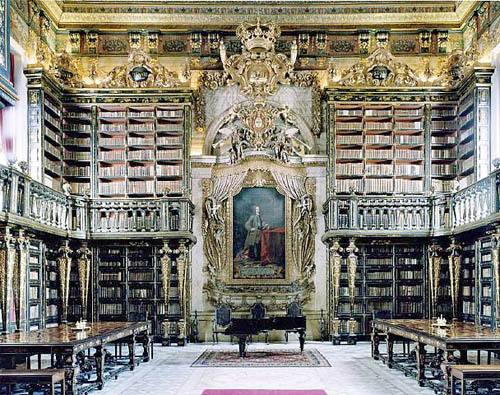
Sol Gaitan on if:book writes an interesting commentary on the exhibit of Candida Höfer's photographs at the Sonnabend Gallery. He notes that Höfer's photographs of Portuguese libraries create:
that feeling of "temple of learning" with which libraries have often been identified. On the other hand, the meticulous attention to detail, hand-painted porcelain markers, ornately carved bookcases, murals, stained glass windows, gilt moldings, and precious tomes are an eloquent representation of libraries as palaces of learning for the privileged. In spite of that, and ever since libraries became public spaces, anyone, in theory, has access to books and the concept of gain or monetary value rarely enters the user's mind.

Libraries are a book lover's paradise, a physical compilation of human knowledge in all its labyrinthine intricacy. With digitization, libraries gain storage capacity and readers gain accessibility, but they lose both silence and awe. Even in the digital context, the basic concept of the library as a place for the preservation of memory remains, for many "enlightened" readers the realization that human memory and knowledge are handled by for-profit enterprises such as Google, produces a feeling of merchants in the temple, a sense that the public interest has fallen, one more time, into private hands.

Comparison with Curious Expeditions' collection photographs of libraries (see previous post) makes me, however, think less in terms of a public-private distinction than the sacred-secular one evoked by the phrase "temple of learning." The ornate decorations of these libraries resembles ecclesiastical architecture, and that holds true whether the library is truly private or governmental or academic or really public (e.g. the New York Public Library, the British Library reading room, the Carnegie academic and public libraries all over the U.S. built in neo-classical style, etc.). The architecture effectively conveys a feeling that books and the knowledge they contain are something "set apart," that is, sacred or holy. Google books, on the other hand, conveys nothing of that, to me at least. There are attempts, however, to give at least some iconic texts in electronic form a semblance of a such an aura (e.g. the British Library's "Turning the Pages" web displays, Bible's on DVD that reproduce codex images, etc.). I suspect such efforts will not only continue, but become stronger and more sophisticated as publishers of e-materials (both for-profit and non-profit, secular and sectarian) try to appropriate the iconicity of bound books for their electronic products.

Saturday, September 15, 2007

Habit-forming reading


Though it's the opinion of this blog that books are already among the most iconic objects and images in very many cultures, a British publisher, TankBooks, is trying to sell books by making them in the shape and look of what is in their opinion an even more iconic object, the pack of cigarettes. Headlined "Tales to Take Your Breath Away," the publisher justifies this in iconic terms: "TankBooks pay homage to this monumentally successful piece of packaging design by employing it in the service of great literature. Cigarette packs are iconic objects, familiar, tried and tested, and over time TankBooks will become iconic objects in their own right." Inspired Marketing calls this move "truly inspired." Sales stats should show whether they're just blowing smoke ...

Friday, September 14, 2007

Iconic Books Symposium at Syracuse University

The Ray Smith Symposium on Iconic Books will take place October 18-20th at Syracuse University. Twelve scholars with specialties in diverse cultures and periods will gather to energize research on this important but neglected topic.

Anchoring the symposium will be two keynote addresses:
- “Images to be Read and Words to be Seen: the Iconic Role of the Early Medieval Book” by Prof. Michelle Brown (University of London, the British Library) on Thursday, October 18th at 7:00 p.m., and
- “Making Do With the Fetish: Scriptures and Vernaculars” by Prof. Vincent Wimbush (Claremont Graduate University, the Institute for Signifying Scriptures) on Friday, October 19th at 5 p.m.

During the day on the 19th and 20th, the invited scholars will take turns leading hour-long discussions about iconic books from the perspective of their own research and specialties. The symposium will conclude with a small film festival featuring a few short movies in which iconic texts play a central role.

For the list of invited participants, topics of discussion sections, and registration, housing, and travel information, see the link at left to "Symposium 2007." We hope to see you there!

Wednesday, September 12, 2007

Fla. Synagogue Offers Time-Share Torah


The Associate Press reports:
For a one-time gift of $1,800, members of Temple Israel [in Miami] can sponsor a section of the scroll. Each year, during the week before that section is read at Shabbat services, donors can keep the torah in their home — an event that has prompted families to host scripture studies, parades and dinner parties.

"When it's brought into a house, it makes the house more holy," said Rabbi Mitch Chefitz, who came up with the idea. "If the torah's in your room, then you have an honored guest."

... The torah was in need of cleaning and repair — to patch holes and fix lettering — so Chefitz came up with the time-share project.

About 40 of the 52 available weekly torah time-shares have been purchased at Temple Israel, a Reform synagogue. Other members have given $18 to sponsor a single letter of the scroll, and all five books have been sponsored for $18,000.

... When [Sandy] Grossman first had the scroll in her home last year, she had a gathering for friends and family. When the guests left, her 12-year-old daughter, Bari Pasternack, ran to the torah and kissed it. She read from it, and she took it to her bedroom with her and chanted prayers.

The mother watched. All her life, Grossman said, she never truly understood the torah. But that night, it came alive.

It's hard to imagine a better example of the iconic power of a Torah scroll.

Supplement (September 18th): This news has not gone down well with Rabbi Yossi Mandel of Everett, WA, who describes the ritual care with which Jewish scribes copy torah scrolls and decries this innovation: "There is no need to denigrate what is considered a sacred artifact in Judaism."

Black Book Art exhibit


The Minnesota Center for Book Arts has mounted what it claims is the first ever exhibit of book art by African American artists, according to Minnesota Public Radio. On display are the works of twenty-five artists. The exhibit, "We, Too, Are Book Artists," runs through Sept. 22.

Saturday, September 8, 2007

Beautiful Libraries


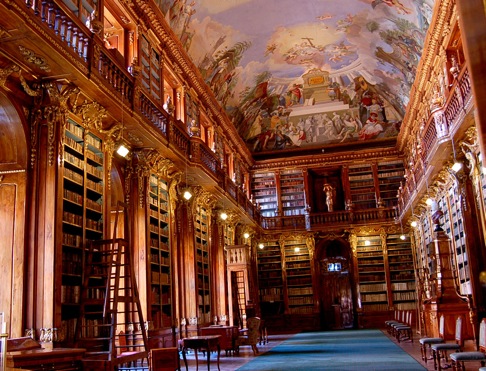
Curious Expeditions has put together a remarkable collection of photographs of beautiful libraries. This picture of the Philosophical Hall of Strahov Monastery in Prague (Czech Republic) is only one of very many examples.

From an iconic books perspective, the collection illustrates vividly the close association between religious architecture and library architecture. Frequently, as in the case of the Strahov Monastery, they are one and the same thing.

Even, perhaps especially, secular universities often repeat the trope of the library as the "soul" of the university. Donors and architects have literalized that metaphor with library temples in stone, steel, wood and concrete. Elaborate libraries have thus become the ultimate reliquaries for that nearly universal icon of knowledge and wisdom, the book.

However, for a very different aesthetic of library design, see the winning concept for a new Czech national library. Thanks to Lu Terceiro for pointing out both items.

Victorian family bibles gaining popularity

Ken Gloss, owner of the Brattle Book Shop and appraiser of rare books, told the Boston Globe that "What might have been [a time when] most of these Bibles, you couldn't even move, now some of these big old Bibles people will buy to give as gifts to divinity students, priests retiring. . . . There [are] definitely more people interested in religion, the history of religion, religious books, [and] different religions."

Friday, September 7, 2007

Miniature Guru Granth

newKerala.com describes a miniature (1x1 inch) Guru Granth Sahib (the Sikh scripture) in Agra, India. According to Kashmir Singh, the head cleric there, it "was specially made by the British for the convenience of Sikh soldiers during World War I, as they could not carry a normal sized book in the battlefield to pray. It was manufactured in Germany." The date and location can't both be right (Germans printing Sikh scripture for the British during WWI?), but I suppose the printing may have occurred in the years before 1914.

This account supports previous posts on this blog that suggested practical motives behind the production of miniatures. Do I remain skeptical only because my weak eyes, peering through prescription reading glasses, can't imagine anyone regularly reading such small print?

Wednesday, September 5, 2007

Iconic Bible Music Video

From the files of the Iconic Book Project: A hilarious celebration and parody of the iconicity of the Bible in American evangelical culture first appeared on YouTube in 2004. It is Dan "Southpaw" Smith's rap music video, "Baby Got Book."

New Prayer Book for Reform Judaism

People often express stronger feelings about the congregational worship books that they use routinely, such as hymnals and prayer books, than they do about versions of scriptures. Though many lay people leave debates over the latter to professionals, they willingly voice strong opinions about any changes to the former. Thus the news that American Reform Judaism is introducing a new prayer book, Mishkan T'filah: A Reform Siddur, next month provides an opportunity to think about the emotions that become attached to familiar ritual books.

The NY Times article about it (thanks to my colleague, Gail Hamner, for pointing it out) provides a convenient summary of the history of Reform siddurs (prayer books) in America. The new siddur is notable for offering four versions of every prayer: in Hebrew or Aramaic, in English translation, a contemporary poetic equivalent and a theological interpretation. It also provides two short commentaries: one "historical or practical," the other "spiritual."

The new siddur has been under development for twenty years, so its appearance can hardly come as a surprise. It will be interesting, though, to see to what extent the different options it provides actually get used.

Tuesday, September 4, 2007

Sell Books by Threatening to Burn Them

Prospero's Books, a used book store with a staff of two in Kansas City, has hit on book burning as a marketing device. They give a high-minded goal, according owner Tom Wayne on KCTV Channel 5: "We hope to spark a conversation about the importance of books in the face of a marked shrinking in reading trends, and staggering waste streams of actual books." But the motive is to move an unwanted inventory of 20,000 volumes, as the store website admits.

I suppose it was only a matter of time before the uproars over desecrating scriptures--and the secular equivalent, abhorrence to burning any book--would be seized on as a marketing gimmick. The Rag & Bone Blog wonders "Is this such a bad thing?" Prospero's notes that books are routinely thrown away by the thousands by bookstores and libraries, not to mention the rest of us.

Prospero's is, of course, playing on the iconic status of books, which distinguishes them from most other disposable commodities. I wonder, though, if their campaign doesn't do more to show just how disposable books are than to motivate people to save them.

Monday, August 27, 2007

Book Art on Blogs


A blog by Lu Terceiro provides a recent series of posts on "book as art object" with pictures of book art installations culled from the WORK site, including this untitled piece by Job Koelewijn (2005).

Tuesday, August 21, 2007

Bible in MP3

(Having more to do with the performance of scriptures than their iconicity ...) Iyov has compiled a remarkably long list of MP3 recordings of people reading the Bible in various English translations.

Instant relics: $1000+ coffee table books

Thanks to Rare Book News for pointing out this Wall Street Journal article which reports that an art book publisher has five new art books on its fall list priced in excess of $1,000. Leading the pack is Super Yacht, $3,950, with "an Italian-silk cover, protected by a clamshell Lucite case, and 648 color pages, which include rare photographs."

Sunday, August 19, 2007

Bulletproof Bible

One of the traits often attributed to the Bible is the ability to stop a bullet and save a soldier's life. An About.com Internet site documenting urban legends offers quotations reporting this legend at least as far back as 1841 (with one quotation claiming Oliver Cromwell knew about it!), and the latest war continues the tradition. According to a Buffalo, New York, television news broadcast, US Army PFC (Private First Class) Brendan Schweigart's Bible protected him from a ricocheting bullet:
It's the personal story of a Southern Tier soldier who can tell you the Word of God literally saved his life in Iraq! Army PFC Brendan Schweigart tells News 4's Ellen Maxwell how his personal bible stopped a bullet that would have killed him.

[. . .]

"They were cleaning the wound, you know, working on me, and then I for some reason just asked for my bible."

When the 22 year old was handed his bible, he realized the sniper's bullet had stopped there.

[. . .]
More skeptical readers might also be interested in Episode 16 of Season 2 of the cable television show Mythbusters, in which the hosts test the myth by seeing whether or not a book can stop a bullet. (For the most part, it can't.)

Friday, August 10, 2007

Troops Occupy Iraq's National Library

The Guardian reports that Iraqi troops have seized Iraq's national library to use its roof as a military outpost. The library director complains that "They have turned our national archive into a military target." The Guardian's lead line for this story announces that "Thousands of rare books and manuscripts in Iraq's national library and archive, one of the country's most important cultural institutions, are in peril." Jeremy Dibbell on Bibliophile editorializes: "The library building and grounds must be off-limits as a base for military operations, in order to prevent reprisal attacks on it and other cultural institutions."

Of interest from an iconic books perspective is the claim that important libraries and other cultural institutions, such as museums, should be off-limits to military activity. This reproduces in secular language the religious claim that military personnel stay out of shrines and other holy sites. Regard for libraries and museums as secular shrines is, of course, widespread in modern culture, even if recognition of the religious nature of this attitude is not.

Wednesday, August 8, 2007

Floating Book Fair / Exhibit / Mission

A ship containing a Christian books store calls on ports in Africa and Asia (see Doulos; a sister-ship sails Central and South American waters). Local press releases tout its scheduled stop this week in Chennai, India, as an "international Christian book fair." The merchandise includes
high-quality imported Indian Bibles in gilt edges, genuine leather bound, personalised versions in sizes, varying from large church editions to ultra small personal pocket Bibles. ... The Fair would also feature some exceptional Bibles like the largest, heaviest, smallest, waterproof, steel grip and personalised Bibles. ... In the personalised Bible, the reader's name appears 7000 times.
Other stories feature the floating store as "a floating book store for bibliophiles," "a book fair full of surprises," and "The Biggest Bible on display at Chennai Book Fair." A 2005 story in WikiNews about the ships emphasized that they bring books to people in regions otherwise without access to them.

Beyond the obvious use of iconicly crafted scriptures both as merchandise and as merchandizing display, the ships and the media coverage they willingly receive vividly illustrate how the interest in books in general, and scriptures in particular, reaches across cultural and religious boundaries. Iconic books have therefore always been useful tools for missionary work.

Tuesday, August 7, 2007

Timbuktu's Old Books (3)

Today's New York Times has a long article about Timbuktu's manuscript libraries. The story emphasizes the social and political stakes involved in the city's library project:
A surge of interest in ancient books, hidden for centuries in houses along Timbuktu’s dusty streets and in leather trunks in nomad camps, is raising hopes that Timbuktu — a city whose name has become a staccato synonym for nowhere — may once again claim a place at the intellectual heart of Africa. ...

Timbuktu’s new seekers [investors in the town and libraries] have a variety of motives. South Africa and Libya are vying for influence on the African stage, each promoting its vision of a resurgent Africa. Spain has direct links to some of the history stored here, while American charities began giving money after Henry Louis Gates Jr., the Harvard professor of African studies, featured the manuscripts in a television documentary series in the late 1990s.
The feature includes an audio slide show and links to on online exhibit of Timbuktu manuscripts at the US Library of Congress.

Saturday, August 4, 2007

Desecration as Protest

Previous posts have noted furor over desecrating scriptures in many countries, and the issue is again causing controversy in the USA. The arrest of a former Pace University student on hate-crime charges for throwing two Qur'ans in public toilets is generating charges of hypocrisy from many quarters, because similar acts by artists using Christian symbols have previously been defended on free-speech grounds (e.g. Hyscience, NY Post, Front Page; see the response from the Council on American-Islamic Relations).

Far less attention is being given to news that artist Charles Merrill burned a rare and valuable Qur'an. Earlier, he marked and cut up a Bible. He explained his attempt at even-handed desecrations of scriptures as symbolic acts of protest: "The purpose of editing and burning Abrahamic Holy Books is to eliminate homophobic hate."

As I observed in the case of the burning Bible on German TV, attention to descrations of one tradition's scriptures brings increased attention to similar acts in other traditions. The iconic status of a book is not static, but constantly changes. Iconic books provide convenient tools for both giving offense and taking offense, and today's politics gives many people reasons to do both. I expect that people's sensitivities to how their scriptures are being treated will keep rising for a while.

Attempt at Publishing Monopoly on Guru Granth

Sikh authorities in Rajasthan, India, are trying to get legislation passed that would grant legal monopolies for the printing of copies of the Guru Granth Sahib, the Sikh scriptures. This effort seeks to guard it from profanation or desecration, which has also been a recent tactic of intra-communal conflict (see Sikhs).

August 8th: The Punjab government announced to day that it would, in fact, "issue an ordinance banning the publication and publishing of the Guru Granth Sahib, the Sikh scripture, by private publishers," according to newKerala.com.

Friday, August 3, 2007

Brittle Book Syndrome on YouTube


Thanks to Bibliophile Bullpen for drawing attention to this YouTube video of bookbinder Peter Goodwin's describing "brittle book syndrome," with side comments about the advantages of books over electronic media...

Tuesday, July 31, 2007

Calligraphy in decline?

Several new articles about religious calligraphy: An Iranian manuscript illuminator laments the decline of his art form because his contemporaries "prefer modern art to traditional work." I mentioned a similar complaint from a Indian calligrapher in a previous post. Two other articles show that some calligraphers still find patrons for hand-copied Qur'ans (Muslim scriptures) and Guru Granths (Sikh scriptures) in India and Canada. But both scribes' goal of writing the largest copy of their respective scriptures hints that calligraphic art alone is no longer enough either.

Saturday, July 28, 2007

Monumental Qur'an: Checkpoint into Mecca

Since my query a few weeks ago concerning a Qur'an monument over a highway, I have finally found what I was looking for. In fact, this is the checkpoint into Mecca, on the road from Jeddah. Since Jeddah is the nearest major airport to the holy city of Mecca, most pilgrims to Mecca arriving by air would enter this way. It is the place where (male) pilgrims don their white garments for the hajj, and a state of ritual purity and equality begins. Non-Muslims are not permitted beyond this checkpoint into the sacred sites of Mecca.

I intend to investigate this monument more (when was this built? who designed it? what do other checkpoints look like?), and will update this post as I learn more, but if anyone else can contribute some information, please comment.

These photos are from the website virtualtourist.com. I am surprised that I haven't been able to find more pictures of this iconic book monument. While it is understandable that images from the sacred sites of Mecca might be limited, pictures of the Ka'ba other places are widely available.

Any ideas why this image is not more globally known?

Wednesday, July 25, 2007

Sutra Paintings & Accessories


The Korea Times reviews an exhibit at the National Museum of Korea titled "Sutra Painting: In Search of Buddhahood."

... The exhibition consists of two themes. The first highlights the Diamond Sutra Block made of gold found in Iksan Wanggung-ri pagoda, Buddhist reliquary as well as objects such as sutra case, sutra chest, and cloth for wrapping sutra.

The second offers the sutra paintings ranging from the period of Unified Silla (668-935) to the Joseon Kingdom (1392-1910) arranged chronologically to present an entire view of the distinguishing characteristics in accordance with its period and style. ...

The exhibit runs until September 16.

Tuesday, July 24, 2007

Giant Vietnamese Declarations of Independence


Thanh Nien News reports:
A calligraphy book in wood weighing over 300kg, thought to be the largest in Vietnam, titled Declaration of Independence, is on show in Hanoi.

The 2 m by 84 cm book was created in 21 days by Trinh Van Tuan from rare and durable kinds of wood and paper, and is a reproduction of three works considered national declarations of independence.

The first two documents included in this his new work of calligraphy date to 1077 and 1428 while the third was written by Ho Chi Minh "based on the American Declaration of Independence and the French Declaration of the Rights of Man and the Citizen to affirm the independence of the Democratic Republic of Vietnam from France."

Monday, July 23, 2007

Koreana Tripitaka (2)

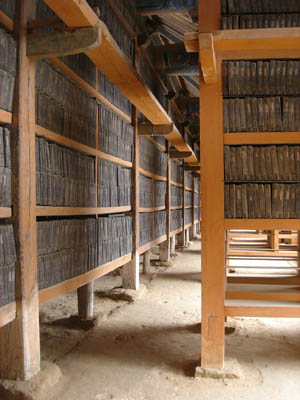
Yohan Yoo has provided me with the following links to background information on the huge collection of carved wooden printing blocks of the Buddhist scriptures called the Koreana Tritipaka, which I mentioned in a previous post. They emphasize the iconic intention that motivated their production as well as their preservation and veneration up to the presernt. The links take you to pictures as well as the full articles:
From Korean Tripitaka: "The entire Korean Tripitaka was carved twice during the Koryo Dynastry (918-1392), both times on wooden blocks. The king and the people believed that the presence of these sacred texts would help to drive back invasions and also bring good luck."

From Wikipedia: "The Tripitaka Koreana was first carved in 1087 when Goryeo was invaded by the Khitan in the Third Goryeo-Khitan War. The act of carving the woodblocks was considered to be a way of bringing about a change in fortune by invoking the Buddha's help. The original set of woodblocks were destroyed during the Mongol invasions of Korea in 1232, when Goryeo's capital was moved to Ganghwa Island during nearly three decades of Mongol attacks, although scattered parts of its prints still remain. King Gojong thereafter ordered the revision and re-creation of the Tripitaka; the carving took 16 years, from 1236 to 1251. This second revision is usually what is meant by the Tripitaka Koreana. In 1398, it was moved to Haeinsa, where they have remained housed in four buildings."

Life in Korea adds: "The original set took 77 years to complete, and was finished in 1087. However, it was destroyed in 1232 by a Mongol invasion. King Kojong ordered the set remade and work began in 1236. It was felt that replacing the wood blocks would convince Buddha to intervene and help repel the Mongolian invaders. Originally carved on Kangwha Island, they were moved to Haein-sa during the early years of the Yi dynasty."

Korean Tripitaka concludes: "The Korean Tripitaka has great national significance to the Korean people. It represents their steadfastness in adversity and their wish to maintain their cultural identity. In some ways it is the national conscience of Korea."

This collection of iconic texts imbued with both religious and nationalistic significance is doubly fascinating because it is the print blocks, not the printed texts produced from them, that were given and have retained such revered status. Perhaps that is because the wooden blocks are materially larger and more substantial and take much longer to create than printed paper books and so are better suited to veneration as monuments.

Sunday, July 22, 2007

Married to the Qur'an

Mohammed Al Shafey reports in Asharq Alawsat about a custom in Sindh province of Pakistan called being "married to the Qur'an."
... In this type of marriage, young girls are asked to dedicate themselves to memorizing the Holy Quran. Their families then hold a ceremony to marry the girl to the holy book. A girl places her hand on the Quran and takes an oath that she is married to it until death. ...

Women who are married to the Holy Quran are not allowed to have a relationship with a man or to marry anybody. Moreover, men fear being cursed if they have a relationship with a woman who is married to the Quran.

The trend is more notable amongst the rich and feudal families in Sindh. It was first devised to deny women their rights of inheritance and out of fear of property being passed on to outsiders through the daughters or sisters [i.e. their spouses or children]. According to independent sources in the Pakistani capital, Islamabad, approximately 10,000 girls are married to the Quran in the Sindh province. ...

Shafey notes that the government along with community activities have tried to suppress the practice, which he and they judge to be un-Islamic.

From the perspective of the comparative study of iconic books, this is a fascinating example because it combines a traditional iconic use of the physical Qur'an for taking oaths with its traditional performative use for memorized recitation. The oath becomes a wedding vow of fidelity to the recitation of the book itself. The combination thus becomes a marriage ritual with the power to constrain the young woman's future behavior. The social and religious power deployed through such ritual uses of scripture is very clear.

Islamic Art in London (2)


In addition to the article cited in my previous post, the BBC has now published a review of the London exhibit, Spirit and Life, which includes a slide show of seven images from the exhibit, including this page of a blue Qur'an. It adds that "Other texts on display include a single page from a vast Koran whose pages stretch 2m (6.5ft) in height and a scroll the width of a palm with a microscopic text probably painted with a single-haired brush."

Thursday, July 19, 2007

Gigantic Books


The worth of iconic texts gets marked by, among other things, the construction of monuments that take the shape of the books themselves. Monuments of the Qur'an appear in the palace square of Sharjah in the UAE (above) and on roadsides in Bahrain, while the tablets of the Ten Commandments fill an entire hillside in Murphy, North Carolina.

Gigantic monuments to secular texts apparently have more difficulty in getting funded, if the aborted plan to construct a 50-foot tall replica of Gilles Deleuze and Felix Guattari’s book A Thousand Plateaus: Capitalism and Schizophrenia in Minneapolis, Minnesota, is any indication.

Wednesday, July 18, 2007

Review

A summary review of In the Beginning: Bibles Before the Year 1000, edited by Michelle Brown, has been posted by the Review of Biblical Literature.

The "Magic" of Original Documents

Gannett News Service provides an interview with U.S. National Archives senior curator Stacey Bredhoff, who describes the effect of viewing the Declaration of Independence in the Archives Rodunda:

Q: Why is it important for people to come here to see the declaration firsthand?
A: I think there is some kind of magic in standing in front of the original document. You’re standing in front of the original Declaration of Independence, faded as it is, but still you can make out some of the signatures and you think, “Whoa, these people were real. This really happened.”

I compare this tendency to ascribe "magical" power to viewing some significant textual exemplars to the religious role of relics. Whereas any copy of the Declaration of Independence is iconic in American political culture, the "original" in the Archives Rotunda is a relic: it does is not displayed so that visitors can analyze its meaning in depth or read it aloud in its entirety (it's much too faded to do either very well) but for its material, visual effect alone.

Ritual Rhetoric and Scripture

(With apologies for self-promotion) My book, Ritual and Rhetoric in Leviticus: From Sacrifice to Scripture, is now out. Its contribution to the topic of iconic books is primarily in chapter 9, "The Rhetoric of Scripture," which reproduces my 2005 JBL article with a small addition discussing David Carr's book, Writing on the Tablet of the Heart (2005).

Tuesday, July 17, 2007

Chinese to preserve Tibetan books


The Chinese Academy of Social Sciences and the China Tibetology Research Centre is launching a two-year effort to preserve 426 volumes of Buddhist scriptures on palm-leaf manuscripts, dating from the 7th to the 13th centuries C.E. For a short history of the development and impact of palm leaf manuscripts, see Palm Leaf. An impression of the literary and artistic effort that went into creating the vast Tibetan libraries can be gathered from the pictures and introduction to the exhibit, Guardians of the Sacred Word, that was on display in New York in 1996. The difficulties involved in such preservation work are described vividely in the report on similar efforts in Thailand.

The vast majority of the Tibetan libraries and their contents were destroyed during and after the Chinese invasion of Tibet in 1951. This new effort at preserving Tibet's manuscript heritage under Chinese sponsorship seems to be a remarkable policy reversal. I wonder how the Tibetan government in exile feels about this ...

Islamic Creationists and the Rhetoric of a Beautiful Book

The New York Times article "Islamic Creationist and a Book Sent Round the World" examines the recent mailing of Harun Yahya's Atlas of Creation to scientists, politicians, and museums in the United States. Of interest to Iconic Books aficionados is the role that appearance plays in this latest round in the debate over human and natural origins. According to the article, "for many, it is too beautiful for the trash bin but too erroneous for their shelves." The article quotes UCB evolutionary biologist Kevin Padian as saying his colleagues were "just astounded at its size and production values and equally astonished at what a load of crap it is." Elsewhere, the article quotes Brown University biologist Kenneth R. Miller: "While they said they were unimpressed with the book’s content, recipients marveled at its apparent cost. 'If you went into a bookstore and saw a book like this, it would be at least $100,' said Dr. Miller, an author of conventional biology texts. 'The production costs alone are astronomical. We are talking millions of dollars.'"

Scholars of iconic books are quite familiar with the rhetorical value of a beautiful book and equally familiar with Islam as one of the traditions that is most well-known for its beautiful religious texts. Here, I think, we see a member of that tradition put those artistic and rhetorical tools to use in a different kind of argument. Even if the content of the Atlas of Creation fails to persuade the audience, the physical presence of the book is too powerful to ignore.

Monday, July 16, 2007

Islamic Art in London

Rare Book News points out the opening of "Spirit and Life," an exhibit of Islamic Art from the Agha Khan Museum collection at the Ismaili Center in London, July 14 through August 31. The displays include "one of the finest illustrated manuscripts ever produced, the Persian epic masterpiece of Shahnameh (The Book of Kings), and an extremely rare copy of the Canon of Medicine of Ibn Sina also known as Avicenna."

Sunday, July 15, 2007

Burning Bible


The image of a burning Bible appeared multiple times Wednesday in a German TV documentary about Christian fundamentalism. Bild, in a report headlined "TV-Skandal!" picked up by other German media, asked several political and church leaders if one is allowed to do this, getting predictably critical answers. One commented on how much greater the negative reaction would be if it had been a Qur'an: "Was wäre wohl in Deutschland los, wenn die ARD einen brennenden Koran gezeigt hätte?"

It is worth noting the different standards and practices revolving around the iconic use and misuse of scriptures--and how they change over time and influence each other across religious boundaries. The Western media attention to Qur'an desecration over the last few years has heightened some people's sensibilities about other sacred texts and leads one to wonder about the differences.

Saturday, July 14, 2007

Desecrating Scriptures: Uses and Abuses

According to several articles in the Daily Times, Pakistan's draconian blasphemy laws make the charge of desecrating a Qur'an particularly dangerous. In one case, a man in Lahore apparently framed another for burning a Qur'an in order to buy his property at half price. In another case, a Christian man has been jailed without bail for burning a Qur'an. He claims to have been told that doing so would help him get his wife back (but he is also claiming insanity).

The seriousness of these charges is illustrated by stories about people beaten after speaking ill of Muhammed, Islam or the Qur'an, and then being arrested while their attackers go free. Some religious and political leaders are calling for the death penalty for blasphemers, and mobs and jailors occasionally carry it out. The Human Rights Commission of Pakistan has been protesting these laws for many years, as have Pakistani Christians, but apparently with little success.

These stories obviously show the social power transacted by the use and abuse of an iconic book. But they also point out how hard it is to control the iconic dimension of scriptures. Scholars and other religious authorities traditionally dominate interpretation of the textual dimension, so that debates over doctrine and orthodoxy remain under the control of a few rival elites. The iconic dimension, however, can be manipulated by whoever has access to a copy of the text--whether to honor a scripture or to desecrate it or to frame a rival or to gain economic advantage or, as in the case of the hapless husband mentioned above, to try to harness its iconic power for personal ends. This story, if accurate, shows an esoteric use of an iconic book coming into conflict with the same text's exoteric veneration. The exoteric usually wields greater power, as this man's continuing jail stay shows.

Tuesday, July 10, 2007

Funeral for the "N-Word"

This last weekend, an NAACP-led gathering in Detroit held a funeral for the "n-word," intending to remove it from usage. Most major news sources have an article about the event, and the Chicago Tribune article includes a video. The funeral for the racial slur is comparable to the handling of iconic books, treating the word as a person and conducting it out of common usage with the ceremony customarily used for people, including a horse-drawn cart containing a pine box and black flowers.

What strikes me as most interesting here is the way that something as celebrated as a religious text or name and something as reviled as the n-word can both be handled with the same practices. At the level of language, the racial slur is talked around with the euphemism "the n-word" in much the same way that the divine name and the names of certain religious personages are handled with care, such as writing "G_d" or using titles instead of the proper name (i.e., "The Prophet"). The word is ushered out of usage with a funeral, a ritual more commonly associated with showing respect for the deceased than with erasure. The value of a text or a word can be either positive or negative, but in either case, it can be treated as an icon and handled through caution and ceremony.

Friday, July 6, 2007

Qur'ans as Islamic Art

The Australian provides a review by Sebastian Smee of "The Arts of Islam," an exhibit in Sydney of part of the private collection Nasser D. Khalili. Among many other things are a group of Qur'ans that illustrate several features of iconic and relic texts that we have been discussing on this blog:

"... the show opens with a display of Korans, big and small, from Iran, China, North Africa, Egypt and Sicily. Later on, there is a fragment from a Koran believed to have been inscribed by a one-handed, left-handed calligrapher from the central Asian city of Samarkand. Trying to impress the great ruler Tamerlane, he had written a Koran so small that it could fit under a signet ring. The ploy failed so he turned around and made a giant Koran: each page almost 1m long and 1.8m high, with only seven lines per page.

"A single line is on show here. Impressive as it is, it serves as a reminder that many of Islam's greatest cultural treasures -- a high proportion of them in book form -- have been split up or otherwise tampered with in the name of profit. The practice continues unabated today, with random pages from previously whole manuscripts and individual tiles ripped from the walls of buildings appearing at auction on a regular basis."

Thursday, July 5, 2007

Uneasiness over Non-Canonical Texts

April DeConnick, on the Forbidden Gospels Blog, has raised the question, “Why do non-canonical texts make us uneasy?” As a scholar of Nag Hammadi texts and other early Christian writings, she has repeatedly run up against the desire among fellow academics to keep such materials marginalized.

The issue is not new, though the publication in accessible form of “Gnostic” materials in the last several decades has brought it home to students of early Chistian history. One hundred years ago, it was the publication of the Gilgamesh flood story that threatened to relativize the Hebrew Bible’s account of origins by placing its materials within a wider and older historical and religious context.

The cultural standing of Jewish and Christian scriptures, however, seems not to have been dented much by such discoveries over the last one-and-a-half centuries or by the two-centuries of historical-critical scholarship on their origins and development. I suggest that resilience is due to the fact that the Bible’s reputation depends as much on the inspiration it produces through performance in sermon, song and dramatization (now frequently on film) and on the legitimacy conveyed by its iconic representation in ritual, art, and mass media as it does to the textual authority conveyed by interpretations of its message by scholars.

If anything, the main effect of biblical scholarship on public perceptions of the Bible is to emphasize the scripture’s importance precisely because so much attention and effort is devoted to controversies over its meaning and origins. Here may lie one source of anxiety about non-canonical texts: the intuitive suspicion that more attention to these other materials raises their status and dilutes claims to the unique importance of the scriptures.

The history of the actual religious influence of such scholarship suggests that Christians and Jews have little reason to worry. The net effect of comparative scholarship is probably to draw even more popular attention to scriptures whose status is, at any rate, well protected by the ways in which Jews and Christians ritualize their iconic and performative dimensions.

Sunday, July 1, 2007

Magna Carta visits Constitution Center


Lincoln Cathedral has loaned its copy of the Magna Carta to the National Constitution Center in Philadelphia for a three-week exhibit, starting July 4th. (The Center has put an English translation of it online.)

It will be interesting to see how the Center displays the document. I've been struck by the very different treatment accorded iconic political texts in the United Kingdom and the United States. The British Library in London displays its two original copies (of the four extant) of the Magna Carta in its room of "Treasures," exhibited on a par with several dozen other rarities such as the Leningrad Codex of the Hebrew Bible, the original manuscript of Beethoven's Ninth Symphony, etc. (And it puts electronic fascimiles of many of them on-line: the Magna Carta is here.)

The U.S. National Archives in Washington, by contrast, displays the fourth original copy of Magna Carta alone in an alcove (see my photograph above) off to the side of the Rotunda that houses the Declaration of Independence and the U.S. Constitution--not nearly so grand as the Rotunda itself (see picture in previous post) but an elaborate iconic display nonetheless that emphasizes its uniqueness much more than the British Library's rather documentary approach.

The American emphasis on the iconicity of founding national documents reflects how much the U.S. government stakes its political legitimacy on being "Constitutional."

Timbuktu's Old Books

The Guardian today put online a beautifully photographed audio slide-show showing a sample of Timbuktu's scattered ancient manuscripts which, as my previous post noted, are now being collected into libraries and catalogued.

Friday, June 29, 2007

Wardington Hours as Relic Book


PhiloBiblos pointed out yesterday's BBC report that the British government imposed an export ban on the Wardington Hours (a 15th century illuminated Christian devotional text, a "Book of Hours") in order to give the British Library time to raise the money to match a German buyers' offer. This example illustrates how rare, museum-quality books usually function socially more like relics than like icons. That is, unlike iconic books like the Bible or Qur'an which are readily reproduced and whose distribution and export tend to be heartily encouraged, relic books are regarded as one-of-a-kind and often carry significant associations with particular places or countries. The textual and performative dimensions of relic books have ceased to be important; they are valued for their iconic dimension alone. And, like other kinds of relics, relic books are often divided into smaller parts to distribute their value: so the BBC article ends by noting that the Wardington Hours may have originally been part of "a complete Book of Hours now held in the Huntington Library in California."

Wednesday, June 27, 2007

Pro-Wrestler Chris Benoit and the Bible

In the coverage of the murder/suicide of professional wrestler Chris Benoit and his family, a recent Sports Illustrated article foregrounded the detail that the wrestler put a Bible next to the bodies of his wife and son before he hanged himself: "Benoit strangled his wife, suffocated his 7-year-old son and placed a Bible next to their bodies before hanging himself with a weight-machine pulley, authorities said Tuesday." The article at the linked site has since been changed to include new details, but the original text mentioned the Bible in the headline (which appeared on CNN.com), the lead paragraph, and the final sentence. Within the article, Benoit was said to have a "wholesome family-man image."

In a related article discussing the possibility that Benoit's actions were the result of 'roid rage, (psychological instability caused by the use of steroids), Sports Illustrated cites wrestling industry spokesman Gary Davis and the industry's public statement WWE [World Wrestling Entertainment] Shocked At Latest Developments In Benoit Tragedy, Concerned By Sensationalistic Reporting concerning Benoit's Bible: "The presence of a Bible by each [of the bodies] is also not an act of rage." The same article features a picture of Benoit captioned with "Police say Chris Benoit strangled his wife, suffocated his 7-year-old son and placed a Bible next to their bodies before hanging himself with a weight-machine pulley." Other news coverage (including AP wire articles) also includes the detail about the Bible. Clearly it is important for the reader to know this detail.

The iconicity of the Bible seems to be the key element in play, although one wonders what the rhetorical goal of including this fact about the murder scene might be. The articles do not make explicit connections between Benoit's actions and the Bible. Is the effect to construct him as pious, despite his crimes? Are we to think of him as having concern for the religious disposition of his family even after death? Is the Bible to be seen as a magical amulet of sorts, protecting them after death?

One must also consider this news coverage as it contrasts against similar coverage of other crimes. In cases when role-playing game books or certain music CDs (such as Marilyn Manson) have been found in the libraries of murderers or suicides, the press is quick to discover a causal link between the book or CD and the killer. One can only wonder how this story would play if the book placed by the victims had been a Qur'an.

Tuesday, June 26, 2007

Caligraphy & Recitation: Islamic Arts

The Indian Muslim profiles a professional calligrapher trying to preserve what he perceives as a dying art. He is quoted as equating calligraphy with recitation: "There are two major arts in Islam. Reciting the Quran well and writing the script of the Quran gracefully."

"Reciting well" would probably not describe a group of six men in Bahrain who are attempting to break the world speed record for reading the Qur'an aloud, which currently stands at "140 hours and two minutes."

Ancient Sutra auctioned

Bloomberg Radio reports on a Beijing auction:
"On Saturday, Hanhai auctioned a copy of the Prajna Paramita sutra that included an inscription claiming it was from the caves of Dunhuang in western China, where Buddhist art and religion thrived from the fourth century. The 3.1 meter parchment scroll, with the portrait of a sitting Buddha, sold to an anonymous phone bidder for 2.6 million yuan, a record for an ancient Chinese manuscript.
The inscription at the end, bearing the mark of collector Li Shengduo (1858-1935), a former envoy to Japan and owner of one of China's most extensive collections of ancient texts, says the scroll came from Dunhuang and was written in about 247. The Prajna Paramita sutra is believed to have been first translated into Chinese from Sanskrit around 402 by the monk Kumarajiva."
(Note: 2.6 million yuan = around $341,000)

Monday, June 25, 2007

Golden Qur'an at Pushkin Museum

Interfax reports:
"The unique Golden Koran is going to be presented to the public in the Pushkin Museum of Fine Arts, Moscow, on Monday.
The Golden Koran consists of 162 pages made of pure gold. The book weights almost 30 lb.
The Golden Koran is unique. It has been made by the world’s eldest mint, the Goznak Russian Mint in Moscow. It took them eighteen months to create the masterpiece, which it is impossible to copy or to forge.
It is based on one of ten copies of the 8th century manuscript of Uthman’s Koran, once preserved in a private collection in Russia. In 1936 the original of the world’s eldest manuscript of the Koran was appropriated by the Soviets and since that time it has been kept in the St. Petersburg Institute of Oriental Studies of the Russian Academy of Sciences.
The Golden Koran will be exhibited in the Pushkin Museum for the next two weeks."

Sunday, June 24, 2007

Egypt asks for Rosetta Stone


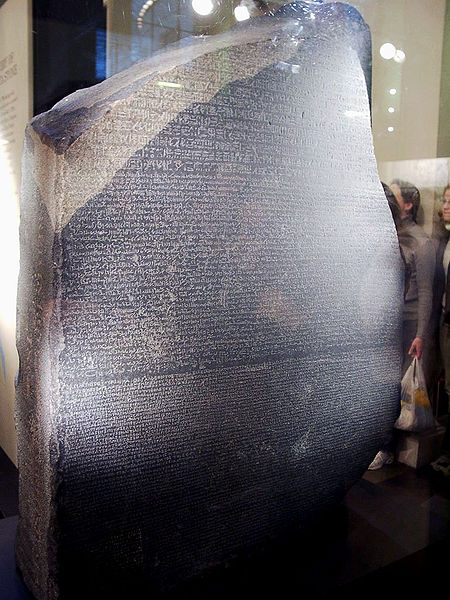
The Art Newspaper reports that Egypt has asked the British Museum to loan it the Rosetta Stone for a three month exhibit. The article notes that one issue complicating this request is the stone's "iconic importance. It is probably the single most-visited object in the BM’s entire collection, attracting even more visitors than the Parthenon Marbles."

Declaration of Independence

As July 4th approaches, one of America's iconic national texts, the Declaration of Independence, is beginning to pop up in the news. A 1820 copy of the document fetched $477,650 at auction this month, while a Broadway Theater is reviving the 1960s musical, 1776, for a limited run. Of course, one of the most elaborate shrines to any relic text is the recently renovated Rotunda of the National Archives that displays the Declaration and the U.S. Constitution in Washington, D.C.

Hand copying the Bible

Lest we think that the devotional practice of copying has no place in modern American Christianity, today brings a story about a Missouri man who spent forty years copying the King James Version by hand.

Friday, June 22, 2007

Johannes who?

Ben Vershbow on if:book points out that the Koreans were printing with metal movable type two hundred years before Gutenberg. He provides a picture of "the oldest existing document in the world printed with metal movable type: an anthology of Zen teachings, Goryeo Dynasty, Korea... 1377."

Wednesday, June 20, 2007

Rig Veda manuscripts on UNESCO's list

UNESCO has added 30 manuscripts of the Rig Veda to its "Memory of the World Register," which lists "documentary heritage of ... world significance." (Its news service mis-states their age as dating "from 1800 to 1500 B.C.", confusing an early but plausible date for the composition of the oral vedas with the dating of the 15th-19th century C.E. manuscripts at Pune, India.) The National Mission for Manuscripts of India's Ministry of Culture made the nomination on behalf of the Bhandarkar Oriental Research Institute in Pune. That institute's library was ransaked in 2004 by one hundred fifty vandals outraged at the claims of an American scholar who had done research there. The UNESCO designation will bring prestige to the institute and, maybe, some protection. So here is a case of enlisting the prestige of an oral scripture, the Rig Veda, in the iconic form of some of its oldest manuscripts to lend legitimacy to a research institution. (By the way, UNESCO proclaimed "the tradition of Vedic Chanting" to be a "Masterpiece of the Oral and Intangible Heritage of Humanity" in 2003.)

Books in French presidential portraiture

Thanks to Dan Visal on if:book for reproducing the Times Literary Supplement's one-paragraph historical survey of the use of books in the official portraits of French Presidents. The topic was stimulated by Nicolas Sarkozy's decision to have himself portrayed in a library full of leather-bound volumes (a pose favored also by many American lawyers).

Tuesday, June 19, 2007

Miniature Emancipation Proclamation


NPR's All Things Considered had an interesting report yesterday on a miniature edition of Lincoln's Emancipation Proclamation that was carried by Union soldiers. This report discusses why it was important for soldiers to have a small book to carry (i.e., it is less cumbersome than a scroll!) but I think there must be an iconic aspect to this, as a pamphet edition would probably be more readable. I'd appreciate hearing from others who might know more about this edition, or who have any pictures of the tiny book. NPR's segment is also about an exhibit of miniature books on display at the Grolier Club in New York City.

Monday, June 18, 2007

Leading Iraqi calligrapher killed


The chaos in Iraq is taking its toll on all aspects of Iraqi culture, including the art of classical Arabic calligraphy. The BBC reported that Khalil al-Zahawi was ambushed and killed on May 26th. For pictures of him at work and a few samples of his work, see Sad day for Arabic calligraphers.

Wednesday, June 13, 2007

Manuscripts Online

News today that the Jewish National and University Library has made high definition digital images of all the pages of a 14th-century prayerbook, the Mahzor Nuremberg, available for viewing online. This codex is notable not only for its fine calligraphy and unique marginal commentaries, but also for its large size (50 x 37 cm, 1042 pages).

This news reminds me again of one of the remarkable benefits of the internet revolution that has made possible direct access, freely and world-wide, to one-of-a-kind texts. A leader in this field has been the British Library, whose Turning the Pages website offers complete views of more than a dozen works, including the Golden Haggadah, Baybar's Qur'an, and the Lindisfarne Gospels.

Tuesday, June 12, 2007

Compilation of Guru Granth

The India Post conveniently summarizes traditions regarding the compilation of the Guru Granth Sahib (the Sikh scripture). The article details clearly how all three dimensions of this scripture were ritualized from the beginning: inclusion or exclusion from the text marked the relative authority of rival gurus, performance of the verses was based on various Indian musical traditions, and iconic veneration of the book was mandated from its first publication.

The same paper also reports that the Sikh conflict in Punjab seems to be subsiding.

Monday, June 11, 2007

Monumental Qur'an


I'm not sure if this is the image Jim is looking for, but this is one big Qur'an on a stand, found here; according to this site, which appears to be that of a tourist, the image is of the Emir palace in the UAE with an monumental open Qur'an.

Searching for Quran monument over highway

For several years I have been searching for a location and a photo of a monument of an open Quran on a stand that is large enough for at least two lanes of cars to pass underneath. I have seen this in the video "Islam" in the Religions of the World series by Schlessinger Media, but not in a still photo. Can anyone help me out? Please post photos on the blog or email them to me.

Saturday, June 9, 2007

Bible sales & media messages

I've been reading the Chicago Tribune's report on bible sales in the USA (see previous post) in conjunction with the China Daily's report about the "Bible Ministry Exhibition of the Church in China," which publicizes Chinese bible sales and distributions. The latter report and exhibit overtly aims to demonstrate to Western audiences that religious freedom exists in the People's Republic (a highly contested idea, to put it mildly). The juxtaposition of the two articles makes me wonder what ideological messages are conveyed by news stories about American bible sales. One overt message is to show with marketing statistics that American Christianity remains robust--not too different from the China Daily's goals, even if aimed at a different set of controversies. Another implied point reinforces the iconicity of the Bible as the perennial "best seller." The restriction of the sales statistics to single national markets (though many of the American publishers have international distribution networks) suggests that the Tribune article, like China Daily's, has some nationalistic undertones.

Conservation & Innovation (2)

The Chicago Tribune reports that the Bible sells big; so do its spinoffs. These spinoffs include those developed for niche markets ("Bibles for archeology buffs, for young couples and for golfers") and "Biblezines" modeled on Seventeen magazine, as well as more familiar children's bibles, study bibles, etc. From a perspective on iconic books and our earlier discussion of technological innovation in religious publishing, what fascinates me is the almost infinite variety in form that Christian bibles can take without sparking much controversy in churches--and also apparently without affecting the status of the iconic Protestant bible (black leather-bound codex) as one of the most recognizable religious symbols in contemporary societies. On the other hand, slight changes in translation practices that impinge on contemporary cultural debates (e.g. gender-neutral language in the NRSV or the proposed revised NIV) can prompt huge outcries and lead publishers (in the case of the NIV) to withdraw and revise expensive translation projects. There seems to be a widespread and highly nuanced differentiatation between what is essential to bibles (and, I suspect, many other scriptures) and what is variable. It is tempting to see this as a distinction between form and content, but that dichotomy is too simple. After all, the standard contents of a modern Protestant Bible (Old Testament, New Testament, but no Apocrypha) is the product of 19th century publishers' decision that the apocryphal books are unnecessary and therefore can be safely omitted in order to cut printing costs.

Tuesday, June 5, 2007

Sikh conflict 2

Frontline in "Faiths at war" provides some background on the current conflict among Sikhs in India's Punjab, including this description of the use of a very iconic book in intra-religious conflict:

"In 2001, Dalit godman Piara Singh Bhaniarawala set off riots by releasing the Bhavsagar Granth, a 2,704-page religious text suffused with sakhis, or miracle stories, extolling his spiritual powers. According to the godman, the Bhavsagar Granth was written after upper-caste Sikhs in a neighbouring home refused to allow the display of the gurdwara's Guru Granth Sahib in a Dalit home. When Sikh neoconservatives burned copies of the Bhavsagar Granth, Bhaniarawala's followers retaliated by setting alight Birs, or copies of the Guru Granth Sahib. SGPC President Jagdev Singh Talwandi insisted that Piara Singh be booked for murder, claiming that the Guru Granth Sahib is a 'living guru'. Punjab's government balked at this measure but did prosecute Bhaniarawala for inciting communal hatred."

Monday, June 4, 2007

On Restoring Sacred Objects


In On Restoring Sacred Objects (1998), Jack C. Thompson, engages thoughtfully the conflicts that can arise between a community with strict religious standards about who may handle a sacred text and professional conservators with strict professional standards about how to restore that text. This issue has generated discussion among museum curators and conservators: see, for example, Virginia Greene, "'Accessories of Holiness': Defining Jewish Sacred Objects" (1992), and Daniel D. Stuhlman, "The Preservation of Torah Scrolls" (2006).

Sunday, June 3, 2007

Wall graffiti > desecration charge

I have already pointed out that charges of desecrating scriptures are become increasingly popular weapons of inter-religious conflict, but now the charge of desecration has been extended to the erasure or overwriting ("scribbled lines" according to Daily News & Analysis) of a few Qur'anic verses on the wall of a nursing school in Pakistan. As a result, the principal and four students (all Christians) have been temporarily suspended pending a government investigation.

Female Torah scribe

An American has become "the world's only known, traditionally trained female scribe," according to The Jewish Daily Forward (June, 2005). But the article also describes the continuing halakhic arguments over whether women should be permitted to copy Torah scrolls.

Library of wooden printing blocks


If:book also provides Ben Vershbow's account and vivid pictures of the Haeinsa monastery in Korea where the Tripitaka Koreana is housed--88,000 wooden printing blocks of Buddhist scriptures engraved in the 13th century. His description of the monastery's ceremonies and its popularity with tourists as well as pilgrims underscores the rituals that convey iconicity to texts--in this case, not the books themselves but the blocks by which books can be printed.

Conservation & Innovation

Cordell pointed me to the The Complete KJV Holy Bible which contains "over 72 Hours of Text and Narration on Two DVDs." It reproduces the look of a Bible on screen, complete with turning pages (see the video preview). Ben Vershbow commented on the blog if:book, "What the makers of this DVD seem to have figured out is how to combine the couch potato ritual of television with the much older practice of group scriptural reading." It would be interesting to know how sales are doing--and whether people who buy the DVDs really use them very much.

Religious groups have voiced far less resistance to technological innovations in book forms, such as e-books and online editions, than literati have. I think that is because the sacred scrolls and codices of Jews, Christians, Muslims and others are so iconic that new technologies raise no threat of replacing them, only of providing new ways of accessing their contents. That is why, as Vershbow noted at the beginning of his blog post, "The bible has long been a driver of innovation in book design," as have other scriptures. Scriptures also preserve and propagate antiquated forms (scrolls, illuminated manuscripts, palm-leaf manuscripts, etc.) very effectively. In the case of sacred texts, then, innovation and fidelity to tradition do not seem to be contradictory impulses.

Saturday, June 2, 2007

Old books as cultural memory in Timbuktu

Part of the power of iconic books, especially the old and/or rare copies that function as cultural relics, derives from how they seem to hold out the promise of preserving or even retrieving an endangered cultural heritage. Libraries therefore are often depicted as cultural shrines. A case in point is the story in Friday's Guardian that Timbuktu's old manuscripts are being gathered into public and private libraries and made accessible to scholars and the public. “`We must preserve them because it is our history,' says Abdulrahman Ben Essayouti, imam of Timbuktu's Great Mosque. `Writing remains but stories disappear'."

Friday, June 1, 2007

Tiny books

Books seem to lend themselves to experiments in miniaturization--and in marketing. LabNewsOnline reports that Canadian physicists have created a 0.07 x 0.10 mm book with thirty silicon chip pages and letters 40 nanometers high (cost per copy: £10,000). Unlike this case, miniature books frequently take the form of scriptures. WNG-GraphiLux markets several scriptures, each inscribed in its entirety on the surface of a single crystal. Available and marketed separately are the entire Greek Bible, the Qur'an in Arabic, and Bhagavad Gita in Sanskrit, which are sold in pendants and other jewelry. The popularity of scriptures as amulets has long fueled the production of tiny scriptures. Miniature Bibles and Qur'ans are now widely marketed on the internet.

Wednesday, May 30, 2007

Copying Qur'an sparks arts development


The heavily financed effort to make a copy of the Qur'an using Malaysian motifs has sparked an Islamic arts revival, according to NSTOnline, which chronicles the large investments of money and effort involved in this undertaking.

Ten Commandments Stamp

The Ten Commandments movement in the U.S. is now targeting the Post Office, asking for a second time that it publish a Ten Commandments Stamp.

Oaths of Office

From the files of the Iconic Book Project: The use of “sacred” books in taking oaths of office seems to be a nearly universal practice in the 21st century, at least by heads of state and other high officials. Compare images of inaugurations in the United States, Liberia, Israel, and Malawi, in which oath takers lays their hands on a Bible, with those from Indonesia (scroll down) where a Qur’an is held over the head of the oath taker, and those from Russia and (apparently) Venezuela where the oath is taken on the country’s constitution. Ukrainian President Victor Yushchenko took his oath of office on both Bible and constitution simultaneously (scroll down) but then kissed the Bible. Some Indonesian oath ceremonies (e.g. for cabinet members) accomodate religious pluralism by having every oath taker accompanied by clergy and the books of their respective faiths. Of course, the taking of religious oaths of office (and various other kinds of oaths) feature the same kinds of rituals, from which the political ceremonies no doubt derive.

Monday, May 28, 2007

"An Extraordinary Bible"

Arion Press offers a "monument to the scriptures" with the introduction of its "Folio Bible," a lecturn edition that "seeks to preserve all that is best in the English Bible as it has been known and used throughout the years." Andrew Hoyem (pictured), the publisher of the Folio Bible, remarks that the text is embedded into the paper: "What you are seeing here is rather like a stone inscription, cut into stone with a three-dimensional effect." Another artisan involved in the publication of the Folio Bible comments that “It reminds me of building a cathedral because it's hard physical work, such as moving the heavy galleys and all the other lifting.”

It's not for bargain hunters, which begs the question of "What's an icon worth, anyway?"

KJV USB Flash Bible


It seems inevitable that the latest technologies are put into service for proliferating the text of a sacred book, but those of us interested in the iconic aspect of the Bible should find this USB flash drive version of the KJV Bible interesting. That it looks like a Bible ought to look is an important selling point: according to one sales pitch, it has a "High quality leather look and feel with gold detail and chain."

Book of Kells Article

The New York Times article "Irish Classic is Still a Hit (In Calfskin, Not Paperback)" discusses the application of new technologies to the Book of Kells. The anticipated results of the study include better understandings of the medieval technologies of bookmaking, including identifying the DNA in the calfskin pages and the origins of the inks.

The Saint John's Bible

In the words of Saint John's Abbey and University, the Saint John's Bible "illuminates the Word of God for a new millennium." This massive project combines a handwritten Bible with colorful art including traditional and modern elements in a conscious effort to revive the medieval manuscript tradition and make it appealing to people of the 21st century. The FAQ clarifies their mission and goals, and the iconic qualities are readily apparent in their image gallery.

There is also a traveling museum exhibit showing the Saint John's Bible and the work going into it; some portion of this exhibit will appear in connection with the San Diego Natural History Museum's Dead Sea Scrolls Exhibit, which quite conveniently takes place at the same time as the 2007 AAR/SBL Annual Meeting.

Sunday, May 27, 2007

Scripture as Talisman, Specimen, and Dragoman

"Scripture as Talisman, Specimen, and Dragoman" is the title of Dr. Edwin Yamauchi's Presidential Address to the Evangelical Theological Society on November 16, 2006. Dr. Yamauchi's address now appears in the latest issue of the conservative Journal of the Evangelical Theological Society 50/3 (March 2007): 3-30. Dr. Yamauchi, an internationally known scholar of the ancient Mediterranean, maintains a long-standing research interest in the uses (and abuses) of Scriptures for magical purposes in the ancient world. Yamauchi highlights several case examples of how the Bible was used as a magical talisman for "prophylactic purposes," and discusses some cultural consequences of this functional purpose. The author also considers how the Bible functions as a "specimen" for scholars, where the text is of interest only for academic criticism and analysis, and notes additional consequences of this function. Finally, Yamauchi argues that the Bible functions as a "dragoman," a word the author adopts to suggest that the Bible acts as an "interpreter" in the way that a diplomat from the Ottoman Empire would interpret the ruler's decrees. Scholars of iconic books will likely find the "Talisman" portion of Dr. Yamauchi's article to be of the most use, as it is the only section where the author explicitly considers material aspects of the Bible, although even here Yamauchi's focus is more on material configurations of the content of the Bible and less on magical uses of the Book itself.

Funerals for scriptures

The proper way of disposing of worn-out copies of the Sikh scriptures, the Guru Granth Sahib, is by burning them. This ceremony takes the form of a funeral, reports the NewIndPress. I assume this practice stems from the Sikh belief that the holy book is the Guru.

Concern over proper disposal of Qurans is prompting legislative action in Pakistan, according to the Daily Times. On the same theme, Time magazine produced a photoessay some time back about a Pakistani man who tries to preserve and, sometimes, redistribute old Qur'ans. His Qur'an "cemetary" has itself become a shrine.

Copying Scriptures (2)

Members of a synagogue may participate in the completion of a new Torah scroll, most of which is hand-copied by a professional scribe. TwinCities.com reports on the feelings produced in a Minnesota congregation by this tradition. The Dallas Morning News describes how the congregation's participation helps underwrite the considerable expense of having a new scroll copied.

Saturday, May 26, 2007

Theorizing Scriptures

Congratulations to Vincent Wimbush on the publication announcement for a forthcoming volume of essays, Theorizing Scriptures from Rutgers University Press!

The Early Christian Book

At last, the papers from the Early Christian Book Conference held at the Catholic University of America in 2002 have been published. Papers that are particularly relevant to early Christian iconic books are Claudia Rapp, "Holy Texts, Holy Men and Holy Scribes: Aspects of Scriptural Holiness in Late Antiquity;" John Lowden, "The Word Made Visible: The Exterior of the Early Christian Book as Visual Argument;" and Caroline Humfress, "Judging by the Book: Christian Codices and Late Antique Legal Culture."

Friday, May 25, 2007

Legal oaths on any sacred text

Now in the aftermath of the precedent set by Rep. Keith Ellison's use of a Qur'an to take his Congressional oath, the North Carolina Supreme Court has ruled that any sacred text may be used by witnesses and jurors, according to AP. Apparently the words "Holy Scriptures" in the state constitution no longer specifically designate the Bible.

Thursday, May 24, 2007

Sikh scripture conflict

Conflicts between Sikhs over whether any living human can aspire to be a successor to the original ten gurus, and thus in competition with the Guru Grant Sahib (the Sikh scriptures), seems to be boiling up again in Punjab. For an analysis of the social as well as religious issues behind the conflict, see the article by Ajay Bharadwaj.