Iconic books are texts revered as objects of power rather than just as words of instruction, information, or insight. In religious and secular rituals around the globe, people carry, show, wave, touch and kiss books and other texts, as well as read them. This blog chronicles such events and activities. (For more about iconic books, see the links to the Iconic Books Project at left.)

Showing posts with label Ten Commandments. Show all posts

Saturday, June 29, 2024

The Ten Commandments and Christian Nationalism


My first essay about iconic texts was prompted by Judge Roy Moore's installation of a monumental Ten Commandments in the Alabama State Court House in 2001 (original in 2004 here; revised and expanded in 2019 here). I argued that the controversies over Decalogue monuments in courthouses involved competition between religious and national iconic texts--the Ten Commandments versus the U.S. Constitution--for iconic supremacy in the USA.

Twenty years later, more Republican politicians are championing display of the Ten Commandments, this time in schools. The Louisiana legislature passed a bill requiring their display in every public classroom in the state. A similar bill is pending in Texas. Meanwhile, Oklahoma's Superintendent of Schools has directed every public school to teach the Ten Commandments and other parts of the Bible.

In many ways, the goal remains the same, namely to show that "the nation was founded specifically to be a Christian nation" (NY Times 6/27/24). Placing the Ten Commandments and bibles in classrooms legitimizes Christian nationalist claims by ritualizing the scripture's material form, its iconic dimension, through its display. Ritualizing a text's iconic dimension produces a sense of legitimation (for this argument, see here or here; updated here). 

Schools are also the focus of another right-wing crusade: the effort to ban certain books from public and school libraries. The targeted books advocate diverse racial, ethnic, and gender identities. Conflicts over book banning reveal conservative's fear of the power of such books to inspire their readers to imagine themselves and their community's differently (see here). Fear of this kind of textual inspiration probably grows from experiencing scripture's inspiring effects by ritualizing its expressive dimension. Battles over book bans are therefore conflicts over the canons of American literature and history. The Christian nationalist canon is also advanced by mandates requiring the display of the Ten Commandments in schools. 

Both efforts face strong political and legal opposition, at least at the national level. Another threat lies in the religious divisions obscured by the Ten Commandments displays. The monuments and plaques do not reproduce any biblical text exactly. Their contents abbreviate and standardize the biblical ten commandments to accommodate the different counts and interpretations of Protestants, Catholics, and Jews (see the clear analysis by Marc Zvi Brettler and Jed Wyrick). This fact shows, again, that the goal is not semantic interpretation but rather the legitimizing function of iconic display: America will be branded as Christian by the Ten Commandment's visible presence. The irony is that this exact text does not appear in anybody's Bible.

Monday, September 14, 2015

New articles: Religions & Books, and Iconic Scriptures


The new issue of Mémoires du livre / Studies in Book Culture is devoted to the theme of "Livre et religion / Religion and the Book." The articles focus on various aspects of the multifarious interactions between religions and books. I particularly recommend the introduction by the guest editor, Scott McLaren, who draws together the theme and the articles in a broad theoretical overview:
 My own article uses the example of the Jewish Torah to emphasize that ritualizing the semantic dimension of texts does not necessarily take historical priority over ritualizing the iconic and performative dimensions.

Saturday, October 4, 2014

SCRIPT at SHARP in Antwerp


SCRIPT sponsored nine papers in three panels at the of SHARP annual meeting in Antwerp, Belgium on September 18-20, 2014.

On the first panel, "Canonizing and Scripturalizing Iconic Books," I introduced the Iconic Books Project. My paper, “Iconic Scriptures from Decalogue to Bible,” described the iconic motivations that generated the Ten Commandments and the scroll of Torah in ancient Israel. Michael Como (Columbia University) explored the religious, social and environmental effects of bringing Buddhist scribal bureaucracy to Japan in “Canon, Ethnicity and Kingship in Ancient Japan." Kristina Myrvold (Linnaeus University) described how Sikhs narrate the early history of the Guru Granth Sahib in “Entextualization of Sikh Texts in Religious Historiographies and Performances.”

On the second panel, "Literary and Iconic Canons," Jonas Svenson (Linnaeus University) borrowed the concept of contagion avoidance from cognitive psychology to describe Muslim concern to protect the purity of the Qur'an, in “The double Scripture: explaining diversity and conflict in Muslim perceptions and practices in relation to the Qur’an.” Rachel Fell McDermott (Barnard College, Columbia University) then described the life and controversial influence of the Bangladeshi national poet Kazi Nazrul Islam in “When a National Poet is a Heretic: The Collision of Literary and Religious Canons.” Karl Ivan Solibakke (Syracuse University) concluded the panel with by mediating two 20th-century uses of texts and images in “Mimesis and Poesis: Walter Benjamin’s and Vilem Flusser’s Translational Approach to Script.”

In the third panel, "Scriptures as Icons and Talismans," Dorina Miller Parmenter (Spalding University)  advanced theories of iconic books by employing Affect Theory in “Saved by the Book: Exploring the Christian Bible as Effective and Affective Object.” David Ganz (University of Zürich) described medieval Christians' concern to "cover the nakedness" of a book of scripture with decorative bindings in “Clothing Sacred Scripture: Books as Holy Objects in the Western Middle Ages.” Finally, Bradford Anderson (Mater Dei Institute, Dublin) explored the rhetorical and ritual use of Bibles to establish religious and national identity in "'This booke hath bred all the quarrel': The Bible in Seventeenth Century Ireland."

Discussion of each of the papers was lively and continued over several dinners in restaurants on various squares of Antwerp. The SHARP meeting, on the theme "Religions of the Book," provided a venue for many other papers on the impact of book production and book reading on religion, and vice versa. The full program can still be accessed here. 

Sunday, September 4, 2011

Ark of the Covenant in Zimbabwe


The Ark of the Covenant--that fabled container of the most iconic of texts, the Ten Commandments--has had considerable impact on the folklore and practices of several African peoples. Now the BBC reports that a replica of the ark that is possibly 700 years old has been placed on display in Harare, Zimbabwe.

The "ngoma lungundu" belongs to the Lemba people - black Africans who claim Jewish ancestry. They say the vessel was built almost 700 years ago from the remains of the original Ark ...

Tudor Parfitt, who rediscovered the artefact three years ago, told the BBC he believed it was the oldest wooden object ever found in sub-Saharan Africa.

"On each corner there is the remnants of a wooden ring, and obviously at one point, it was carried by inserting poles through these two rings on either side," he said.

"Of course in the biblical account, that's precisely how the Ark of the Covenant was carried across the wilderness."

The BBC's Steve Vickers in Harare says the vessel was unveiled to great fanfare at the city's Museum of Human Science.

Lemba leaders from across Zimbabwe attended the ceremony, along with government ministers
.

This ceremony demonstrates once again the political as well as ethnic legitimacy that can be at stake in the preservation and display of iconic texts, or their reliquaries.

Saturday, May 28, 2011

Ten Commandments (movie) Commemorative Gift Box

Paramount Home Entertainment is marketing its 55th anniversary gift set edition of Cecil B. DeMille's The Ten Commandments in iconic style. As the New York Times reports:
It’s all packaged inside a dictionary-size box with a lenticular 3-D image of the Red Sea on the front; when the sea is “parted” on a built-in hinge, a plastic reproduction of DeMille’s sacred tablets rises majestically into view. The tablets themselves split open to reveal the six discs, which contain both DeMille’s famous 1956 version of the story starring Charlton Heston and his 1923 silent feature with Richard Dix that was his first pass at the material.
But the article complains of "tacky" execution: "And what’s worse, the tablets don’t work: the clasps holding the discs in place easily come loose, allowing the discs slip and slide against each other." But then, the complaint that the Ten Commandments don't work is hardly new ...

Saturday, April 24, 2010

The Shape of the Decalogue Tablets


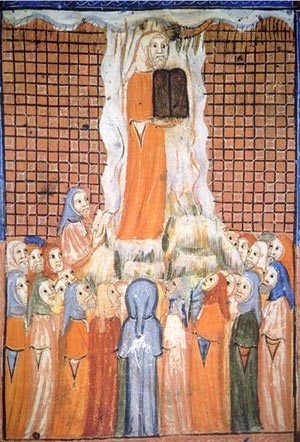
Menachem Wecker in the Jewish Press surveys the shape of the Decalogue in Jewish art, especially late medieval illuminated manuscripts. Though the stereotypical round-topped double tablets appear in the Sarajevo Haggadah (right, ca. 1350), he also finds rectangles, single tablets, and framed texts. No standard shape or depiction carries the day, though Wecker observes that

the claim Jews envision the tablets in the rectangular while Christians hold them to have been rounded does not stand. For the most part, Jewish artists do seem to have followed the grammar of the biblical phrase luchot avanim (tablets of stone) or luchot ha'brit (tablets of the law), which is always presented in the plural, while many Christian artists attached the two tablets to each other.


Perhaps the most interesting depiction is in the Alba Bible (left). Wecker comments:

The tablets seem positioned to squash Moses' head, and if one examines them carefully, one notices that the text - which is not carved into the rock, but painted on top of it - sometimes overflows the allotted space and hangs midair, particularly in the third commandment. It is almost tempting to read the white space surrounding the letters as empty space, in which case the artist has interpreted the forms of the letters as all being miraculously suspended.

Tuesday, November 11, 2008

Monumental Text Debate in Pleasant Grove City, UT

The latest contest in a long history of debates over the presentation of monumental scriptures in public places is unfolding in Pleasant Grove City, Utah. As reported by the New York Times in the article "From Tiny Sect, Weighty Issue for Justices," a city park already has a Ten Commandments monument (donated in 1971 by the Fraternal Order of Eagles) that the town's mayor, Michael W. Daniels, explains as representing "law and history" (but not religion).

Now a religious group called Summum would like to donate a similar monument displaying the Seven Aphorisms that guide the group's theology. Pleasant Grove City did not accept the donation, and the resulting lawsuits have reached the U.S. Supreme Court level. At stake are issues of free speech and freedom of religion in public spaces, and whether a public park that displays the texts of some religions ought to display the texts of other religions as well (if their members choose to donate such monuments). As with other disputes over Ten Commandments monuments, this goes far beyond the text itself, and the physical presence of the monument takes on the weight of Constitutional law; the acceptance (or lack thereof) of a particular religion; and the identity politics of the city, state, and nation.

Friday, July 25, 2008

More Ten Commandments monuments

As controversy and court cases continue to swirl around when and under what circumstances decalogues can appear on public property in the U.S. (see Associate Press, Associated Press), many advocates of monuments to the Ten Commandments have moved or erected them on private property, often as a direct result of the controversies (see Project Moses, World Net Daily). But this new monument on Highway 2 in Bimidji, Minnesota, seems to have arisen from more personal reflections, as reported in the Bemidji Pioneer.

Wednesday, May 14, 2008

For Sale: The Ten Commandments from the Ten Commandments


A very iconic copy of a very iconic text can now be yours! (for $60K or so)

NEW YORK (AP) — Thou shalt find the Ten Commandments up for bid this summer.

A pair of faux granite tablets that Charlton Heston cradled in the 1956 biblical epic "The Ten Commandments" is expected to fetch as much as $60,000, said Marc Kruskol, a publicist for the auction Profiles in History. It is the fourth set of tablets that remains from the film that featured Heston as Moses.

... The auction runs July 31-Aug. 1.

Saturday, November 24, 2007

"Divinely Inspired Constitution"

Americans have a long history of revering their Constitution. Such veneration is particularly strong among politically active Evangelicals of the so-called "religious right," some of whose leaders have termed the U.S. founding documents "the most wonderful instrument ever drawn by the hand of man" (echoing Justice William Johnson in 1823). But Ron Paul, U.S. Representative and Republican presidential candidate, takes this one step further in his "Statement of Faith", which in the second-to-the-last paragraph reads:

" I am running for president to restore the rule of law and to stand up for our divinely inspired Constitution."

Christian bloggers have already castigated Ron Paul as heretical for this statement (see Parableman and evangelical outpost, with Paul's clarification in comment 78). I think it rather represents a logical outcome of efforts to elevate the iconicity of the U.S. Constitution which has, in turn, fueled reactions to portray the Christian Bible as supreme (e.g. with Ten Commandments monuments). Though theologians would like to believe otherwise, practices generate beliefs as often as the reverse. Monuments and shrines to national texts will generate beliefs in their supernatural origins.

Monday, September 24, 2007

Iconic First Amendment at Syracuse University


My employer, Syracuse University, has just built a monumental iconic text into its new building for the Newhouse School of Public Communication. The First Amendment to the U.S. Constitution wraps around three sides of the building in huge letters etched into glass, with especially large letters for the words, "freedom of speech" and "press," as one would expect on a journalism school. The glass enclosed floors above the phrase are mottled in an alternately dark-light design reminiscent of newsprint.

Putting parts or all of the U.S. Constitution in monumental form seems to be a growing trend (for another examples, see the entire text etched in glass at the National Constitution Center in Philadelphia, which opened in 2003). There is even a movement to put monuments to the Bill of Rights (the first Ten Amendments to the U.S. Constitution) on the grounds of all state capitals. The Statesman reports that Arizona approved such a monument in 2006. Texas has done so this year (2007).

In a 2004 article, I compared the movement to defend and promote monuments of the Ten Commandments with the movement to iconicly enshrine the Constitution. I suggested that the debate over the former was, in part, fueled by the latter and involved a struggle over "how to symbolize their relative position and status." That remains the case.

Thursday, July 19, 2007

Gigantic Books


The worth of iconic texts gets marked by, among other things, the construction of monuments that take the shape of the books themselves. Monuments of the Qur'an appear in the palace square of Sharjah in the UAE (above) and on roadsides in Bahrain, while the tablets of the Ten Commandments fill an entire hillside in Murphy, North Carolina.

Gigantic monuments to secular texts apparently have more difficulty in getting funded, if the aborted plan to construct a 50-foot tall replica of Gilles Deleuze and Felix Guattari’s book A Thousand Plateaus: Capitalism and Schizophrenia in Minneapolis, Minnesota, is any indication.

Wednesday, May 30, 2007

Ten Commandments Stamp

The Ten Commandments movement in the U.S. is now targeting the Post Office, asking for a second time that it publish a Ten Commandments Stamp.