Iconic books are texts revered as objects of power rather than just as words of instruction, information, or insight. In religious and secular rituals around the globe, people carry, show, wave, touch and kiss books and other texts, as well as read them. This blog chronicles such events and activities. (For more about iconic books, see the links to the Iconic Books Project at left.)

Showing posts with label bookstore. Show all posts

Saturday, December 24, 2016

Writer's Favorite Bookstores

The New York Times recently asked seven authors to write about their favorite bookstores. The article enhances the iconicity of both authors and bookstores in each other's reflection, while ignoring their economic relationship as producers and marketers of a product...
The Times alos encourages more bookstore nostalgia with its photo essay on Livrario Lello. Back in the summer, it focused on legends about the local landmark, the Strand Bookstore.
Meanwhile, the Guardian tries to take advantage of a popular internet trend with its pictures of "the most beautiful libraries in America."

Wednesday, October 7, 2015

Surprise! E-books decline, independent bookstores increase


The New York Times reported last month that e-book sales have leveled off, and may even be starting to decline:
E-book sales fell by 10 percent in the first five months of this year, according to the Association of American Publishers .... Digital books accounted last year for around 20 percent of the market, roughly the same as they did a few years ago.
Meanwhile, independent bookstores are staging a small resurgence:
The American Booksellers Association counted 1,712 member stores in 2,227 locations in 2015, up from 1,410 in 1,660 locations five years ago.
As a result, "Publishers ... are pouring money into their print infrastructures and distribution," such as huge new warehouses and fast, 2-day distribution to bookstores.

The article attributes the change to plummeting consumer interest in e-readers, like the Kindle and Nook, that have largely been replaced by tablets and large-screen cell phones. But publishers still expect digital texts to continue to be popular, on one platform or another.

Maybe. What the article does not consider is the resilience of the book as a cultural icon that represents enduring value and worth. No digital platform shows any signs of gaining that kind of status. Until it does, digital texts might better be classified as the latest form of ephemeral text.

In the forms of newspapers, blackboards, broadsheets, wax tablets, ostraca, and unbaked clay tablets, ephemeral texts are as old as writing itself. They are always highly utilitarian even in their iconic uses as receipts and currency. The mutability of digital media makes it an effective replacements for older ephemeral texts. They are well on the way to replacing both currency and newspapers.

Books occupy a different place in human symbolism. They represent the permanence of knowledge and value. They are, in many cases, a very practical as well as symbolic technology for cultural preservation. That does not describe all books, of course. But it is possible that in retrospect, the e-book revolution of the early twenty-first century will have succeeded only in skimming off the ephemeral texts that used to take book form, such as pulp paperback novels and phone books.

Sunday, November 29, 2009

Books on On the Media

This weekend's broadcast of NPR's On The Media was devoted to the contemporary book "crisis", with segments on the book industry ("Book It"), authorship and publishing ("Indies on the Industry," "Books 2.0"), book formats ("For the Love of Reading," "For the Love of Books"), and "Books that Die."
An urgent and emotional issue for many!

Sunday, April 19, 2009

Map of the Land of Books

Strange Maps has reproduced a fanciful map of the "land of books" drawn by German illustrator Alphons Woelfle in 1938.

Comments to the post have helpfully provided English translations to the various labels. The Blog points out that:

Plotting out imagined places on a map as if they were “real” countries is a favourite trope in curious cartography. The artificial equation of place and meaning allows for double-entendres and other humorous leaps of the imagination on which this allegorical form of cartography thrives. As a sub-genre of cartography, it has been around since at least La carte de tendre, an 18th-century French map of love’s topography (discussed in entry #245 of this blog). Other examples previously discussed include a Map on Temperance (#258) or a German map of the Empire of Love (#59).

I notice that the map pays almost as much attention to the material production of books as to their literary genres. The river that flows through the land of book sellers as called the "paper stream" and has sources in the land of papermills and the lake of tints...

Saturday, January 24, 2009

Bookstore pictures


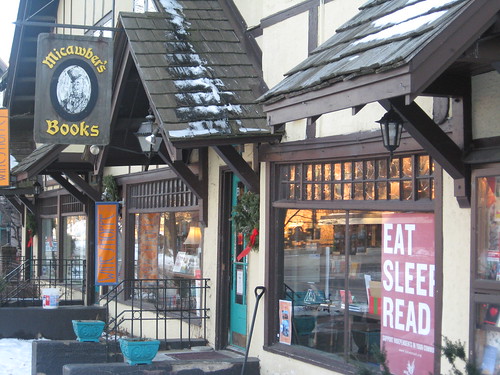
Nigel Beale has put a large set of pictures of independent and college bookstores on Flikr, like this one of Micawber's Books in Minneapolis, MN. Is this an homage to an endangered species?