Iconic books are texts revered as objects of power rather than just as words of instruction, information, or insight. In religious and secular rituals around the globe, people carry, show, wave, touch and kiss books and other texts, as well as read them. This blog chronicles such events and activities. (For more about iconic books, see the links to the Iconic Books Project at left.)

Showing posts with label Buddhists. Show all posts

Tuesday, June 25, 2019

How and Why Books Matter


 https://www.equinoxpub.com/home/books-matter/
What I have learned from 18 years of the Iconic Books Project—now collected together in one place:


Religious and secular communities ritualize some books in one, two, or three dimensions. They ritualize the dimension of semantic interpretation through teaching, preaching, and scholarly commentary. This dimension receives almost all the attention of academic scholars. Communities also ritualize a text’s expressive dimension through public reading, recitation, and song, and also by reproducing its contents in art, theatre and film. This dimension is receiving increasing scholarly attention, especially in religious studies and anthropology. A third textual dimension, the iconic dimension, gets ritualized by manipulating the physical text, decorating it, and displaying it. This dimension has received almost no academic attention, yet features prominently in the most common news stories about books, whether about e-books, academic libraries, rare manuscript discoveries, or scripture desecrations. By calling attention to the iconic dimension of books, James Watts argues that we can better understand how physical books mediate social value and power within and between religious communities, nations, academic disciplines, and societies both ancient and modern.

How and Why Books Matter will appeal to a wide range of readers interested in books, reading, literacy, scriptures, e-books, publishing, and the future of the book. It also addresses scholarship in religion, cultural studies, literacy studies, biblical studies, book history, anthropology, literary studies, and intellectual history.


Table of Contents: 
Introduction: The Iconic Books Project  1-5
Chapter 1 How Books Matter: The Three Dimensions of Scriptures  7-29
Chapter 2 Iconic Books and Texts  31-54
Chapter 3 Relic Texts  55-69
Chapter 4 Iconic Digital Texts: How Rituals Materialize Virtual Texts  71-81
Chapter 5 Desecrated Scriptures and the News Media  83-98
Chapter 6 Ancient Iconic Texts  99-115
Chapter 7 Rival Iconic Texts: Ten Commandments Monuments and the U.S. Constitution  117-134
Chapter 8 Book Aniconism: The Codex, Translation and Beliefs about Immaterial Texts  135-159
Chapter 9 Mass Literacy and Scholarly Expertise  161-166
Chapter 10 Why Books Matter: Preservation and Disposal  167-188

Tuesday, November 6, 2018

Sensing Sacred Texts


The 2017 special edition in Postscripts has now been published as an independent volume, Sensing Sacred Texts, ed. J. W. Watts; Sheffield: Equinox, 2018:

All the human senses become engaged in ritualizing sacred texts. These essays focus especially on ritualizing the iconic dimension of texts through the senses of sight, touch, kiss, and taste, both directly and in the imagination.

Ritualized display of books engages the sense of sight very differently than does reading. Touching gets associated with reading scriptures, but touching also enables using the scripture as an amulet. Eating and consuming texts is a ubiquitous analogy for internalizing the contents of texts by reading and memorization.

The idea of textual consumption reflects a widespread tendency to equate humans and written texts by their interiority and exteriority: books and people both have material bodies, yet both seem to contain immaterial ideas. Books thus physically incarnate cultural and religious values, doctrines, beliefs, and ideas.

These essays bring theories of comparative scriptures and affect theory to bear on the topic as well as rich ethnographic descriptions of scriptural practices with Jewish, Sikh, Muslim, Christian, Buddhist and modern art and historical accounts of changing practices with sacred texts in ancient and medieval China and Korea, and in ancient Middle Eastern and Mediterranean cultures.

Tuesday, October 24, 2017

Postscripts issue on Sensing Sacred Texts


Postscripts: the Journal of Sacred Texts and Contemporary Worlds has published a special issue on Sensing Sacred Texts. The contents are:

"What the Book Arts Can Teach Us About Sacred Texts: The Aesthetic Dimension of Scripture"
        by S. Brent Plate

"How the Bible Feels: The Christian Bible as Effective and Affective Object"
        by Dorina Miller Parmenter

"Engaging All the Senses: On Multi-sensory Stimulation in the Process of Making and Inaugurating a Torah Scroll"
by Marianne Schleicher

"On Instant Scripture and Proximal Texts: Some Insights into the Sensual Materiality of Texts and their Ritual Roles in the Hebrew Bible and Beyond"
by Christian Frevel

"Touching Books, Touching Art: Tactile Dimensions of Sacred Books in the Medieval West"
by David Ganz

"Infusions and Fumigations: Literacy Ideologies and Therapeutic Aspects of the Qurʾan"
        by Katharina Wilkens

"Seeing, Touching, Holding, and Swallowing Tibetan Buddhist Texts"
by Cathy Cantwell

"Neo-Confucian Sensory Readings of Scriptures: The Reading Methods of Chu Hsi and Yi Hwang"
        by Yohan Yoo

"Scriptures' Indexical Touch"
by James W. Watts

Saturday, October 4, 2014

SCRIPT at SHARP in Antwerp


SCRIPT sponsored nine papers in three panels at the of SHARP annual meeting in Antwerp, Belgium on September 18-20, 2014.

On the first panel, "Canonizing and Scripturalizing Iconic Books," I introduced the Iconic Books Project. My paper, “Iconic Scriptures from Decalogue to Bible,” described the iconic motivations that generated the Ten Commandments and the scroll of Torah in ancient Israel. Michael Como (Columbia University) explored the religious, social and environmental effects of bringing Buddhist scribal bureaucracy to Japan in “Canon, Ethnicity and Kingship in Ancient Japan." Kristina Myrvold (Linnaeus University) described how Sikhs narrate the early history of the Guru Granth Sahib in “Entextualization of Sikh Texts in Religious Historiographies and Performances.”

On the second panel, "Literary and Iconic Canons," Jonas Svenson (Linnaeus University) borrowed the concept of contagion avoidance from cognitive psychology to describe Muslim concern to protect the purity of the Qur'an, in “The double Scripture: explaining diversity and conflict in Muslim perceptions and practices in relation to the Qur’an.” Rachel Fell McDermott (Barnard College, Columbia University) then described the life and controversial influence of the Bangladeshi national poet Kazi Nazrul Islam in “When a National Poet is a Heretic: The Collision of Literary and Religious Canons.” Karl Ivan Solibakke (Syracuse University) concluded the panel with by mediating two 20th-century uses of texts and images in “Mimesis and Poesis: Walter Benjamin’s and Vilem Flusser’s Translational Approach to Script.”

In the third panel, "Scriptures as Icons and Talismans," Dorina Miller Parmenter (Spalding University)  advanced theories of iconic books by employing Affect Theory in “Saved by the Book: Exploring the Christian Bible as Effective and Affective Object.” David Ganz (University of Zürich) described medieval Christians' concern to "cover the nakedness" of a book of scripture with decorative bindings in “Clothing Sacred Scripture: Books as Holy Objects in the Western Middle Ages.” Finally, Bradford Anderson (Mater Dei Institute, Dublin) explored the rhetorical and ritual use of Bibles to establish religious and national identity in "'This booke hath bred all the quarrel': The Bible in Seventeenth Century Ireland."

Discussion of each of the papers was lively and continued over several dinners in restaurants on various squares of Antwerp. The SHARP meeting, on the theme "Religions of the Book," provided a venue for many other papers on the impact of book production and book reading on religion, and vice versa. The full program can still be accessed here. 

Tuesday, January 8, 2013

Book as Object in current issue of Terrain

Elizabeth Castelli brings to my attention that the September 2012 issue of Terrain: revue d'ethnologie de l'Europe is devoted to the topic of l'objet libre (the book as object). Here's the table of contents:
  • L’objet livre (Stephen Hugh-Jones et Hildegard Diemberger)
  • Quand le livre devient relique: Les textes tibétains entre culture bouddhique et transformations technologiques (Hildegard Diemberger)
  • Les Agamas: des livres saints canoniques: Le rituel hindou entre transmission orale et textes sacrés (Chris Fuller)
  • Le livre comme trésor: Aura, prédation et secret des manuscrits savants du Sud marocain (Romain Simenel)
  • Le Coran et ses multiples formes (Casablanca, Maroc) (Anouk Cohen)
  • L’objet livre à l’aube de l’époque moderne (Warren Boutcher)
  • Quand le texte se fait matière: Une exploration des versions du manuscrit arabe (Christine Jungen)
  • Le synthétique sacré: Réflexions sur les aspects matériels des textes juifs orthodoxes (Jeremy Stolow)

Thursday, June 23, 2011

Tripitaka Koreana (3)

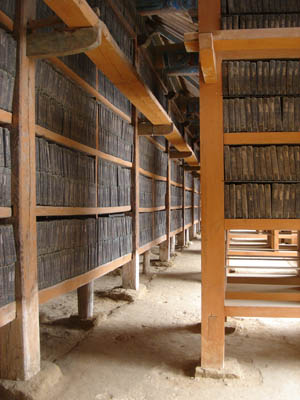
I have twice already blogged about the Tripitaka Koreana (here and here), the 13th-century collection of 88,000 wooden printing blocks of Buddhist sutras stored and displayed in the Haeinsa monestary in Korea. On Sunday, I was lucky to see a procession in Seoul that began the cellebrations of the millenial anniversary of the carving of the original set of printing blocks. Participants carried reproductions of the print blocks on their heads or backs through the streets of the city, preceded by palanquins containing more blocks and followed by dancers and soldiers in period costumes. It was a vivid example of how ritualizing the iconic dimension of texts allows broad participation by lay people who are unlikely to have the linguistic skills necessary to read and interpret these Chinese texts.

Monday, April 25, 2011

SCRIPT Program

Here is the program of SCRIPT's panels in its concurrent meeting with the AAR-EIR in Syracuse on May 6-7. The program for the entire conference is available here.

ICONIC BOOKS (Friday 12:00-1:30)
  • Nancy Menning “Wunderkammern as more than iconic: Watts’s model of scriptures and the Book of Nature”
  • David Dault “The Strange Case of the United 93 Bible: Tragedy, Iconicity, Materiality”
  • James W. Watts “Iconic Electronic Texts, or How Ritual Makes ‘Virtual’ Texts Material”
TEXTS AND IDENTITY (Friday 1:45-3:15)

  • Marcie Middlebrooks “The Inner Spirit and Outer Performance of Korean Buddhist Shinhaeng-dam Stories”
  • Steven Christopher Johnson “Empowering Oppression: LGBT Gaudiya Vaishnava Scriptural Interpretation”
  • Margaret Robinson “Pride, Performance and Praise: Bisexual Anthology as Bible”
TEXT AND COMMUNITY (Friday 3:30-5:00)

  • Chris Duncanson-Hales “RastafarI ‘Q:’ National Geographic “Modern Ethiopia” and “Coronation Day in Addis Ababa””
  • Cecile Marie Wilson “The iconic status of the original manifestos seems confirmed by AMORC’s recent emulation of them.” 
IMAGE AND BOOK (Saturday 8:30-10:30)

  • Karl Ivan Solibakke “The Gospel of the Haunted: Arnold Daghani’s What a Nice World”
  • Glenn Jonathan McCullough “Blake’s Job and the Alchemical Tradition”
  • Judith Oliver “A Multi-Media Performance of the Easter Liturgy In A Nun’s Choirbook from Late Medieval Germany”
  • Jason Neelis “Rebirth Narratives in Gandhāran Buddhist Literary and Material Cultures – Different locative tendencies in early manuscript fragments, art, and pilgrimage accounts”
SCRIPT ROUNDTABLE DISCUSSION (Saturday 10:45-12:15) with Brent Plate, David Dault,
Joanne Waghorne, and James Watts.

Wednesday, July 28, 2010

Moerman on the Lotus Sutra

D. Max Moerman writes about "The Materiality of the Lotus Sutra: Scripture, Relic, and Buried Treasure" in Dharma World:

What is the Lotus Sutra? The scripture itself provides one ready answer: The Lotus Sutra is a Buddha relic. Like a number of other early Mahayana sutras, the Lotus Sutra asserts an equivalence between a roll of scripture and a relic of the Buddha. Employing a new theory of embodiment, the Lotus Sutra replaces the Buddha's corporeal remains with his textual corpus. The material form of the Buddha's word, rather than the material remains of the Buddha's body, is recognized as the central object of veneration and, as such, is to be enshrined in a stupa, a reliquary previously reserved for the remains of a buddha.

Moerman charts the development of ritual practices in medieval Japanese Buddhism that involved creating elaborate copies of the sutra in order to bury them in stupas. Such practices were motivated by concern "with the postmortem salvation of both the religion and the religionist." Moerman draws the moral for scholars of religion:

... the texts themselves did not bear the communicative or pedagogical function usually attributed to scripture. Great care and expense went into the production of these texts .... Yet the texts were never to be recited, studie, or taught, or at least not for 5.67 billion years. The value of their production and use lay in their media as much as in their message .... the power of sacred texts lies not only in their words and ideas but also, as the Lotus Sutra insists, in their materiality and instrumentality.

Moerman revists much of the same material in his essay published in The Death of Sacred Texts: Ritual Disposal and Renovation of Texts in World Religions, edited by Kristina Myrvold(Ashgate, 2010, see summary here).
,

Saturday, November 14, 2009

Origins of Book Veneration in Mahayana Buddhism

A new article explains the origins of book veneration in Mahayana Buddhism. Will Tuladhar-Douglas points out that early Buddhism featured two institutions to preserve the Buddha’s oral teachings on the one hand and to preserve and venerate his relics on the other. The invention of written sutras produced an artifact that functioned as both teaching and relic simultaneously. Therefore reading aloud and written reproduction of the sutras was valued just for the sake reproducing it, as in oral transmission, while the sutra itself was venerated as an important relic. An early (2nd-4th centuries C.E.) text in the Prajnaparamita tradition depicts a sutra on a throne on a glorious stupa being venerated by the gods themselves:

Moreover, at that time the great Bodhisattva Dharmodgata caused a peaked shrine to be built from seven (kinds of) jewels, decorated with copper and sandalwood, draped with strings of pearls. At each of its four corners he had lamps fashioned from single rubies set. On each of the four sides were silver censers facing each of the four directions, in which pure krsnaguru (Vepris bilocularis) incense was burnt to worship the Prajnaparamita. In the middle of this shrine was set a seat (parmika) made from seven jewels; and on the seat was a casket (peca) made from four jewels. The Prajnaparamita, written on leaves of gold coated with lapis lazuli, had been placed inside this. The peaked shrine was decorated with hanging banners and garlands of many colours. (V 249-50.4) Now Sadliprarudita, the merchant's daughter and her five hundred attendants saw the peaked shrine laden with countless arrays of offerings. They saw hundreds of godlings, with Indra chief of the gods, scattering and showering and festooning the peaked shrine with sacred mandarava flowers, sandalwood, gold dust and silver dust. They heard divine hymns. (V 250.5-9)

See Will Tuladhar-Douglas, “Writing and the Rise of Mahayana Buddhism,” in Die Textualisierung der Religion (ed. Joachim Schaper; Tubingen: Mohr Siebeck, 2009), 250-72.

Thursday, March 19, 2009

Tibetan books in Chinese media

The Chinese public relations campaign to influence Western views about Tibet includes--among headlines such as "Tibetans enjoy full religious freedom" and "Tibetan culture well preserved"--a couple of stories about Tibetan books and texts.

One video report from Xinhua Net shows the creation of a "Family Museum" to house a multi-volume Tibetan Buddhist classic after years of storage.


In another, Xinhua "China News" describes efforts to build "the largest stone sutra pagoda in Tibet" on Mount Chakpori opposite the Potala Palace in Lhasa, Tibet.

With a small mallet in one hand and a chisel in another, nine youngsters, sitting or squatting under a large piece of broken gray cloth shelter, are engraving lines of Tibetan sutra "Kangyur" into the stone slates. Less than 20 meters ahead is the pagoda, which is not yet completed after 14 years of construction, but embodies all their piety and faith to Buddha.

Tokdan Dawa Rinpoche, the sponsor of the pagoda, is sitting, with his legs crossed, on a carpet nearby the simple workshop, chanting sutras as throngs of devotees, with prayer wheels in hand, bowed to him and passed by, heading for the pagoda to pray along a dusty path.

As a tradition for centuries, Tibetan Buddhism believers engrave the sutras and Buddha images on stones as a way to keep the classics. It is also believed that the engravers, called "duoduo" in Tibetan, are able to achieve more happiness in their next lives through the toil of inscribing.

... usually a full set of Kangyur sutra includes 108 parts, each of which is written on a book of 200 to 400 pages. The engravers have finished inscribing the sutra and more than one million of stone slates piled into a 13-floor pagoda of more than 30 meters high.

... More than 100 engravers -- some from sophisticated stone-engraving families and some novices -- have volunteered to help build the pagoda. Most of them have worked here for five to six years though their pay for a whole-page Kangyur sutra is only 10 yuan (1.46 U.S. dollars).

... However, the beginning is always difficult.

As Zhoigar could not read, she just copied what she saw on the sutra book onto the stone.

"The characters were no more than some magic patterns to me at that time," recalled Zhoigar. "It also happened a lot that I had my fingers injured by the engraving tools, but the worst was that I wasted a lot of stone plates because of my mistakes, which made me cry a lot."

The tears are paid back after eight years of practicing. Zhoigar now can finish the engraving of an average of 20 stone slates every day at a speed of one Tibetan character in less than one second. She has also become a teacher for the newcomers.

"The more sutras I have engraved into the stones, the more Buddhism teachings I have engraved in my mind, which is far more important than how much money I have earned," said Zhoigar.

Monday, November 19, 2007

Scriptures As Artifacts at SBL meeting

The Iconic Books Project is not the only research effort on this subject. The Scripture as Artifact Consultation, chaired by Brian Malley, showcased the work of eleven scholars at the annual meeting of the Society of Biblical Literature in San Diego.

The session on Saturday, November 17th, focused on “the late medieval period to the present.”
     Marianne Schleicher (Aarhus University) described her research on the relationship between ritual uses and displays of Torah scrolls and the interpretation of Torah in a Dutch Jewish congregation (paper title: “Transitions between Artifactual and Hermeneutical Use of Scripture”).
     Miriam Levering (U. Tennessee, Knoxville) surveyed artifactual/iconic uses of texts in Buddhist traditions before focusing in particular on Zen schools. She noted the irony that medieval Zen traditions generally downplayed the role of scriptures in comparison with other Buddhist schools, but then proceeded to produce a flood of texts that seem to function as scriptures nevertheless (paper title: “Scripture as Artifact: A Comparative Perspective”).
     Unfortunately, I had to miss the remaining papers in Saturday’s session. They were “Curbing Phantasm: The Bible Moralisée” by Eva Maria Raepple (College of DuPage), “The Danish Hymnbook: Artifact and Text” by Kirsten Nielsen (Aarhus University), and “Some Biblical Artifacts in Search of a Sociological Theory” by David Chalcraft (University of Derby). [But see Dori's comment below for a summary of these last two papers.]

Though the session on Sunday, November 18th, focused on “the ancient and early medieval world,” Brian Malley began with a theoretical paper on the relationship between the artifactual use and semantic meaning of scriptures. Starting with a standard model in communications theory, he argued that artifactual uses, rather than being a small and insignificant aspect of scriptural usage, actually impact virtually all uses of the text (paper title: “Text, Artifact and Meanings”).
     The next four papers all described various kinds of ancient evidence for the artifactual uses of scriptural texts. Larry Hurtado (University of Edinburgh) presented the manuscript evidence for the distinctive forms and uses of early Christian scriptures (2nd-3rd centuries C.E.). Christians’ preference for binding their scriptures (OT and NT) in codex (book) form, rather than as scrolls, their use of distinctive abbreviations (nomina sacra) for the names and titles of God and Jesus, and their employment of reader’s aids in manuscripts intended for public reading all distinguish their material culture from its Greco-Roman context (paper title: “Early Christian Manuscripts of Biblical Texts as Artifacts”).
     Stephen Reed (Jamestown College) surveyed the contents and textual form of the Dead Sea Scroll texts used for ancient Jewish phylacteries (tefillin) and mezuzot. He noted that they differ from other biblical scrolls from Qumran not only in their contents ( fairly standardized excerpts from Exodus and Deuteronomy) but also in the condition of their materials (the texts in tefillin were often written on tattered scraps of leather) and their very small, run-together letters that show they were clearly not meant to be read but manipulated ritually (paper title: “Physical and Visual Features of Dead Sea Scriptural Texts”).
     Eduard Iricinschi (Princeton University) described the heavy use and dependence of the ancient Manicheans on the texts written by their founder Mani/Manus. Their texts served to spread the faith rapidly in the Sassanian and Roman empires of the third century and following, but also became a principal target of imperial efforts (in the long run, successful) to suppress the religion (paper title: “ ‘A Thousand Books will be Saved’: Manichean Manuscripts and Religious Propaganda in the Roman Empire”).
     Thomas J. Kraus (Willibald Gluck Gymnasium) investigated the nature and function of Byzantine armbands with medallions that cite the opening verse of Psalm 91 (Ps 90 in the Greek translation) along with others depicting the Madonna and child. He charted the popularity of the talismanic use of Greek Ps 90 in Byzantine Christian culture to explain its prominence in cryptic form on these artifacts (paper title: “ ‘He that Dwelleth in the Help of the Highest’: Septuagint Psalm 90 and the Iconographic Program on Byzantine Armbands”).
     Dori Parmenter (Syracuse University, co-director of the Iconic Books Project) concluded the session with a broader survey of myths of heavenly books and their impact on early and medieval Christian beliefs. She demonstrated that Christians were influenced by ancient Near Eastern and, especially, Jewish ideas of pre-existent heavenly scriptures and “books of life,” but they conceived the heavenly equivalent of Gospel books to be Christ himself as the Word of God. This equivalence between book and Christ appears prominently in ancient and medieval Christian art and provides the ideological underpinning for the liturgical reverence shown Gospel books (paper title: “The Bible as Icon: Myths of the Divine Origins of Scripture”).

Wednesday, July 25, 2007

Sutra Paintings & Accessories


The Korea Times reviews an exhibit at the National Museum of Korea titled "Sutra Painting: In Search of Buddhahood."

... The exhibition consists of two themes. The first highlights the Diamond Sutra Block made of gold found in Iksan Wanggung-ri pagoda, Buddhist reliquary as well as objects such as sutra case, sutra chest, and cloth for wrapping sutra.

The second offers the sutra paintings ranging from the period of Unified Silla (668-935) to the Joseon Kingdom (1392-1910) arranged chronologically to present an entire view of the distinguishing characteristics in accordance with its period and style. ...

The exhibit runs until September 16.

Monday, July 23, 2007

Koreana Tripitaka (2)

Yohan Yoo has provided me with the following links to background information on the huge collection of carved wooden printing blocks of the Buddhist scriptures called the Koreana Tritipaka, which I mentioned in a previous post. They emphasize the iconic intention that motivated their production as well as their preservation and veneration up to the presernt. The links take you to pictures as well as the full articles:
From Korean Tripitaka: "The entire Korean Tripitaka was carved twice during the Koryo Dynastry (918-1392), both times on wooden blocks. The king and the people believed that the presence of these sacred texts would help to drive back invasions and also bring good luck."

From Wikipedia: "The Tripitaka Koreana was first carved in 1087 when Goryeo was invaded by the Khitan in the Third Goryeo-Khitan War. The act of carving the woodblocks was considered to be a way of bringing about a change in fortune by invoking the Buddha's help. The original set of woodblocks were destroyed during the Mongol invasions of Korea in 1232, when Goryeo's capital was moved to Ganghwa Island during nearly three decades of Mongol attacks, although scattered parts of its prints still remain. King Gojong thereafter ordered the revision and re-creation of the Tripitaka; the carving took 16 years, from 1236 to 1251. This second revision is usually what is meant by the Tripitaka Koreana. In 1398, it was moved to Haeinsa, where they have remained housed in four buildings."

Life in Korea adds: "The original set took 77 years to complete, and was finished in 1087. However, it was destroyed in 1232 by a Mongol invasion. King Kojong ordered the set remade and work began in 1236. It was felt that replacing the wood blocks would convince Buddha to intervene and help repel the Mongolian invaders. Originally carved on Kangwha Island, they were moved to Haein-sa during the early years of the Yi dynasty."

Korean Tripitaka concludes: "The Korean Tripitaka has great national significance to the Korean people. It represents their steadfastness in adversity and their wish to maintain their cultural identity. In some ways it is the national conscience of Korea."

This collection of iconic texts imbued with both religious and nationalistic significance is doubly fascinating because it is the print blocks, not the printed texts produced from them, that were given and have retained such revered status. Perhaps that is because the wooden blocks are materially larger and more substantial and take much longer to create than printed paper books and so are better suited to veneration as monuments.

Tuesday, July 17, 2007

Chinese to preserve Tibetan books


The Chinese Academy of Social Sciences and the China Tibetology Research Centre is launching a two-year effort to preserve 426 volumes of Buddhist scriptures on palm-leaf manuscripts, dating from the 7th to the 13th centuries C.E. For a short history of the development and impact of palm leaf manuscripts, see Palm Leaf. An impression of the literary and artistic effort that went into creating the vast Tibetan libraries can be gathered from the pictures and introduction to the exhibit, Guardians of the Sacred Word, that was on display in New York in 1996. The difficulties involved in such preservation work are described vividely in the report on similar efforts in Thailand.

The vast majority of the Tibetan libraries and their contents were destroyed during and after the Chinese invasion of Tibet in 1951. This new effort at preserving Tibet's manuscript heritage under Chinese sponsorship seems to be a remarkable policy reversal. I wonder how the Tibetan government in exile feels about this ...

Friday, June 22, 2007

Johannes who?

Ben Vershbow on if:book points out that the Koreans were printing with metal movable type two hundred years before Gutenberg. He provides a picture of "the oldest existing document in the world printed with metal movable type: an anthology of Zen teachings, Goryeo Dynasty, Korea... 1377."

Sunday, June 3, 2007

Library of wooden printing blocks


If:book also provides Ben Vershbow's account and vivid pictures of the Haeinsa monastery in Korea where the Tripitaka Koreana is housed--88,000 wooden printing blocks of Buddhist scriptures engraved in the 13th century. His description of the monastery's ceremonies and its popularity with tourists as well as pilgrims underscores the rituals that convey iconicity to texts--in this case, not the books themselves but the blocks by which books can be printed.

Tuesday, December 26, 2006

Copying scriptures

The hand copying of Buddhist sutras is an active religious practice for lay people in Japan today, according to the Japan Times.